
EUR/USD is the benchmark of the entire forex market. The most traded pair in the world by a wide margin, it offers the deepest liquidity, the tightest spreads, and the lowest trading costs available anywhere — which makes it the natural home for almost every trader, and the ideal pair on which to learn. Representing the two largest economic blocs on earth, the eurozone and the United States, it sits at the centre of global currency trading. This guide takes a closer look at the pair introduced in the major-pairs overview: what drives it, why it suits beginners so well, when it is most active, and how to approach trading it.
It is the flagship of the majors covered in the major currency pairs, and it moves closely with the US Dollar Index.
Key takeaways
Q: What drives the EUR/USD exchange rate?
A: EUR/USD is driven chiefly by the relative monetary policy of the European Central Bank and the US Federal Reserve (the interest rate differential and its expected path), the relative economic strength of the eurozone and the US, and broad US dollar sentiment, with risk sentiment playing a secondary role.
Q: Why is EUR/USD good for beginners?
A: EUR/USD has the deepest liquidity and tightest spreads of any pair, meaning the lowest trading costs, and it tends to move relatively smoothly. It is also the most analysed pair, so information is plentiful. These qualities make it more forgiving and lower-cost than more volatile or thinly traded pairs.
Q: When is the best time to trade EUR/USD?
A: EUR/USD is most active during the London and New York sessions and especially their overlap, when liquidity is deepest, spreads are tightest and the most meaningful moves occur. The quieter Asian session typically sees subdued, range-bound activity in the pair.
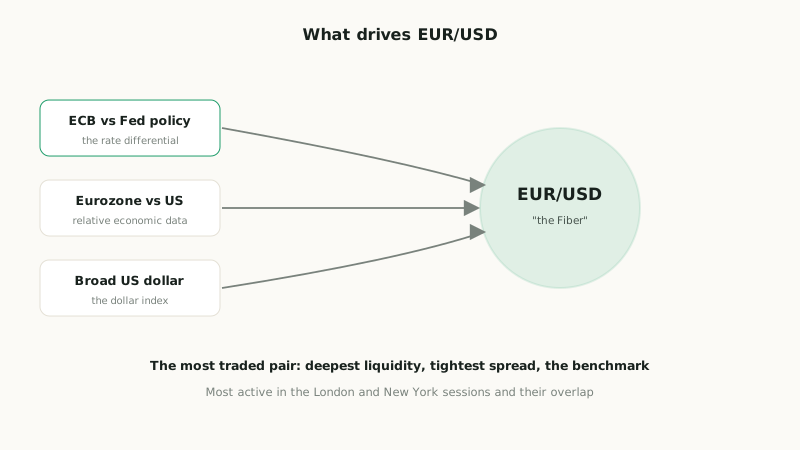
What drives EUR/USD
The dominant driver of EUR/USD, as with most pairs, is the relative monetary policy of its two central banks — the European Central Bank (ECB) and the US Federal Reserve (Fed). The interest rate differential between the eurozone and the US, and crucially the expected path of that differential, is the most powerful force on the pair: when the Fed is expected to tighten relative to the ECB, the dollar tends to strengthen and EUR/USD to fall, and vice versa. Traders watch ECB and Fed meetings, statements and the data that shapes rate expectations as the primary fundamental inputs, exactly as the interest rates and central banks guides describe.
Beyond rates, EUR/USD responds to the relative economic strength of the two blocs — the eurozone's growth, inflation and employment versus the US's — since the stronger economy tends to support its currency. It is also heavily influenced by broad US dollar sentiment: because the dollar is on one side of the pair, general dollar strength or weakness (visible in the dollar index) moves EUR/USD directly, and indeed EUR/USD largely mirrors an inverse of the dollar index given the euro's dominant weight in it. Risk sentiment plays a secondary role. The practical upshot: to understand EUR/USD, watch the ECB-versus-Fed policy balance, eurozone-versus-US data, and the broad dollar — a manageable, well-documented set of drivers that makes the pair as analysable as it is tradeable.
Why it suits beginners
EUR/USD is the pair most often recommended to beginners, for sound reasons rooted in its liquidity. As the most heavily traded pair, it has the deepest liquidity of any market, and this brings a cascade of advantages. Its spreads are the tightest available, meaning the lowest trading costs — every trade you make costs less on EUR/USD than on any other pair, a real edge for a developing trader whose costs would otherwise eat into results. Its price action tends to be relatively smooth, without the erratic jumps of thinner markets, making technical analysis more reliable and the experience less jarring.
EUR/USD is also the most analysed and written-about pair, so educational material, commentary and analysis are abundant — a beginner is never short of resources for understanding it. And while no pair is "safe," EUR/USD's relatively lower volatility compared to pairs like GBP/USD makes it more forgiving, with smaller and less violent swings. The combination — lowest cost, smoothest behaviour, most resources, relatively contained volatility — makes EUR/USD the ideal pair to learn on and to specialise in. As the forex-pairs guide advises, mastering one major pair deeply beats scattering across many, and EUR/USD is the obvious one to master first. Many experienced traders also trade EUR/USD as their core pair throughout their careers, valuing exactly these qualities.
When to trade it
EUR/USD is most active during the London and New York sessions and their overlap — the prime hours when both major financial centres trading the pair are open, liquidity is deepest, spreads are tightest, and the most significant moves occur. This makes sense given the pair represents European and US currencies: its natural home is the European and American trading day. The London/New York overlap in particular is the best window for trading EUR/USD, combining peak liquidity with meaningful movement.
By contrast, the Asian session tends to be a quieter time for EUR/USD, often characterised by subdued, range-bound activity, since neither European nor US markets are open and the pair's main participants are away. This connects to the best-times-to-trade guidance: trade a pair during its active session, and for EUR/USD that means the London and New York hours. The pair's behaviour can differ markedly by session — it may drift in a tight range overnight in Asia and then move decisively when London opens — so aligning your EUR/USD trading with its active sessions gives better liquidity, tighter costs and more meaningful opportunities. For traders in time zones where the London/NY overlap falls at an awkward hour, this is worth planning around, as it is when EUR/USD is most worth trading.
EUR/USD's deep liquidity is the source of all its advantages — tightest spreads, smoothest price action, most analysis, lower volatility. That's why it's the benchmark pair and the ideal one to learn on and specialise in. And because the euro dominates the dollar index, EUR/USD is essentially the inverse of the broad dollar — watch the two together.
How to approach trading it
Trading EUR/USD draws on everything this site teaches, with no special tricks required — its virtue is precisely that it is the "clean" pair on which standard methods work well. All the technical analysis tools (support and resistance, trends, chart patterns, indicators) tend to work reliably on EUR/USD thanks to its smooth, liquid price action, making it an excellent pair for technical approaches. The fundamental analysis is well-defined: watch the ECB and Fed, eurozone and US economic data, and the broad dollar, as described above. And the pair's relatively contained volatility makes risk management and position sizing more straightforward than on wilder pairs.
A few practical points. Keep an eye on the dollar index alongside EUR/USD, since the two are closely (inversely) linked — a move in EUR/USD that coincides with a broad dollar move (visible in the index) is dollar-driven, while one that diverges from the dollar is euro-specific, a useful distinction for understanding what is happening. Be aware of high-impact events — ECB and Fed meetings, eurozone and US inflation and employment data — which can move the pair sharply, and treat their immediate aftermath with the caution the news-trading guidance advises. Beyond that, EUR/USD rewards the disciplined application of a sound strategy, sensible risk management, and the patience and psychology developed across the site. It is the pair on which to build and prove your approach, precisely because its clean, liquid, well-documented nature lets your method work as intended without the added noise and cost of more difficult pairs.
Strategies that suit EUR/USD
One of EUR/USD's underappreciated virtues is how well it accommodates the full range of trading approaches — a direct consequence of its deep liquidity and clean price action. Trend-following works well on EUR/USD: when fundamental forces (a clear ECB-versus-Fed policy divergence) drive a sustained trend, the pair's smooth, liquid movement makes the trend tradeable with the pullback and breakout entries the trend-following guide describes. Range trading also suits it, particularly during quieter periods when the pair consolidates between well-defined levels — its orderly price action means support and resistance tend to hold cleanly, and the boundaries are reliable.
Breakout trading finds good opportunities around the London open and major ECB/Fed events, when the pair can break decisively from overnight ranges — and EUR/USD's liquidity means breakouts tend to be relatively clean rather than the messy false breaks common in thin markets. Across all of these, the pair's technical reliability is the common thread: because EUR/USD moves smoothly and is so heavily traded, technical tools — support and resistance, trendlines, chart patterns, indicators — tend to work as intended, with fewer of the erratic whipsaws that plague illiquid pairs. This makes EUR/USD an excellent pair on which to develop and prove a technical strategy.
A practical approach many traders use is to combine a fundamental directional bias (from the ECB-versus-Fed balance and the broad dollar) with technical timing on EUR/USD's clean charts — exactly the synthesis the strategies section advocates. Establish whether the fundamentals favour the euro or the dollar, then use EUR/USD's reliable technicals to time entries in that direction, perhaps focusing on the London/New York overlap for the best conditions. Whatever the specific strategy, EUR/USD's combination of low cost, smooth movement and technical reliability means it rewards disciplined method-application better than almost any other pair — which is precisely why it is the benchmark on which to build a trading approach.
EUR/USD is the world's most traded pair — deepest liquidity, tightest spreads, lowest cost, smoothest price action — ideal for beginners and a core pair for many pros. It's driven mainly by ECB-versus-Fed policy, relative eurozone-versus-US strength, and broad dollar sentiment, largely mirroring an inverse of the dollar index. Trade it in the London and New York sessions and their overlap. Its clean, reliable price action suits trend, range and breakout strategies and makes technical tools work well — combine a fundamental bias with technical timing, watch the dollar index alongside, and respect ECB/Fed events.