GBP/USD — known to traders as "Cable," after the transatlantic telegraph cable that once carried its quote between London and New York — is the livelier cousin of EUR/USD. It moves bigger and faster, ranges wider, and carries a distinctive sensitivity to UK political and economic events that can produce sudden drama. For traders who want more movement, Cable offers more opportunity; but it also carries more risk, and it demands the respect that its volatility warrants. This guide examines what drives GBP/USD, why it is more volatile than EUR/USD, the special role of UK developments, and how to trade it with appropriate caution.
It is the more volatile counterpart to EUR/USD among the pairs introduced in the major currency pairs.
Key takeaways
Q: What drives GBP/USD?
A: GBP/USD is driven by the relative monetary policy of the Bank of England and the US Federal Reserve, UK economic data, UK-specific political and economic developments (which can cause sharp moves), and broad US dollar sentiment. The rate differential and its expected path are the dominant force.
Q: Why is GBP/USD more volatile than EUR/USD?
A: Cable typically has larger, faster moves and a wider trading range than EUR/USD, partly due to somewhat lower liquidity and partly because the pound is sensitive to UK-specific political and economic events that can trigger sharp moves. This makes it more rewarding for movement but riskier.
Q: Is GBP/USD good for beginners?
A: GBP/USD is generally considered a step up from EUR/USD rather than a starting pair, because its greater volatility means larger swings and more risk per trade. Many traders gain comfort on the steadier EUR/USD first, then graduate to Cable, sizing positions to account for its bigger moves.
What drives Cable
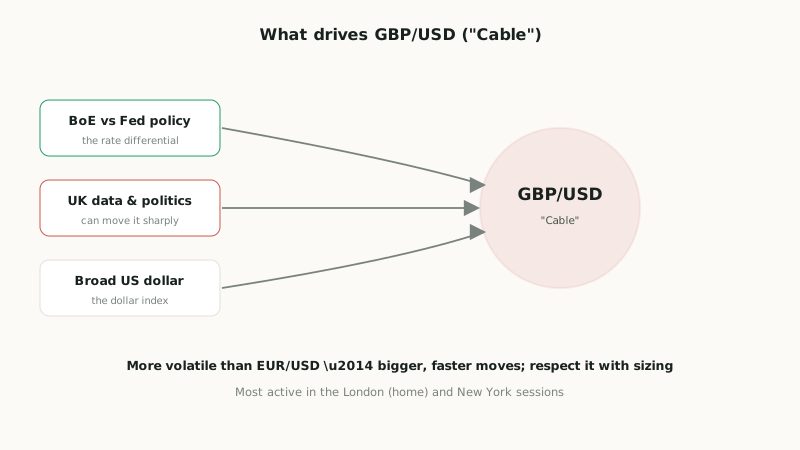
Like EUR/USD, GBP/USD is driven primarily by the relative monetary policy of its two central banks — the Bank of England (BoE) and the US Federal Reserve (Fed). The interest rate differential between the UK and the US, and its expected path, is the dominant fundamental force: shifts in expectations about BoE-versus-Fed policy move the pair powerfully. Traders watch BoE and Fed meetings and the data shaping rate expectations as the primary inputs, just as with any major pair.
GBP/USD also responds to UK economic data (growth, inflation, employment) relative to the US, to broad US dollar sentiment (the dollar being on one side, so the dollar index influences it), and — distinctively — to UK-specific political and economic developments, which deserve special attention because they can move Cable sharply and suddenly. The pound has historically been highly sensitive to UK political events, elections, fiscal announcements and major policy shifts, which can trigger fast, large moves that pairs without such idiosyncratic drivers do not see. This sensitivity to UK-specific news is part of what gives Cable its livelier, more event-driven character. Understanding GBP/USD therefore means watching not only the BoE-versus-Fed balance and the broad dollar, but also the UK political and economic calendar for the kinds of developments that can jolt the pound.
The volatility of Cable
The defining feature of GBP/USD relative to EUR/USD is its greater volatility. Cable typically exhibits larger, faster moves and a wider average trading range than the smoother EUR/USD — it tends to swing more in a given period, with bigger intraday ranges. This greater volatility stems partly from somewhat lower liquidity than EUR/USD (still very liquid, but not quite the deepest market), and partly from the pound's sensitivity to the UK-specific events noted above, which inject sharp moves.
This volatility is a double-edged sword. On one hand, it means more opportunity and bigger potential moves to capture, which is part of why some experienced traders favour Cable — there is simply more movement to trade. On the other hand, it means more risk: larger swings mean larger potential losses, faster adverse moves, and a less forgiving environment than EUR/USD. The wider ranges demand careful attention to position sizing — because Cable moves more, a position of the same size carries more risk than on EUR/USD, so positions must often be sized smaller (in lots) to keep the risk per trade within the same percentage limit. This is a crucial practical point: you cannot trade Cable the same size as EUR/USD and expect the same risk, because its bigger moves translate a given position into bigger swings in your account. Respecting Cable's volatility through appropriate sizing is essential to trading it safely.
Cable's volatility cuts both ways: more movement to capture, but more risk per position. The practical consequence is sizing — because GBP/USD moves more than EUR/USD, the same lot size carries more risk, so you must often size smaller to keep risk per trade constant. Trading Cable like EUR/USD without adjusting size quietly takes on more risk than you intend.
Sessions and UK events
GBP/USD is most active during the London and New York sessions, with London — the pound's home market — being especially important. The London session often sees the most significant Cable activity, and the London/New York overlap is, as for most majors, a peak window of liquidity and movement. The Asian session is typically quieter for the pair. Trading Cable during its active London and New York hours gives the best liquidity and the most meaningful moves, in line with the general session guidance.
A special consideration for Cable is the UK economic and political calendar. Because the pound is so sensitive to UK-specific developments, GBP/USD traders must pay particular attention to UK events — BoE meetings, UK inflation and employment data, fiscal announcements, and significant political developments — any of which can trigger sharp, fast moves in the pair. These events can produce volatility beyond the normal session rhythm, sometimes at times tied to UK announcements. As with all high-impact events, the immediate aftermath of major UK news can be chaotic, with wide spreads and whipsaw moves, warranting the caution the news-trading guidance advises. Cable's event-sensitivity makes calendar awareness even more important than for less idiosyncratic pairs — being caught unaware in a Cable position when major UK news breaks is a recipe for an unpleasant surprise given the pair's tendency to move sharply on such developments.
How to approach trading it
Trading GBP/USD well means combining standard sound technique with healthy respect for the pair's character. As a step up from EUR/USD, Cable is often best approached after gaining comfort on the steadier benchmark pair — many traders learn on EUR/USD and graduate to Cable once they can handle its greater volatility. The same technical and fundamental methods apply, but with heightened attention to a few things. Position sizing is paramount, as discussed: size for Cable's bigger moves, typically smaller in lots than you would trade EUR/USD, to keep your risk per trade within limits.
Calendar awareness is heightened: track the UK events that can jolt the pound, and be cautious around them. The pair's volatility also means stops need appropriate room — a stop too tight for Cable's normal swings will be hit by routine noise, so stops must account for its wider ranges (while position size is reduced to keep the risk constant, per the position-sizing guide). For traders who can manage these demands, Cable offers genuine appeal: its movement provides more for active strategies to work with, and its event-driven nature creates opportunities (and risks) that the calmer EUR/USD lacks. The key is to approach it with eyes open — trading the volatility deliberately and with proper sizing, rather than being caught out by it. Cable rewards the prepared, disciplined trader who respects its livelier nature, and punishes those who treat it as casually as the gentler EUR/USD.
Cable, the dollar and the pound
Understanding GBP/USD is helped by knowing its relationships with other pairs and gauges — connections that reveal whether a given Cable move is driven by the dollar or the pound. GBP/USD is positively correlated with EUR/USD, as the correlations guide explains, because both have the dollar as the quote currency and both are European currencies against the dollar; they tend to move together, especially on broad dollar moves. When EUR/USD and GBP/USD rise or fall in tandem, the common driver is usually the dollar — visible also in the dollar index moving inversely.
This gives a practical diagnostic. Watch the dollar index alongside Cable: if GBP/USD is moving in line with EUR/USD and the broad dollar (the DXY), the move is dollar-driven, part of a broad dollar trend affecting all dollar pairs. If, however, GBP/USD diverges from EUR/USD and the dollar index — moving on its own while other dollar pairs are quiet — then the move is pound-specific, driven by UK factors (data, politics, the BoE) rather than the dollar. This distinction is especially valuable for Cable given its sensitivity to UK-specific events: a sharp GBP/USD move that is not matched by EUR/USD or the dollar index is a signal that something pound-specific is happening.
To isolate pound-specific developments further, some traders watch EUR/GBP — the euro against the pound — which strips the dollar out entirely and reflects the pound's strength relative to the euro. A move in EUR/GBP points to a euro-versus-pound story, helping separate pound factors from euro factors. Triangulating across GBP/USD, EUR/USD, the dollar index and EUR/GBP lets a Cable trader pinpoint what is actually driving a move — the dollar, the pound, or the euro — which is genuinely useful for a pair as event-sensitive as Cable. This relational awareness, combined with the volatility-conscious sizing discussed above, equips a trader to handle GBP/USD's livelier, more idiosyncratic nature with clarity rather than confusion.
GBP/USD ("Cable") is driven by BoE-versus-Fed policy, UK data, broad dollar sentiment, and — distinctively — UK-specific political and economic events that can move it sharply. It's more volatile than EUR/USD, so size smaller to keep risk constant and give stops room. It's positively correlated with EUR/USD: when they move together with the dollar index, the driver is the dollar; when Cable diverges, the move is pound-specific (watch EUR/GBP to isolate the pound). Most active in the London (home) and New York sessions — a step up from EUR/USD that rewards respect for its volatility.