
Most of the world's central banks store much of their wealth in one currency. Most oil and many commodities are priced in it. A huge share of international loans and bonds are issued in it. And in a crisis, when fear grips markets, the world rushes toward it. The US dollar's status as the dominant reserve currency is the quiet foundation beneath much of how forex behaves — its persistent demand, its safe-haven role, and the very plumbing of the global financial system. This guide explains reserve currencies: what they are, why the dollar dominates, what underpins reserve status, the de-dollarisation debate, and what it all means for forex.
It underpins the dollar's safe-haven behaviour, relates to central banks' reserve management and intervention, and connects to geopolitics.
Key takeaways
Q: What is a reserve currency?
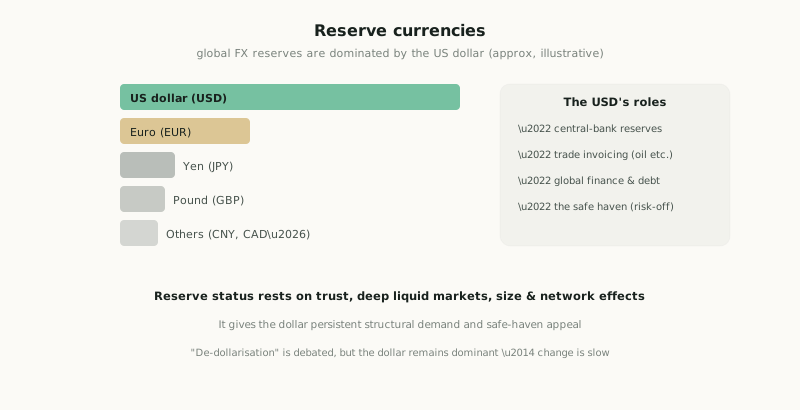
A: A reserve currency is one held in significant quantities by central banks and governments as part of their foreign exchange reserves, and widely used in international trade, finance and as a store of value. The US dollar is the dominant global reserve currency, with the euro second and the yen, pound and others holding smaller shares.
Q: Why does the US dollar dominate?
A: Because of trust and stability, the depth and liquidity of US markets (especially Treasuries), the rule of law, the size of the US economy, convertibility, and powerful network effects — everyone uses the dollar partly because everyone else does. The majority of global reserves, trade invoicing (including most oil), and international finance are denominated in dollars.
Q: What is de-dollarisation?
A: De-dollarisation is the idea that the dollar's dominance might erode over time — through the rise of currencies like the renminbi, geopolitical shifts, or alternative arrangements. It's an active debate, but the dollar remains dominant by a wide margin, largely because of network effects and the lack of a ready alternative, so any change is likely to be slow.
What a reserve currency is
A reserve currency is a currency held in significant quantities by central banks and governments as part of their foreign exchange reserves, and used widely in international trade, finance, and as a store of value. Central banks hold FX reserves for several reasons — to intervene in currency markets and manage their own currency (the intervention link), to pay for imports, to maintain stability and confidence, and to service foreign debt — and they hold those reserves predominantly in the major reserve currencies (plus gold). The US dollar is the dominant global reserve currency by a wide margin: the majority of global FX reserves are held in dollars, the euro is a distant second, and the yen, pound and others hold smaller shares, with the Chinese renminbi growing but still small. Beyond reserves, the dollar dominates trade invoicing (a great deal of international trade, including most oil — the "petrodollar" — is priced and settled in dollars), international debt and finance (much global borrowing is dollar-denominated), and overall FX transactions (the dollar is on one side of the large majority of all currency trades). It is, in effect, the world's money.
Why the dollar dominates, and the privilege it brings
The dollar's dominance rests on a set of mutually-reinforcing foundations, summarised below.
What underpins reserve-currency status
These foundations explain why the dollar holds its position. Trust and stability — confidence in the currency's value and in US institutions — is essential; reserves are only worth holding in a currency you trust. Deep, liquid markets, above all the vast US Treasury market, mean reserve holders can park enormous sums and move in and out easily — a place to store wealth at scale, which few other markets offer. The rule of law and predictable property rights reassure holders their assets are safe. The sheer size of the US economy gives the dollar weight and reach. And powerful network effects lock it in: everyone uses the dollar partly because everyone else does — if trade is invoiced in dollars, debt issued in dollars, and reserves held in dollars, it's convenient and rational for each new participant to use dollars too, a self-reinforcing dominance that's very hard to displace.
This dominance brings the issuer — the United States — a notable benefit often called the "exorbitant privilege." Because there's huge, persistent global demand for dollars and dollar assets (Treasuries), the US can borrow more cheaply and in its own currency, fund deficits more easily (the world is eager to hold its debt), and enjoys other advantages of issuing the world's money. This structural demand is a quiet, ongoing support for the dollar that other currencies lack.
De-dollarisation, and what it means for forex
A recurring debate concerns de-dollarisation — whether the dollar's dominance will erode over time, through the rise of alternatives (the renminbi is often discussed), geopolitical shifts (countries seeking to reduce dependence on the dollar system), or new arrangements. It's a real and active discussion, and the dollar's share of reserves has drifted over the years. But the honest assessment is that the dollar remains dominant by a wide margin, for the very reasons above — above all the network effects and the lack of a ready alternative with comparably deep, liquid, trusted markets (the euro has structural issues; the renminbi isn't freely convertible and lacks the same trust and open markets). So while de-dollarisation is worth watching as a long-term theme, any meaningful change is likely to be slow and gradual, not sudden — reserve-currency status, once established, is sticky.
For forex, understanding reserve status explains a great deal about the dollar's behaviour. It gives the dollar persistent, structural demand (the world needs dollars for trade, debt and reserves) and underpins its role as the premier safe haven — in risk-off episodes, capital flees to the dollar (and Treasuries) precisely because it's the trusted global money, which is why the dollar often rises in crises even when the crisis is American in origin. Central banks' management of their dollar-heavy reserves also moves currencies, and the topic carries real geopolitical weight. But the honest caveat is that reserve dynamics are slow-moving, structural context, not a short-term trading signal — reserve status shapes the dollar's character (persistent demand, safe-haven appeal) and its long-term backdrop, but it doesn't tell you which way the dollar will move next week. The honest framing: a reserve currency is held by central banks as FX reserves and used widely in international trade, finance and as a store of value; the US dollar dominates (most reserves, trade invoicing, global finance), resting on trust, deep liquid markets (Treasuries), rule of law, economic size and powerful network effects — giving the US an "exorbitant privilege" and the dollar persistent demand and safe-haven status. De-dollarisation is debated but the dollar remains dominant (no ready alternative; change is slow). For forex, this explains the dollar's structural demand and crisis-haven behaviour — valuable big-picture context for understanding the dollar, but a slow-moving structural factor, not a short-term signal. Use it to grasp why the dollar behaves as it does, alongside the faster drivers and disciplined risk management.
How reserve status shifts — slowly
The de-dollarisation debate gains perspective from history, because reserve-currency status has shifted before — just very slowly. Before the US dollar, the British pound sterling was the world's dominant reserve currency, anchored by the British Empire, the size and reach of the UK economy, and London's financial pre-eminence. The dollar overtook sterling across the first half of the twentieth century as the US economy grew to dominance and, decisively, through the institutional arrangements that followed the Second World War — but even then the transition took decades, with sterling lingering as a significant reserve currency long after the US had become the larger economy. The lesson is twofold: reserve status can change hands, so the dollar's dominance isn't guaranteed forever; but such transitions are generational, driven by deep shifts in economic power and trust, not by announcements or sudden events. Network effects and inertia make incumbency extraordinarily sticky.
So what would it actually take for the dollar's status to erode meaningfully? A credible alternative would need the same foundations the dollar enjoys: deep, liquid, open financial markets (a place to store trillions safely), full convertibility, the rule of law and trusted institutions, and the confidence of the world's central banks and investors — built up over a long time. Today's candidates fall short: the euro is constrained by the absence of a unified fiscal backing and periodic existential doubts; the Chinese renminbi, despite a growing economy, isn't freely convertible and lacks the open markets and institutional trust required. There's discussion of a more multipolar future — several currencies sharing reserve roles, or new arrangements reducing dollar reliance — and that's plausible as a gradual, partial evolution over the long run, especially amid geopolitical fragmentation. But a wholesale, rapid displacement of the dollar is unlikely precisely because no ready alternative exists and the network effects are so powerful. For the forex trader, the practical takeaway is to treat reserve-currency status as a very slow-moving structural backdrop: worth understanding as the foundation of the dollar's persistent demand and safe-haven role, and worth watching as a long-term theme (a genuine, gradual erosion would have profound implications), but not something that drives trading on any normal horizon. It shapes the dollar's character and its long arc — it doesn't move it this week — so it belongs in your understanding of why the dollar behaves as it does, applied alongside the faster drivers and sound risk management.
A reserve currency is held by central banks as FX reserves and used widely in global trade, finance and as a store of value. The US dollar dominates — most global reserves, most trade invoicing (including oil, the "petrodollar"), much international debt, and one side of most FX trades — with the euro a distant second. Its dominance rests on trust/stability, deep liquid markets (US Treasuries), rule of law, economic size, and powerful network effects (used because everyone uses it), giving the US an "exorbitant privilege" (cheaper borrowing in its own currency). De-dollarisation is debated, but the dollar stays dominant (no ready alternative; change is slow). For forex it explains the dollar's persistent structural demand and safe-haven role (capital flees to it in risk-off, even in US-origin crises). But it's slow-moving structural context, not a short-term signal — use it to understand why the dollar behaves as it does, with risk management.