
Beyond the heavily-traded majors and the established crosses lies the wilder frontier of the forex market: the exotic currency pairs. An exotic pairs a major currency with the currency of a smaller or emerging-market economy — and these pairs offer big moves and often high yields, but at a price: wide spreads, fierce volatility, and exposure to risks that can punish the unprepared severely. Exotics are not for beginners; they are an advanced corner of the market that demands experience and caution. This guide explains what exotics are, gives examples, examines why they behave as they do, covers their link to the carry trade, and emphasises the cautions that anyone considering them must heed.
It deepens the third category introduced in forex pairs explained, and connects to the carry trade and risk sentiment that drive these pairs.
Key takeaways
Q: What are exotic currency pairs?
A: Exotic currency pairs pair a major currency with the currency of a smaller or emerging-market economy — examples include USD/TRY (Turkish lira), USD/ZAR (South African rand) and USD/MXN (Mexican peso). They are far less traded than majors or crosses, with wide spreads and high volatility.
Q: Why are exotic pairs risky?
A: Exotics have low liquidity, which causes wide spreads (high trading costs) and high volatility (large, sudden moves). They are exposed to emerging-market risks such as political instability and economic crises, and are strongly risk-sensitive, suffering sharp moves in risk-off conditions. This combination makes them high-risk.
Q: Should beginners trade exotic pairs?
A: No. Exotic pairs are an advanced corner of the market, unsuitable for beginners. Their wide spreads erode results, their high volatility can produce fast large losses, and their exposure to emerging-market and political risks makes them unpredictable. Beginners are far better served by the major pairs.
What exotic pairs are
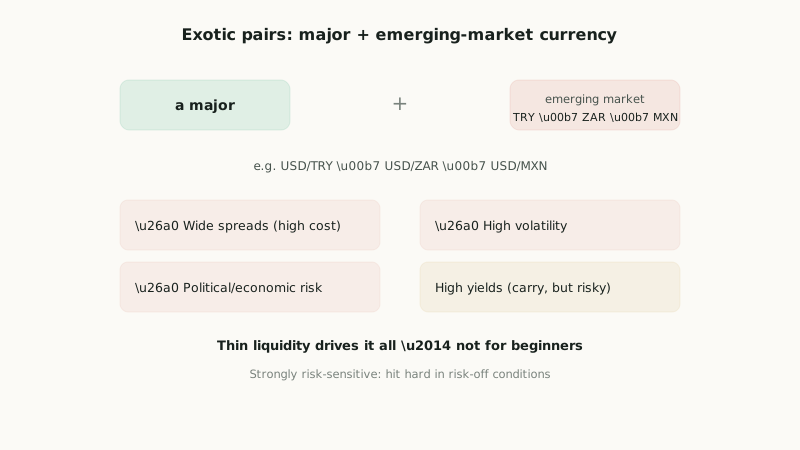
An exotic currency pair combines a major currency (such as the US dollar or euro) with the currency of a smaller or emerging-market economy. Common examples include USD/TRY (US dollar against the Turkish lira), USD/ZAR (against the South African rand), USD/MXN (against the Mexican peso), and various others pairing a major with currencies from emerging or smaller economies. These differ fundamentally from the majors (which all pair the dollar with another major currency) and the crosses (which pair two majors): the defining feature of an exotic is the inclusion of a non-major, emerging-market currency.
The most important fact about exotics is that they are far less traded than majors or crosses, and this thin liquidity is the root cause of all their distinctive characteristics. Where the majors enjoy enormous trading volume and deep liquidity, exotics are relatively illiquid — fewer participants, less volume, shallower markets. As the forex-pairs-explained guide establishes, liquidity drives spreads, smoothness and execution, so the low liquidity of exotics translates directly into wide spreads, erratic price action and the other challenging features explored below. Understanding that exotics' defining trait — the emerging-market currency — brings with it low liquidity, and that low liquidity drives everything else, is the key to understanding why these pairs behave so differently from the smooth, cheap majors.
Wide spreads and high volatility
The two defining practical characteristics of exotics, both flowing from low liquidity, are wide spreads and high volatility. The wide spreads mean exotics are expensive to trade — the gap between bid and ask is substantially larger than on a major, sometimes dramatically so, which means every trade starts at a bigger disadvantage and costs more to enter and exit. For a trader, this is a serious headwind: the wide spreads alone erode results, taking a larger bite out of every trade than the tiny spreads of EUR/USD. Over many trades, this cost difference is significant, and it is one of the main reasons exotics are unsuitable for active or beginner trading.
The high volatility means exotics can make large, sudden, sometimes violent moves — far bigger and faster than the relatively contained majors. This volatility stems both from the thin liquidity (fewer participants means prices move more on a given order flow) and from the nature of emerging-market currencies, which are prone to sharp moves driven by the economic and political instability that often characterises their economies. The combination of wide spreads and high volatility makes exotics high-risk: you pay more to trade them and they can move against you fast and far. A position in an exotic can produce a large loss quickly in a way that a major rarely would, and the wide spread means you start each trade further behind. This is why exotics carry a fundamentally different, and higher, risk profile than the majors most traders should focus on.
Emerging-market and sentiment risks
Beyond liquidity-driven traits, exotics carry the specific risks of their emerging-market economies. These currencies are exposed to political instability, economic crises, abrupt policy changes, capital controls, and the various upheavals more common in emerging and smaller economies than in the stable major-currency economies. Such events can cause large, abrupt currency moves — a political crisis or economic shock can send an exotic plunging — adding a layer of idiosyncratic, hard-to-predict risk on top of the volatility. The relative lack of stability and predictability in these economies makes their currencies inherently more hazardous to hold.
Exotics are also strongly risk-sensitive, behaving as classic "risk" currencies in the risk-on/risk-off framework. In risk-on conditions, capital flows toward higher-yielding emerging-market currencies, supporting the exotics; but in risk-off conditions — when fear strikes — capital flees emerging markets rapidly for the safe havens, hitting the exotics hard. This means exotics can suffer sharp, sudden declines during global risk-off episodes, often more severely than other currencies, as the flight from risk and from emerging markets compounds. Their sensitivity to global sentiment adds yet another source of volatility and risk. Many exotics also carry high interest rates — a risk premium compensating investors for these very dangers — which makes them candidates for the carry trade, but the high yield is precisely a reward for bearing the substantial risks, not a free lunch.
Everything about exotics traces back to thin liquidity and emerging-market risk: wide spreads (you pay more), high volatility (they move fast and far), and acute risk-sensitivity (they crater in risk-off panics). Their high yields are a risk premium, not free money — compensation for exactly the dangers that make them unsuitable for beginners. The spread alone is a headwind most traders don't need.
The carry-trade connection
The high interest rates that many exotics carry create their main legitimate appeal beyond pure volatility trading: the carry trade. As covered in the carry-trade guide, the strategy involves borrowing a low-yield currency to invest in a high-yield one, earning the interest differential — and the high-yielding exotics are natural candidates for the high-yield side. Historically, carry traders have funded positions in low-yield currencies (like the yen) to invest in higher-yielding emerging-market currencies, capturing the substantial rate differential.
But the exotics' carry appeal comes hand-in-hand with the carry trade's characteristic danger, amplified. The high yield that attracts carry traders is a risk premium for bearing the exotic's substantial risks, and those risks — high volatility, emerging-market instability, acute risk-off sensitivity — are exactly what produce the violent carry-trade unwinds. When risk-off conditions strike, the high-yielding exotics can plunge as capital flees, inflicting losses that dwarf the accumulated carry, precisely the asymmetric "pennies in front of a steamroller" dynamic the carry-trade guide warns about. So while exotics feature in carry strategies, they do so as among the riskiest expressions of an already-risky strategy. The high yields are seductive, but they are compensation for real and severe dangers, and the carry trade in exotics demands the full discipline of risk management and a clear understanding that the rate differential is a payment for bearing genuine, sometimes catastrophic, risk.
Approaching exotics with caution
The overriding message about exotic pairs is caution. They are an advanced corner of the market, emphatically not for beginners, who are far better served by the majors and their deep liquidity, tight spreads and relative stability. The wide spreads erode results, the high volatility can produce fast and large losses, the emerging-market risks add unpredictable shocks, and the acute risk-off sensitivity means they can crater when fear strikes — a combination that punishes the unprepared severely. A beginner trading exotics is taking on the market's highest-risk pairs before mastering the basics, a recipe for trouble.
For experienced traders, exotics can have a place — for those who specifically want to trade their volatility, gain exposure to particular emerging economies, or pursue carry strategies with full awareness of the risks — but always approached with care, conservative position sizing (the wide spreads and volatility demand it), and a clear understanding of the specific risks of the economies involved. Even then, exotics should be a deliberate, well-understood choice, not a casual foray. The core guidance from the forex-pairs-explained pillar holds firmly: liquidity is your friend, costs compound, and the majors should be the focus for the vast majority of trading. Exotics exist for specific purposes in experienced hands, but the higher costs and risks mean they are a specialist's tool, not a place to learn or to trade casually. Understanding exotics — including understanding why most traders should largely avoid them — is valuable; trading them requires experience, caution, and respect for the substantial risks that their big moves and high yields are compensation for.
Practical notes if you do trade them
For the experienced trader who chooses an exotic deliberately, the pairs' nature dictates a few practical adjustments. The wide spreads make rapid in-and-out trading self-defeating, so exotics suit longer-held positions where the spread is a smaller fraction of the expected move. The high volatility demands notably smaller position sizes than on a major to keep risk per trade within the same limit, with stops given room for the larger swings (and size reduced accordingly). Following the relevant economy's fundamentals is essential, since exotics move violently on country-specific news, and heightened caution around risk-off episodes is vital, as exotics can gap and plunge faster than stops fill cleanly in thin markets. None of this makes exotics untradeable for the prepared, but it confirms they are a specialist's undertaking, demanding more care, smaller size, and closer attention than the majors.
Exotic pairs combine a major with an emerging-market currency (e.g. USD/TRY, USD/ZAR, USD/MXN). Their thin liquidity drives wide spreads (high cost) and high volatility (big, sudden moves), and they carry emerging-market risks (political/economic instability) plus acute risk-off sensitivity (they crater when fear strikes). High yields make them carry-trade candidates, but the yield is a risk premium for genuine, sometimes severe danger — and exotics are among the riskiest carry plays. If you do trade them, use much smaller size, give stops room, favour longer holds over scalping, follow the country's fundamentals, and be wary around risk-off episodes. An advanced, high-risk corner of the market: not for beginners.