Fibonacci retracements answer one question: where might a pullback end? But that leaves the harder and arguably more useful question unanswered: once the trend resumes, how far might it go? This is where Fibonacci extensions come in. While retracements measure backward into a completed move, extensions project forward, beyond the 100% level, to estimate where a move might reach. They are how a trader turns a Fibonacci level from a place to enter into an actual price target — completing the round trip of planning a trade. This guide explains the extension levels, how they differ from projections, and how to use them.
This builds on Fibonacci retracements and complements the wave-specific treatment in Elliott Wave extensions, where extension applies to the lengthening of trending waves.
Key takeaways
Q: What is a Fibonacci extension?
A: A Fibonacci extension projects potential price targets beyond the 100% level of a move, using ratios such as 127.2%, 161.8% and 261.8%. Where retracements measure how far a pullback may go, extensions estimate how far the resumed move may travel.
Q: What are the main Fibonacci extension levels?
A: The key extension levels are 127.2%, 161.8% and 261.8%. The 161.8% level (the golden ratio applied beyond 100%) is the most widely watched, often serving as the primary target for a move.
Q: What is the difference between a Fibonacci extension and a projection?
A: The terms are often used loosely. An extension typically projects beyond a single move's 100% level, while a projection uses three points — a move, its retracement, and the resumption — to project a target. Both estimate where a move may reach.
Projecting beyond the move
The principle behind extensions is that just as pullbacks tend to find support at Fibonacci proportions of a move, the resumed trend tends to travel Fibonacci-related multiples of that move before pausing or reversing. Where a retracement divides a move into fractions (you only ever go partway back), an extension multiplies it (you can go well beyond the original distance). The 161.8% extension, for example, projects a target at 1.618 times the length of the measured move, beyond its endpoint.
This forward-looking quality is what makes extensions so valuable for trade planning. A retracement helps you find an entry; an extension helps you define where to take profit. Together they let a trader map a complete trade in advance: enter on a pullback to a retracement level, target an extension level, and define risk with a stop — a fully planned trade with a reasoned, proportional objective rather than an arbitrary one.
The key extension levels
The Fibonacci extension levels most traders watch are:
- 127.2% — the first extension target (the square root of 1.618), often reached in moderate continuations.
- 161.8% — the golden ratio applied beyond 100%, and the most widely watched extension. It serves as the primary target for many traders and frequently marks where a strong move pauses.
- 261.8% — a far target (1.618 squared), reached in powerful, extended trends.
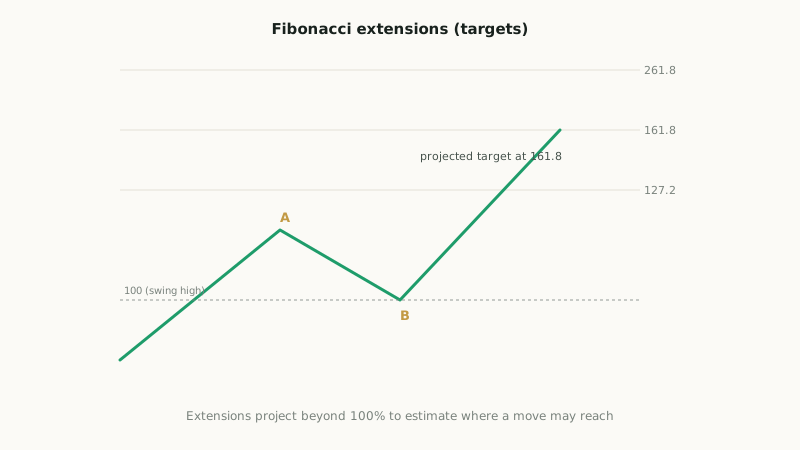
The 161.8% level deserves special mention because of how often it appears as a natural target — it is to extensions what 61.8% is to retracements, the headline level that draws the most attention and, partly for that reason, tends to be respected. When a move reaches the 161.8% extension, it is a logical place to expect a pause, take partial profit, or watch for a reversal.
Extension versus projection
A point of frequent confusion is the difference between an extension and a projection, terms often used interchangeably but with a useful distinction. An extension in the strict sense is measured from a single move: you take an impulse leg and project Fibonacci multiples of it beyond its endpoint. A projection (sometimes called an expansion) uses three points — the start and end of an initial move, plus the end of its retracement — to project a target for the next leg, in the manner of an A-B-C structure.
In practice, most charting platforms offer both tools, and the three-point projection is often what traders actually use, because it incorporates the retracement and projects the next move from where it actually begins. The arithmetic differs slightly, but the goal is identical: to estimate, using Fibonacci ratios, where a move is likely to travel. For the purposes of trade planning, the key is to be consistent about which tool you use and to understand that both are producing a proportional target, not a precise prophecy. The 161.8% relationship is the most important in either case.
Retracements and extensions are two halves of the same plan. The retracement finds your entry on the pullback; the extension sets your target on the resumption. Used together, they let you define a complete, proportionally-reasoned trade — entry, stop and target — before price even arrives.
Confluence and realism
Like retracement levels, extension targets are most reliable when they sit in confluence with other evidence. An extension level that coincides with a prior structural high or low, a round number, or another Fibonacci projection from a different swing is far more likely to be respected than one floating in isolation. Experienced traders look specifically for these clusters — zones where several independent projections agree — and treat them as the meaningful targets, rather than acting on any single extension line.
The same honest caveat that applies to retracements applies here, perhaps more strongly: extensions are estimates, not guarantees. A move may reverse before reaching 161.8%, blow straight through it to 261.8%, or stall somewhere in between. Treating an extension as a zone where a reaction becomes more likely — a logical place to manage the trade — rather than as a price the market is obligated to hit, is the realistic approach. Extensions are a tool for setting reasoned objectives and managing trades, not for predicting the future with false precision.
Fibonacci extensions on forex
On currencies, extensions are used exactly as on any market, and they share retracements' advantage of needing no volume data. The standard application is to use a retracement to enter a pullback in the direction of the trend, then use an extension — most often the 161.8% projection — to set the profit target. Many forex traders take partial profit at 127.2% or 161.8% and trail the remainder toward 261.8% in strong trends, scaling out at the proportional levels as the move develops.
The discipline is to plan the whole trade in advance: identify the trend, find the retracement entry, set the extension target, and define the invalidation, all before committing. Combined with the entry-side tools and the confluence-first mindset of the Fibonacci trading strategy, extensions complete the Fibonacci toolkit — turning the question "where might this go?" from a guess into a reasoned, proportional estimate that anchors a complete trading plan.
Scaling out at extension levels
Because extensions provide several targets rather than one, they lend themselves naturally to scaling out of a position — taking profit in stages rather than all at once. A common approach is to close a portion of the position at the first extension (127.2%), another portion at 161.8%, and to let a final portion run toward 261.8% in a strong trend, often trailing the stop behind price as each level is reached. This banks profit progressively while keeping exposure to a move that continues to extend.
The appeal of scaling out at Fibonacci extensions is that it resolves the perennial tension between taking profit too early and giving back gains by holding too long. By predefining the extension levels as staged exits, a trader removes the in-the-moment emotional decision and follows a plan. The 161.8% level usually serves as the anchor — the target where the bulk of profit is taken — with the lower and higher levels as the first and final scales around it.
Completing the round trip with retracements
Extensions are at their most useful paired with retracements in a single, coherent trade, because together they cover both halves of the plan. The retracement locates the entry: price pulls back to a retracement level in the direction of the trend, and the trader enters there. The extension then locates the exit: the resumed move is projected to an extension target, where profit is taken. One tool answers "where do I get in?" and the other answers "where do I get out?", and a trader who uses both can map an entire trade — entry on the retracement, stop beyond the invalidating level, target at the extension — before price has moved. This complete, proportionally-reasoned plan is the real reward of mastering both sides of the Fibonacci toolkit, and it is why the two are almost always taught and used together.
Fibonacci extensions project price targets beyond 100% using 127.2%, 161.8% and 261.8%, with 161.8% the headline level. They pair with retracements to plan a complete trade — retracement for entry, extension for target — and their multiple levels suit scaling out of a position in stages. A strict extension uses one move; a projection uses three points, but both estimate where a move may reach. Favour targets in confluence with structure, and treat them as zones where a reaction is more likely, not guaranteed prices.