It is the most popular tool in all of technical analysis, and one of the simplest ideas behind it: markets rarely move in a straight line, and when they pull back, they tend to retrace a predictable fraction of the prior move before continuing. The Fibonacci retracement tool turns that observation into a precise map — a set of horizontal levels marking where a pullback is most likely to find support or resistance. Whether you regard the levels as mathematically meaningful or simply self-fulfilling, they are watched by enough traders to matter. This guide explains what Fibonacci retracements are, the levels that count, and how they are used.
This is the foundation of the Technical Analysis pillar's Fibonacci cluster, and it connects directly to the wave-specific application in Elliott Wave Fibonacci ratios.
Key takeaways
Q: What is a Fibonacci retracement?
A: A Fibonacci retracement is a tool that marks potential support and resistance levels at key percentages of a prior price move — 23.6%, 38.2%, 50%, 61.8% and 78.6%. It is based on the idea that markets tend to retrace a predictable fraction of a move before continuing in the original direction.
Q: What are the main Fibonacci retracement levels?
A: The key levels are 23.6%, 38.2%, 50%, 61.8% and 78.6%. The 61.8% level (the golden ratio) and the 38.2% level are considered the most significant, while 50% is included by convention despite not being a true Fibonacci ratio.
Q: How do traders use Fibonacci retracements?
A: Traders use them to find potential entry points during a pullback in a trend. In an uptrend, they watch for price to retrace to a Fibonacci level and find support before resuming higher. The levels are zones to watch for confirmation, not automatic buy or sell signals.
The core idea
A Fibonacci retracement is built on a single, intuitive premise: after a strong move in one direction — an impulse — price typically pulls back part of the way before resuming, and the extent of that pullback tends to cluster around certain proportions. Rather than retracing a random amount, the market seems to favour pulling back to specific fractions of the original move, and the Fibonacci tool marks exactly those fractions. The trader's job is then to watch how price behaves as it reaches each level.
The reason these particular proportions are used comes from the Fibonacci sequence and the ratios it generates, explored fully in the golden ratio in trading. For the practical purpose of using the tool, what matters is that the levels are derived from those ratios and that, for whatever combination of mathematical, psychological and self-fulfilling reasons, price reacts at them often enough to be useful. The retracement tool simply takes a move you define — from its start to its end — and overlays the key proportional levels across it.
The key levels
The Fibonacci retracement levels every trader should know are:
- 23.6% — a shallow retracement, typical of very strong trends that barely pause before continuing.
- 38.2% — a common, moderate retracement and one of the most significant levels, derived directly from the sequence.
- 50% — the halfway point. Strictly, this is not a true Fibonacci ratio, but it is included by long convention because the halfway retracement is so frequently respected.
- 61.8% — the golden ratio, and arguably the single most important level. Deep retracements often find support or resistance here.
- 78.6% — a deep retracement (the square root of 0.618), the last level before a full retracement of the move.
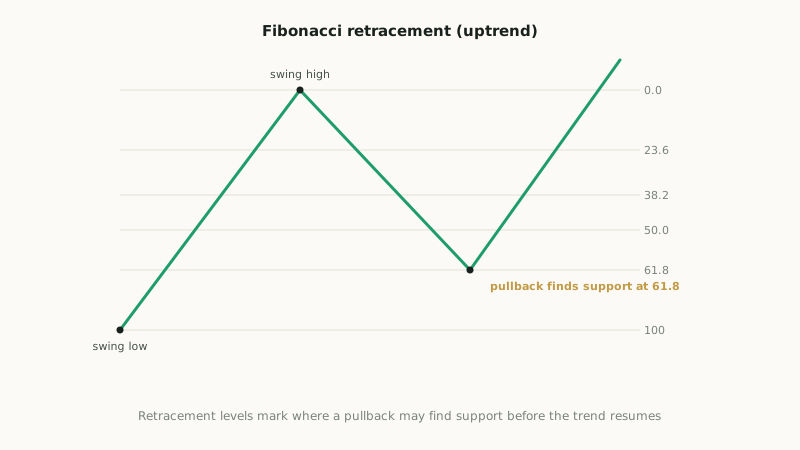
A retracement beyond 78.6% — approaching a full 100% retracement of the move — increasingly suggests that the original move may not have been the start of a genuine trend, or that something has changed. The shallower levels (23.6%, 38.2%) tend to hold in strong trends; the deeper ones (61.8%, 78.6%) come into play when a pullback is more substantial.
How the levels act
Fibonacci levels function as potential support and resistance. In an uptrend, after price makes a strong advance and begins to pull back, the retracement levels mark where that pullback may find support and the uptrend may resume — the levels act as a floor. In a downtrend, after a strong decline and a corrective bounce, the levels mark where the bounce may find resistance and the downtrend may resume — the levels act as a ceiling. The tool thus helps a trader anticipate where a counter-trend move is likely to run out of steam.
The critical word throughout is potential. A Fibonacci level is a zone to watch, not a guarantee. Price reaching the 61.8% level does not mean it must bounce; it means that level is a logical place to look for the trend to resume, and to seek confirmation before acting. Treating the levels as automatic triggers — blindly buying at 61.8% because the tool says so — is the most common way traders misuse them. The levels identify where to pay attention, and price action then confirms or denies the expectation.
Fibonacci levels tell you where to watch, not what to do. The level is a zone of interest; the decision to act should come from how price behaves there — a rejection candle, a structure shift — not from the level alone. This single distinction separates traders who use the tool well from those who lose money with it.
Why the levels work (and the honest caveat)
There is genuine debate about why Fibonacci levels appear to work, and an honest treatment should acknowledge it. One view holds that the ratios reflect something fundamental about natural and human systems, markets included. A more sceptical and probably more defensible view is that the levels work substantially because they are self-fulfilling: so many traders watch the same Fibonacci levels and place orders around them that the levels become significant simply through collective attention. If enough participants expect support at 61.8% and buy there, support appears at 61.8%.
For the practical trader, the distinction matters less than it might seem. Whether the levels are mathematically magical or merely a giant shared convention, the effect is the same: price reacts at them often enough to be useful, precisely because everyone is watching. What this caveat should instil is appropriate humility — the levels are a probabilistic tool reflecting crowd behaviour, not a law of nature, and they work best as one input among several rather than as a standalone oracle. That realism is exactly why confluence and confirmation, covered in the Fibonacci trading strategy, are so important.
Fibonacci retracements on forex
Fibonacci retracements are especially well suited to forex for two reasons. First, they are derived purely from price and require no volume data, so the lack of true volume on spot forex — a limitation for Wyckoff and Dow's volume tenet — does not affect them at all. Second, Fibonacci is so widely used by currency traders that its self-fulfilling character is, if anything, stronger in the deep and heavily-charted forex market. The levels are watched, and so they tend to matter.
The practical workflow is to identify a clear, significant price move on the timeframe you trade, draw the retracement across it (covered step by step in how to draw Fibonacci retracements), and then watch the key levels — especially 38.2%, 50% and 61.8% — for price to find support or resistance in line with the larger trend. Crucially, the retracement is used to trade with the trend: buying pullbacks to Fibonacci support in an uptrend, selling bounces to Fibonacci resistance in a downtrend. Used that way, as a map of where to look for the trend to resume, the Fibonacci retracement is the versatile, foundational tool that earns its place as the most popular instrument in technical analysis.
Fibonacci across timeframes
One of the most powerful refinements in using retracements is to read them across multiple timeframes, because not all Fibonacci levels carry equal weight — a level's significance scales with the timeframe of the swing it is drawn from. A 61.8% retracement of a major weekly move is watched by far more traders, and tends to be respected far more reliably, than a 61.8% retracement of a minor five-minute wiggle. The higher the timeframe of the underlying swing, the stronger and more meaningful its levels.
This creates a valuable form of confluence when levels from different timeframes align. When a higher-timeframe retracement level falls at the same price as a lower-timeframe one, that shared level is doubly significant — watched by both the position traders working the higher timeframe and the swing traders working the lower one. Many of the most reliable Fibonacci reactions occur at these multi-timeframe confluence points, where a daily 61.8% level and a four-hour 38.2% level, say, coincide.
The practical method is to draw retracements on the higher timeframe first to identify the major levels, then drop to a lower timeframe both to find additional levels that may align and to refine entries when price reaches a significant higher-timeframe level. This top-down, multi-timeframe use of Fibonacci mirrors the broader discipline of letting the larger timeframe set context while the smaller one sharpens timing — and it is how experienced traders separate the levels worth acting on from the noise.
A Fibonacci retracement marks where a pullback may find support or resistance at key proportions of a prior move — 23.6%, 38.2%, 50%, 61.8% and 78.6% — with 61.8% and 38.2% the most significant. The levels show where to watch, not what to do; confirm with price action and trade with the trend. Higher-timeframe levels carry more weight, and multi-timeframe alignment is powerful confluence. They likely work largely through collective attention, so treat them as a probabilistic tool and lean on confluence rather than any single line.