Knowing the Fibonacci levels is not a strategy — it is just vocabulary. Plenty of traders can recite that 61.8% is the golden-ratio retracement and still lose money, because they treat the levels as automatic buy and sell signals rather than as one component of a complete plan. A genuine Fibonacci strategy combines the levels with trend analysis, structure, confluence and risk management to produce reasoned entries, stops and targets. This guide lays out how to actually trade Fibonacci: not the levels in isolation, but the disciplined framework that turns them into trades.
It brings together the tools from retracements and extensions into a working method, and it shares its location-first philosophy with premium and discount zones.
Key takeaways
Q: How do you trade using Fibonacci?
A: A practical Fibonacci strategy uses retracements to find entries on a pullback in the direction of the trend, seeks confluence with structure or other levels for confirmation, and uses extensions to set targets. The levels identify where to act; price action and confluence confirm whether to act.
Q: Is Fibonacci a reliable trading strategy?
A: Fibonacci is reliable as part of a complete approach — combined with trend analysis, structure and risk management — but not as a standalone signal. The levels work best as confirmation and trade location, with the actual edge coming from disciplined execution and trend alignment.
Q: What is Fibonacci confluence?
A: Confluence is when a Fibonacci level coincides with another piece of evidence — a structural support or resistance level, a round number, a moving average, or another Fibonacci projection. A level supported by confluence is far more likely to hold than one in isolation.
Step one: trade with the trend
The foundation of any sound Fibonacci strategy is to use the levels in the direction of the prevailing trend. Fibonacci retracements are, at their core, a tool for finding favourable entries on pullbacks — and a pullback only makes sense as an entry if there is a trend for it to be a pullback within. So the first step is always to establish the trend: in an uptrend, you use retracements to find long entries as price pulls back to support; in a downtrend, to find short entries as price bounces to resistance.
Trading retracements against the trend — shorting a pullback in an uptrend because it reached 61.8%, say — is fighting the dominant current and is the fast route to losses. The levels do not have a direction of their own; the trend supplies it. This is why establishing the trend, using the structure and trend-reading tools covered across the site, must come before any Fibonacci level is acted upon. The retracement tells you where to look for an entry; the trend tells you which way that entry should face.
Step two: demand confluence
The single most important principle in trading Fibonacci well is confluence — the alignment of a Fibonacci level with other independent evidence. A Fibonacci level on its own is a weak signal; the same level becomes a strong one when it coincides with something else the market watches. The most valuable confluences include a Fibonacci level lining up with a prior structural support or resistance level, a round number, a moving average, a supply or demand zone, or — powerfully — another Fibonacci projection drawn from a different swing.
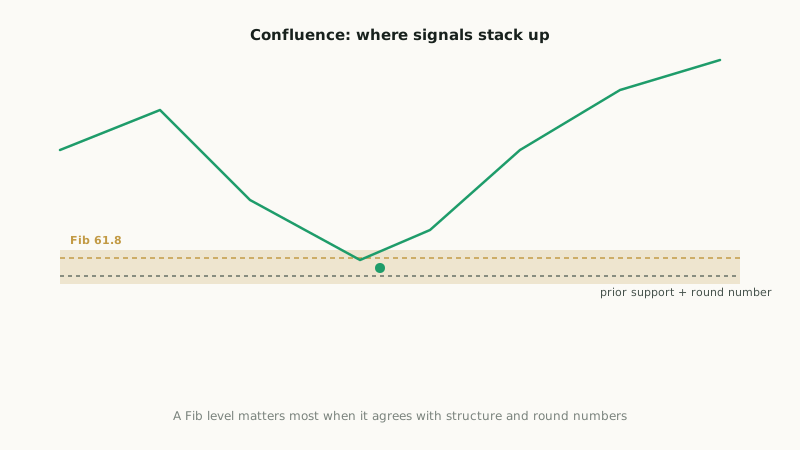
The practical method is to treat zones of confluence, not individual lines, as the meaningful levels. When the 61.8% retracement, a prior swing low, and a round number all fall within a few pips of each other, that cluster carries far more weight than any one of them alone — it represents several independent reasons for price to react there. Building the habit of looking for confluence, and ignoring isolated levels that lack it, is what transforms Fibonacci from a guess into a disciplined edge.
Step three: wait for confirmation
Even a high-confluence level is a zone to watch, not an automatic trigger. The disciplined Fibonacci trader waits for confirmation from price action before entering. Confirmation might be a rejection candle at the level (a pin bar or engulfing candle showing the level holding), a shift in lower-timeframe structure, or any of the price-action signals that indicate the level is actually being respected rather than merely reached. Price touching a Fibonacci level proves nothing on its own; price reacting at it is the signal.
This confirmation step is the safeguard against the most common Fibonacci mistake: entering blindly at a level on faith that it must hold. Levels fail regularly, and the trader who enters without confirmation is repeatedly caught when they do. Waiting for price to demonstrate that the level is holding — accepting that this means occasionally missing a trade that reverses without a clear signal — is the cost of avoiding the far larger losses that come from trading levels on autopilot. Patience at the level is itself part of the edge.
The Fibonacci edge is not in the levels — it is in the combination. Trend supplies direction, confluence supplies significance, confirmation supplies timing, and risk management supplies survival. The level is just where these four meet. Anyone trading the level alone has three-quarters of the strategy missing.
Step four: entry, stop and target
With trend, confluence and confirmation in place, the trade can be structured. The entry comes on confirmation at the confluence zone — say, a rejection at the 61.8% retracement coinciding with a structural level. The stop goes just beyond the level that would invalidate the idea: below the swing low (or the 78.6% level) for a long, above the swing high for a short, so that a decisive break of the level cleanly ends the trade. The target is set using a Fibonacci extension — commonly the 161.8% projection — or the next significant structural level.
This structure produces the favourable risk-to-reward that makes Fibonacci trading worthwhile: a tight stop just beyond a well-defined level against a target a multiple of that distance away. A trader can plan the entire trade in advance — entry zone, invalidation, objective — before price arrives, then simply execute if and when confirmation appears. And crucially, position size is set so that the stop, if hit, represents only a small, predetermined fraction of the account, ensuring that the inevitable failed levels are survivable. The levels supply the map; risk management ensures you are still trading after the trades that don't work.
A Fibonacci strategy on forex
Pulling it together for a currency trader, the workflow is: identify the trend on a higher timeframe; draw a retracement across the most recent significant swing; mark the confluence zones where Fibonacci levels meet structure, round numbers or other projections; wait for price to reach a high-confluence zone and produce a confirmation signal in the trend's direction; enter, with a stop just beyond the invalidating level and a target at a Fibonacci extension or structural objective; and size the position so the risk is a small, fixed fraction of the account.
Done this way, Fibonacci is not a magic system but a disciplined framework for trade location and planning, with the genuine edge coming from trend alignment, confluence, confirmation and risk control rather than from the levels themselves. This is the honest reality behind the most popular tool in technical analysis: the levels are useful precisely because so many watch them, and they become a strategy only when embedded in the discipline that surrounds them. Used with that discipline, the Fibonacci toolkit — retracements for entries, extensions for targets, confluence for significance — is a versatile and reliable part of a forex trader's arsenal.
A worked example
To see the framework in action, consider a concrete (if simplified) scenario on a currency pair. The daily chart shows a clear uptrend — a sequence of higher highs and higher lows — so the bias is to look for longs only (step one: trade with the trend). Price has just made a strong advance and begun to pull back. The trader draws a retracement across that advance, from the swing low to the swing high, and notes the key levels.
The 61.8% retracement falls at a price that also coincides with a prior swing high that had acted as resistance and should now act as support, and sits just above a round number (step two: confluence). The trader marks this zone and waits. Price drifts down into the zone over the next few sessions, and on reaching it prints a clear bullish rejection candle with a long lower wick — the level is holding (step three: confirmation). Only now does the trader act.
The entry is taken on the close of the rejection candle. The stop is placed just below the 78.6% level and the swing low — a decisive break there would mean the pullback was actually a reversal, cleanly invalidating the trade. The target is set at the 161.8% extension of the prior move, with a plan to take partial profit at the prior swing high along the way (step four: entry, stop, target). Finally, the position is sized so that if the stop is hit, the loss is only a small, predetermined fraction of the account.
Notice what did the work in this example: the trend supplied the direction, the confluence of the 61.8% level with structure and a round number supplied significance, the rejection candle supplied the timing, and the stop and position sizing supplied survival. The Fibonacci level was the meeting point, not the signal in itself. That is precisely how the levels are meant to function — as the location where a disciplined, multi-factor plan comes together, never as a standalone reason to trade.
A Fibonacci strategy is trend (direction), confluence (significance), confirmation (timing) and risk management (survival) meeting at a level. Trade retracements with the trend, demand confluence with structure and round numbers, wait for price to confirm, then structure entry, stop and target with a Fibonacci extension and a small fixed risk. As the worked example shows, the level is where the plan comes together — the edge is in the discipline around it, not the line itself.