A Fibonacci retracement is only ever as good as the two points you anchor it to. Draw it across the right swing and the levels line up with where price actually reacts; draw it across the wrong swing and every level is meaningless noise. This is the part of Fibonacci that beginners most often get wrong — not the theory of the levels, but the practical act of placing the tool. This guide covers how to draw a retracement properly: choosing the right swing, anchoring it correctly, the body-versus-wick question, and the common mistakes that quietly ruin otherwise sound analysis.
It is the practical companion to Fibonacci retracements explained, turning the concept into a repeatable charting skill.
Key takeaways
Q: How do you draw a Fibonacci retracement?
A: Identify the significant swing being retraced, then anchor the tool from the start of the move to its end — from the swing low to the swing high in an uptrend, or from the swing high to the swing low in a downtrend. The tool then draws the retracement levels across that move.
Q: Do you draw Fibonacci from high to low or low to high?
A: It depends on the trend direction. In an uptrend you draw from the swing low (start) to the swing high (end); in a downtrend you draw from the swing high (start) to the swing low (end). You always anchor from the start of the move to its end.
Q: Should you use the candle body or the wick for Fibonacci?
A: Both approaches are used. Anchoring to the wick (the absolute high or low) is the most common and captures the full move; anchoring to the body (open or close) ignores extreme spikes. Consistency matters more than which you choose.
Step one: choose the right swing
Everything starts with identifying the correct swing to measure — the significant price move you expect to be retraced. This is the single most important decision, and it is where judgement enters. The swing should be a clear, meaningful move with an obvious start and end: a strong impulse leg, not a minor wiggle. On a trending chart, you are looking for the most recent significant leg in the trend's direction — the advance you expect a pullback to retrace before the uptrend resumes, or the decline you expect a bounce to retrace before the downtrend resumes.
The key is significance. A retracement drawn across a tiny, insignificant move produces levels that mean nothing, because the move itself meant nothing. A retracement drawn across a major, structurally important swing produces levels the wider market is likely to watch and respect. When in doubt, anchor to the larger, clearer move on a higher timeframe — the same principle of working from significant higher-timeframe structure that runs through all sound analysis. Choosing the swing well is most of the battle.
Step two: anchor from start to end
Once you have the swing, the anchoring rule is simple and direction-dependent: draw from the start of the move to its end. In an uptrend, the move started at the swing low and ended at the swing high, so you anchor from the low to the high — the levels then appear as potential support below, where a pullback may land. In a downtrend, the move started at the swing high and ended at the swing low, so you anchor from the high to the low — the levels appear as potential resistance above, where a bounce may stall.
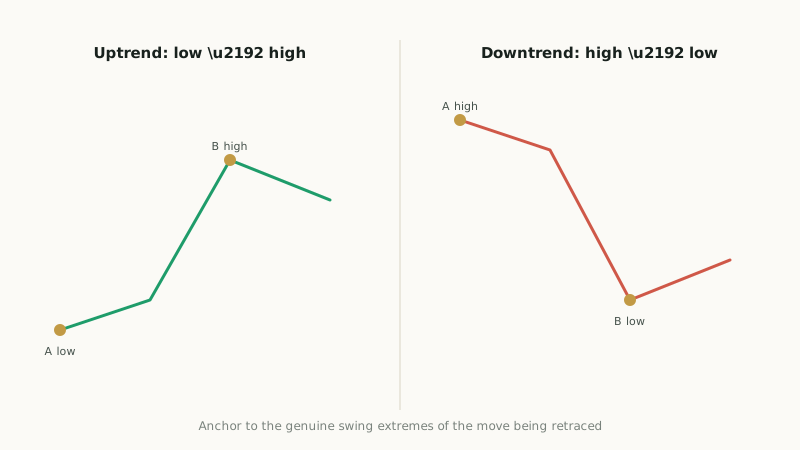
A useful way to remember it: you always draw in the direction the move travelled. The 0% level sits at the end of the move (the most recent extreme) and the 100% level at its start, with the retracement levels filling the space between — marking how far back toward the start a pullback might travel. Getting the direction right is essential; anchoring backward puts the levels in the wrong place entirely.
Step three: body or wick?
A common question is whether to anchor to the candle wick (the absolute high or low, including spikes) or the candle body (the open or close, ignoring spikes). Both are legitimate, and each has a rationale. Anchoring to the wick captures the full extent of the move, including the extreme prices actually traded, and is the most common approach. Anchoring to the body ignores what some traders regard as noise — the brief spikes and stop-runs at the extremes — and can produce cleaner levels in markets prone to wicky, volatile candles.
There is no universally correct answer, and the difference is often small. What matters far more than the choice itself is consistency: pick one approach and apply it the same way every time, so your levels are comparable from one chart to the next. Inconsistency — using wicks one day and bodies the next, or switching to whichever happens to fit — is a subtle form of the curve-fitting that undermines Fibonacci analysis. Choose your convention and stick to it.
The tool does the arithmetic; you do the judgement. Ninety percent of drawing Fibonacci well is choosing a significant swing and anchoring it consistently. Get those right and the levels are meaningful; get them wrong and no amount of pretty levels will help.
Common mistakes to avoid
Several recurring errors ruin Fibonacci retracements, and knowing them is half the cure. The first is choosing an insignificant or arbitrary swing — drawing across a minor move that the market has no reason to respect. The second is inconsistent anchoring: snapping the tool to slightly different points each time, or mixing body and wick, so the levels shift unpredictably. The third is curve-fitting: redrawing the retracement repeatedly until a level happens to line up with where price already turned, then declaring Fibonacci "worked" — which proves nothing, since the levels were fitted after the fact.
A fourth common error is cluttering the chart with too many retracements at once, until every price is near some level and the analysis becomes meaningless. A fifth is ignoring the trend — drawing retracements without regard to the larger direction and then trading against it. The defence against all of these is discipline: commit to a significant swing and a consistent anchoring method before price arrives, keep the chart clean, and use the levels in the context of the prevailing trend. Drawn carefully and consistently, the retracement becomes a reliable map; drawn loosely, it becomes a Rorschach test that confirms whatever you already believed.
Drawing Fibonacci on forex
On currency pairs, the drawing process is identical, and a practical higher-timeframe-first workflow works best. Start by identifying the trend and the most significant recent swing on a higher timeframe — the daily or four-hour — and draw the retracement across it. Use a consistent anchoring convention (wicks are most common on forex's spiky, 24-hour candles). Then watch the key levels (38.2%, 50%, 61.8%) for price to react in line with the trend, dropping to a lower timeframe to refine entries if desired.
Because forex trades around the clock and is heavily charted by a global community of traders, the levels on a well-chosen significant swing tend to be widely watched and therefore meaningful — the self-fulfilling effect at its strongest. The reward for drawing carefully is real: a properly anchored retracement on a significant forex swing gives you levels that a large slice of the market is watching alongside you. Combined with confirmation and confluence from the Fibonacci trading strategy, a well-drawn retracement is the foundation of every Fibonacci-based trade.
Drawing multiple retracements for confluence
A more advanced but highly practical technique is to draw more than one retracement — across different swings — and look for the places where their levels cluster. A single chart often contains several significant swings on different timeframes, and each produces its own set of Fibonacci levels. Where levels from two or more independent swings fall at the same price, that shared zone is far more significant than any single level, because it is supported by multiple, independent measurements arriving at the same conclusion.
The method is to identify two or three significant swings — perhaps a larger move and a smaller move within it, or swings from two different timeframes — and draw a retracement across each, then look for where their levels overlap. A price zone where the 61.8% of the larger swing meets the 38.2% of the smaller one is a high-confluence area worth real attention. This is the disciplined opposite of the chart-cluttering mistake: rather than drawing many retracements carelessly until everything is near some level, you draw a few deliberate ones specifically to find where genuine, independent levels agree.
This technique connects directly to the confluence-first philosophy that makes Fibonacci work. A lone level is a weak signal; a zone where multiple retracements, and ideally also structure and round numbers, all converge is a strong one. Learning to draw a small number of meaningful retracements and read their confluence — rather than relying on a single line — is the bridge from merely drawing Fibonacci correctly to actually trading it well, as developed in the Fibonacci trading strategy.
Draw a Fibonacci retracement by choosing a significant swing and anchoring from the start of the move to its end — low-to-high in an uptrend, high-to-low in a downtrend — with a consistent wick-or-body convention. Avoid insignificant swings, inconsistent anchoring, curve-fitting, clutter and ignoring the trend. To find the strongest zones, draw a few deliberate retracements across different swings and look for where their levels cluster. The tool does the maths; choosing the swing and anchoring consistently is the real skill.