
When you open a trading account, you'll be presented with a menu of types — micro, mini, standard, ECN, raw, swap-free — and for a beginner the choices can be bewildering. In fact, forex account types differ in just two main ways: how big a trade you can make (the lot size / capital tier), and how your broker prices and fills your orders (the execution model). Understanding these two dimensions — plus a few extra account features like swap-free accounts — makes the menu simple, and helps you pick an account suited to your capital and needs. This guide explains the account tiers, the execution models, and how beginners should choose.
It's a companion to choosing a broker and the cost of trading (the execution model affects your costs), and builds on lots and demo accounts.
Key takeaways
Q: What are the main types of forex accounts?
A: Forex accounts differ along two main dimensions: by trade size (cent, micro, mini and standard accounts, which trade progressively larger lot sizes) and by execution/pricing model (market-maker accounts versus ECN/STP 'no dealing desk' accounts). Brokers may also offer swap-free (Islamic) and demo accounts.
Q: What is the difference between a market maker and an ECN account?
A: A market-maker (dealing-desk) account has the broker act as counterparty, often with fixed spreads and no separate commission. An ECN/STP (no-dealing-desk) account routes your orders to the wider market, typically offering tighter, variable spreads plus a separate commission per trade.
Q: Which forex account type is best for beginners?
A: Beginners are usually best starting small — with a demo account first, then a micro or cent account that allows tiny position sizes and little capital at risk. This lets you learn and trade real conditions without large exposure while you build experience and confidence.
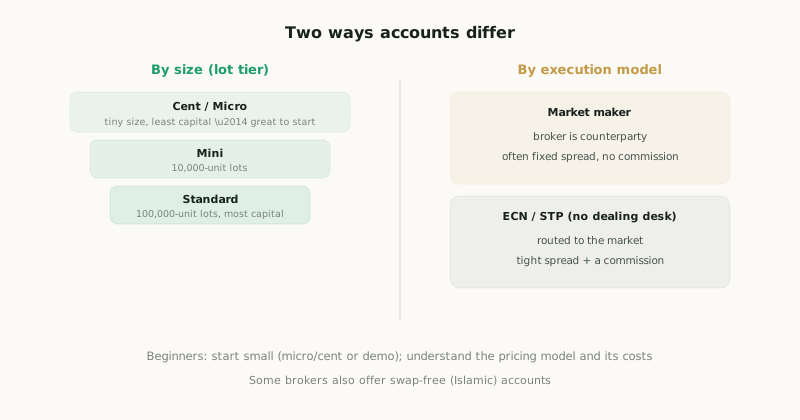
By size: the lot tiers
The first dimension is trade size — how large a position the account is designed for, measured by the lot sizes it lets you trade (lots are the unit of trade size from the pips-lots-and-leverage guide). Accounts come in tiers, from tiny to large. A standard account trades standard lots (100,000 units of the base currency), the largest common size, requiring the most capital and putting the most money per pip at stake — suited to well-funded or experienced traders. A mini account trades mini lots (10,000 units), a tenth of the size, requiring less capital. A micro account trades micro lots (1,000 units), smaller still — popular with beginners and those with modest capital, since each pip is worth very little and risk per trade can be kept tiny. Some brokers offer a cent account, where balances and trades are denominated in cents (effectively even smaller sizes), designed for testing strategies with real money at minimal stakes.
The practical significance of the tiers is about capital and risk. Smaller-lot accounts (micro, cent) let you trade with less money and take much smaller positions, so the amount risked per trade can be very small — ideal for beginners learning with limited capital who want real experience without large exposure. Larger-lot accounts (standard) suit bigger balances and larger position sizes. Crucially, the account tier doesn't change how you trade — the same strategies and principles apply — only the scale; and proper position sizing (risking a small percentage per trade) is what actually controls your risk, with the account tier simply determining the granularity of sizes available. A beginner with a small account is well served by a micro or cent account, which allows the small position sizes that prudent risk management on limited capital requires. As your capital grows, you can move to larger tiers, but there's no rush — trading small while learning is exactly right.
By execution: how orders are priced and filled
The second, and often more consequential, dimension is the execution and pricing model — how the broker handles your orders and how it charges you. There are two broad models. A market-maker (or "dealing desk") broker acts as the counterparty to your trades: it effectively takes the other side, sets its own prices, and typically offers fixed spreads with no separate commission (its compensation is built into the spread). An ECN/STP broker (Electronic Communication Network / Straight Through Processing, often called "no dealing desk") instead routes your orders to the wider market — to liquidity providers and other participants — typically offering tighter, variable spreads (sometimes very low "raw" spreads) plus a separate commission per trade. The table summarises the contrast.
Market maker vs ECN/STP
| Aspect | Market maker (dealing desk) | ECN / STP (no dealing desk) |
|---|---|---|
| Who's the counterparty | The broker itself | The wider market |
| Spreads | Often fixed, wider | Variable, tighter ("raw") |
| Commission | Usually none (cost in spread) | Separate per-trade commission |
| Pricing | Set by the broker | From market liquidity providers |
The difference matters for two reasons. First, cost structure: a market-maker account bundles the cost into a (usually wider) spread, while an ECN account splits it into a tight spread plus a commission — the total cost is what counts (the cost-of-trading guide explains how to compare them), and the better deal depends on the specifics. Tight-spread-plus-commission (ECN) is often favoured by active traders and scalpers for whom small spreads matter; fixed-spread (market maker) can be simpler. Second, there's a potential conflict of interest with market makers: because the broker is the counterparty, it may (in principle) profit when you lose — which is why many traders prefer the no-dealing-desk model, where orders go to the market and the broker's interest is more aligned (it earns from commissions/spread regardless of your outcome). In practice, well-regulated market makers operate fairly, and regulation matters more than model for trustworthiness (the choosing-a-broker guide covers this), but the distinction is worth understanding. Beyond these two main models, you may encounter swap-free (Islamic) accounts, which don't charge or pay the overnight swap (for traders whose religious principles prohibit interest), and of course demo accounts for practice (covered in demo-vs-live). The account's base currency (the currency your balance is held in) is another small choice to make.
How beginners should choose
For a beginner, choosing an account type comes down to a few sensible principles. Start with a demo account to learn the platform and practise without risking money (as the demo-vs-live guide advises), before going live. When you do go live, start small — a micro or cent account is ideal, letting you trade real conditions (with real emotions, which demo can't replicate) while keeping position sizes tiny and capital at risk minimal. This lets you build experience and confidence without the larger exposure of standard accounts. Understand the execution model and its costs — know whether your account is market-maker (cost in the spread) or ECN/STP (tight spread plus commission), and what you're actually paying (the cost-of-trading guide helps you work this out), since costs affect your results. Choose an account suited to your capital and trading style — small capital points to micro/cent tiers; an active, cost-sensitive style points toward tight-spread ECN accounts; and your needs (e.g. swap-free) may dictate specific account features.
Above all, don't over-think it at the start: the account type matters far less than learning to trade well, managing risk, and choosing a reputable, well-regulated broker (the single most important decision, covered in choosing-a-broker). A micro account at a trustworthy, regulated broker is a perfectly good starting point for almost any beginner. As you gain experience and capital, you can reassess — moving to larger tiers, or to an ECN account if tight spreads suit your style — but the early priority is simply to start small, with a good broker, and learn. The honest, beginner-friendly takeaway: forex accounts differ by size (cent/micro/mini/standard — governing the scale you trade and capital needed) and by execution model (market maker, with fixed spreads and no commission, versus ECN/STP, with tight spreads plus commission and direct market access), with extras like swap-free accounts. Beginners should start with a demo, then a small micro or cent account, understand their execution model and costs, and — most importantly — prioritise a reputable regulated broker over the finer points of account type. Start small, choose wisely, and let the account grow with your experience.
Other account features to check
Beyond size and execution model, a few other account features are worth checking when you open an account, as they affect your experience and costs. The minimum deposit varies widely — some accounts open with very little, others require more — so pick one matching the capital you intend to start with (and never deposit more than you can afford to lose). The base currency of the account (the currency your balance is held in) is worth setting sensibly to avoid unnecessary conversion costs — ideally your own currency or a major one you'll fund in. The leverage offered differs by account and jurisdiction; remember (from the overleverage discussion) that the leverage available is a maximum to use sparingly, not a target — a high figure isn't a reason to use it.
Other features to look for: negative balance protection (which ensures you can't lose more than your deposit — a valuable safeguard, required by regulators in some regions); the trading platform(s) the account supports (the software you'll actually use — make sure it's one you're comfortable with); the range of instruments available (which pairs, and whether other markets are offered, if you want them); and the practicalities of deposits and withdrawals (methods, speed and any fees). And, of course, demo and swap-free options as discussed. None of these should override the fundamentals — a reputable, regulated broker and an account suited to your capital and style — but checking them avoids unpleasant surprises. The sensible approach is to read the account specifications before opening, confirm the features suit you, and start with a small, well-matched account at a trustworthy broker. With the size, execution model and these extra features understood, the once-bewildering account menu becomes a straightforward set of sensible choices.
Forex accounts differ two ways. By size: cent and micro (tiny lots, least capital — ideal for beginners), mini (10,000-unit lots), standard (100,000-unit lots) — governing scale, not how you trade; position sizing controls actual risk. By execution model: market maker / dealing desk (broker is counterparty, often fixed spreads, no separate commission, possible conflict of interest) versus ECN/STP / no dealing desk (routed to the market, tight variable spreads plus a commission). Also check: minimum deposit, base currency, leverage offered (a max to use sparingly), negative balance protection, platform, available instruments, deposit/withdrawal terms, and swap-free/demo options. Beginners: start with a demo, then a small micro/cent account; understand your execution model and costs; and above all prioritise a reputable, regulated broker over the finer account details. Start small and let the account grow with your experience.