Trading isn't free, and beginners routinely underestimate what it costs. Between the spread, commissions and overnight swaps, every trade carries a price tag — and those costs add up fast enough to turn a winning strategy into a losing one if you ignore them. Understanding the true cost of trading is essential, because your trading edge has to overcome your costs to leave a profit, and costs shape which strategies are even viable. This guide explains the three main costs of trading forex — spread, commission and swap — how each is charged, the smaller account fees to watch for, and why costs matter so much.
It builds directly on the bid/ask spread from reading a quote, connects to the pricing models in account types, and is especially important for cost-sensitive styles like scalping.
Key takeaways
Q: What are the main costs of trading forex?
A: The three main costs are the spread (the gap between the buy and sell price, paid on every trade), commission (a separate per-trade fee on some account types), and swap (an overnight financing charge or credit on positions held past the daily rollover). There can also be account fees like withdrawal or inactivity charges.
Q: What is a swap or overnight financing charge?
A: A swap (or rollover) is a small charge or credit applied to a position held overnight, based on the interest-rate difference between the two currencies in the pair (plus a broker markup). It matters for trades held for days or weeks, but not for positions opened and closed within the same day.
Q: Why do trading costs matter so much?
A: Because they add up and eat into returns. Frequent traders pay the spread (and commission) many times over, while long-held positions accumulate swaps — and these costs must be overcome by your trading edge. A strategy that's profitable before costs can be unprofitable after them, so costs shape what strategies are viable.
The three main costs
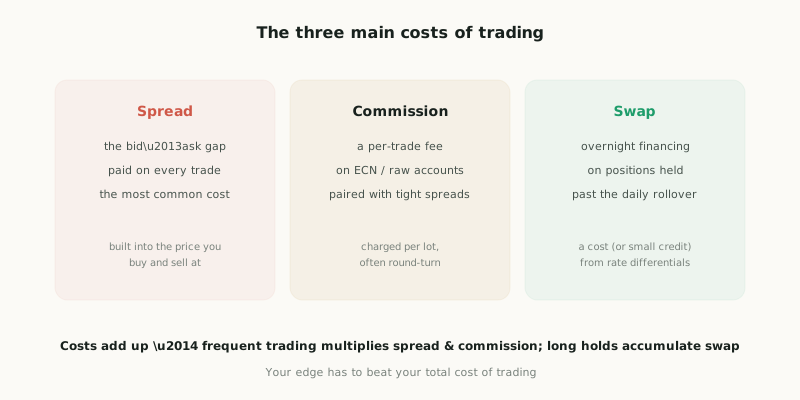
Forex trading has three principal costs, summarised below, plus some smaller account-level fees.
The costs of trading
The spread is the most common and unavoidable cost: it's the difference between the bid (sell) and ask (buy) prices of a pair. Because you buy at the higher ask and sell at the lower bid, you effectively pay the spread on every trade — the moment you open a position, you're down by the spread, and the price must move in your favour by at least the spread for you to break even. The spread is how most brokers (and all "spread-only" market-maker accounts) charge you, with the cost built into the price. Spreads are tighter (cheaper) on liquid major pairs and in active sessions, and wider (more expensive) on exotic pairs, in quiet periods, and around news. The spread is the cost you pay most often, so it's the one to understand first.
Commission is a separate per-trade fee charged on some account types — typically ECN or "raw-spread" accounts (from the account-types guide) — in exchange for much tighter spreads. Instead of building the cost into a wider spread, these accounts give you a very tight spread plus a commission (usually charged per lot traded, often "round-turn" covering both opening and closing). So with a commission account you pay tight spread + commission, versus a wider spread alone on a market-maker account — and the total cost is what matters when comparing them (sometimes the tight-spread-plus-commission combination is cheaper, sometimes not, depending on the specifics). Swap (or rollover) is the overnight financing cost: if you hold a position open past the daily rollover time, you pay (or occasionally receive) a swap based on the interest-rate difference between the two currencies in the pair, plus a broker markup. Holding a higher-interest currency against a lower-interest one can earn a small credit; the reverse incurs a charge (this is the mechanism behind the carry trade). Swap matters for positions held for days or weeks (swing and position trading), where it accumulates, but is irrelevant to trades opened and closed within the same day (no overnight hold, no swap). Finally, watch for smaller account fees — deposit/withdrawal charges, inactivity fees, currency-conversion costs — which vary by broker and, while minor, are worth knowing.
Why costs add up — and must be beaten
The reason costs deserve real attention is that they add up, and your edge has to overcome them. Each individual cost may seem small — a spread of a fraction of a pip, a modest commission, a small overnight swap — but they accumulate, and how much they matter depends heavily on your trading style. For frequent traders — scalpers and day traders who take many trades — the spread (and commission) is paid over and over, many times a day, so costs accumulate rapidly and can become a major drag; a scalper aiming for small profits per trade is especially cost-sensitive, since the cost is a large fraction of each small target (which is exactly why low costs are critical for scalping, and why high-frequency strategies need tight spreads to be viable). For longer-term traders holding positions for days or weeks, the spread is paid only once per trade (less significant), but swaps accumulate over the holding period and become the cost to watch.
The fundamental point, which connects to expectancy, is that your trading edge must beat your total cost of trading to leave a profit. A strategy that looks profitable before costs can be unprofitable after them — the costs are subtracted from every trade's result, so a small edge can be entirely consumed by spreads and commissions, especially with frequent trading. This has real implications: it means costs must be factored into your expectations and strategy from the start (a backtest or plan that ignores costs is misleading); it means cost-sensitive styles (scalping, high-frequency) demand low-cost accounts and tight spreads to survive; and it means even longer-term traders should account for swaps on held positions. Underestimating costs is a classic beginner error that quietly erodes results — the trader makes "winning" trades that, after spread and commission, barely break even or lose. The honest, practical takeaway: trading has three main costs — the spread (paid every trade, the most common), commission (a per-trade fee on tight-spread accounts), and swap (overnight financing on held positions) — plus minor account fees. These add up, especially for frequent traders (multiplying spread and commission) and long holds (accumulating swap), and your edge must overcome them to profit. Understand your total cost of trading, factor it into your expectations and strategy, choose accounts and pairs with costs suited to your style, and never assume trading is cheap. Respecting the cost of trading — rather than ignoring it — is part of trading realistically and profitably.
Worked examples and minimising costs
Two simple examples show how costs accumulate differently by style. Consider a day trader who takes, say, ten trades a day on a major pair. They pay the spread (and, on an ECN account, a commission) on every one of those trades — ten times a day, perhaps fifty times a week, hundreds of times a month. Even a small per-trade cost, multiplied by that frequency, becomes a substantial monthly total that their trading must overcome before showing any profit. Swap is largely irrelevant to them (they don't hold overnight), but the repeated spread-and-commission is their dominant cost — which is why active traders care so much about tight spreads and low commissions, and why a cost-heavy account can quietly sink a frequent-trading strategy.
Now consider a position trader who holds a single trade for several weeks. They pay the spread just once (on entry, effectively), so per-trade transaction cost is trivial for them — but they pay the swap every night the position is held, and over weeks those nightly charges add up to a meaningful cost (or, if they're on the favourable side of the interest differential, a small accumulating credit). For them, swap is the cost to watch, not the spread. The lesson: your dominant cost depends on your style — frequent traders are dominated by spread/commission, long-term holders by swap. A useful habit is to roughly estimate your monthly cost: multiply your typical per-trade cost by how many trades you take, and add expected swaps on held positions — a sobering number that grounds your profit expectations.
To minimise costs: trade liquid major pairs (tighter spreads) in active sessions (avoiding the wide spreads of quiet hours); choose an account whose pricing model suits your style (tight-spread ECN for frequent trading, where total cost may be lower; simple fixed-spread for occasional trading); avoid unnecessary overtrading (every extra trade is another cost — a discipline the psychology section also urges for other reasons); be mindful of swaps if holding positions for long periods; and watch for account fees. Above all, factor costs into your strategy and expectations from the start — a realistic plan accounts for them, so you're never surprised when "winning" trades net less than the raw price move suggested. Costs are a permanent feature of trading; minimising them where sensible, and always accounting for them, is simply part of trading well.
Trading forex has three main costs: the spread (the bid–ask gap, paid on every trade — the most common, built into the price), commission (a separate per-trade fee on ECN/raw-spread accounts, paired with tight spreads), and swap (overnight financing on positions held past the daily rollover — matters for multi-day holds, not intraday). Plus minor account fees. Your dominant cost depends on style: frequent traders (scalpers/day traders) are dominated by repeated spread/commission; long-term holders by accumulating swap. Estimate your monthly cost (per-trade cost × trades, plus swaps) to ground expectations. Crucially, your edge must beat your total cost — a strategy profitable before costs can lose after them. Minimise costs (liquid pairs, active sessions, the right account model, no overtrading), and always factor them into your strategy. Never assume trading is cheap.