Scalping is the fastest game in trading: dozens of trades in a day, each targeting just a handful of pips, each held for mere seconds or minutes. The idea is to accumulate many tiny profits into a meaningful total — but because each profit is so small, the costs of trading become everything, and the demands on the trader are brutal. Scalping sits at the very fast end of the trading-styles spectrum, and it is emphatically a specialist's pursuit, not a beginner's. This guide explains what scalping is, why costs and execution dominate it, the intense demands it makes, and where it fits among the trading styles. We also use it to orient the whole styles cluster with an at-a-glance comparison.
It is the fastest of the styles introduced in trading styles by timeframe, a step beyond even day trading.
Key takeaways
Q: What is scalping in forex?
A: Scalping is an ultra-short-term trading style that aims to profit from very small price moves, taking many trades a day and holding each for seconds to minutes. Each trade targets just a few pips, so scalpers rely on high trade frequency and tight costs to accumulate profit.
Q: Why are costs so important in scalping?
A: Because scalpers target only a few pips per trade, the spread and any commission make up a large fraction of each trade's potential profit. Over many trades these costs compound heavily, so low spreads, fast execution and minimal slippage are critical — high costs can erase a scalper's edge entirely.
Q: Is scalping good for beginners?
A: No. Scalping is one of the most demanding styles, requiring fast decisions, intense focus, excellent execution and strict cost control under pressure. The high frequency amplifies the impact of mistakes and emotions. Beginners are far better served by slower styles like swing trading.
Scalping at a glance
What scalping is
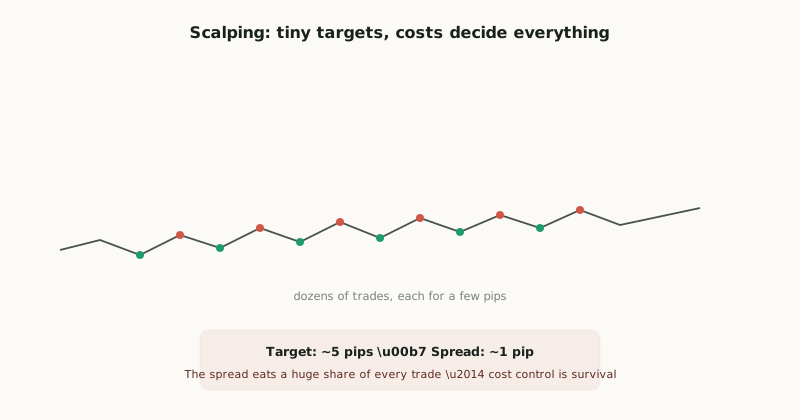
Scalping is an ultra-short-term trading style aimed at profiting from very small price movements. A scalper takes a high volume of trades — often dozens in a single session — holding each for a very brief period (seconds to a few minutes) and aiming to capture only a small number of pips per trade. No single trade is meant to be significant; the profit comes from accumulating many tiny gains across a large number of trades. This is the defining logic of scalping: many small wins adding up, rather than fewer larger ones.
This makes scalping fundamentally different in character from the slower styles. Where a swing or position trader holds for days or months and cares about the larger trend, the scalper operates on the smallest timeframes (tick, one-minute charts), exploiting tiny, fleeting moves and momentary inefficiencies, in and out before the broader market context even matters. The scalper's world is one of rapid-fire execution, split-second decisions, and a relentless stream of small trades. It demands a completely different skill set and temperament from the patient, considered approach of longer-term trading — and, as we will see, its reliance on tiny per-trade profits makes it uniquely sensitive to costs and uniquely demanding to execute.
The five trading styles compared
| Style | Holding period | Frequency | Screen time |
|---|---|---|---|
| Scalping | Seconds–minutes | Very high | Constant |
| Day trading | Intraday | Several/day | High |
| Swing trading | Days–weeks | A few/week | Low–moderate |
| Position trading | Weeks–months+ | Very low | Minimal |
| News trading | Event-driven | Event-dependent | Around releases |
Why costs decide everything
The single most important thing to understand about scalping is that costs dominate it. Because a scalper targets only a few pips of profit per trade, the spread (and any commission) represents a large fraction of each trade's potential gain. If you are aiming for five pips and the spread is one pip, you are starting each trade twenty percent in the hole — a cost burden that a swing trader aiming for hundreds of pips would barely notice. Across the dozens of trades a scalper makes, these costs compound enormously, and they can easily consume — or exceed — the entire profit the scalper's edge generates.
This makes cost control the heart of scalping survival. Scalpers must trade instruments with the tightest possible spreads (which is why the most liquid pairs like EUR/USD, with their minimal spreads, are favoured — the liquidity lesson from the pairs guides matters acutely here), keep commissions low, and minimise slippage (the difference between expected and actual fill prices), since on tiny targets even small slippage is devastating. Execution must be excellent: fast, reliable order fills, because in a style measured in seconds and pips, slow or poor execution destroys the edge. The brutal arithmetic of scalping is that the trader must overcome the cost hurdle on every single one of their many trades, so anything that adds cost — wide spreads, commissions, slippage, poor execution — attacks the strategy at its foundation. This is why scalpers obsess over costs and execution to a degree that traders in slower styles never need to: for the scalper, cost control is not a detail but the difference between profit and loss.
On a 5-pip target, a 1-pip spread is 20% of your goal gone before the trade moves — and you pay it on every one of dozens of daily trades. Many would-be scalpers have a genuine edge on paper that costs and slippage entirely erase in reality. If you can't trade tight spreads with fast, clean execution, scalping's maths simply doesn't work.
The intense demands
Beyond costs, scalping makes intense demands on the trader that few can sustain. It requires near-constant screen time and focus — the scalper must watch the market continuously during their session, ready to act in an instant, with no opportunity to step away. It demands fast, decisive action — decisions and executions in seconds, with no time for deliberation — and the mental sharpness to make many such decisions in quick succession without degrading. The pace is relentless and mentally exhausting, and the high frequency means a scalper accumulates the fatigue the overtrading guide warns about at an accelerated rate.
Scalping is also psychologically punishing. The rapid-fire nature amplifies the impact of emotions and mistakes: there is no time to recover composure between trades, a single lapse in discipline can spiral quickly across many rapid trades, and the constant pressure tests emotional control severely (the tilt risk from the psychology section is acute when decisions come every few seconds). The strictest discipline is essential — cutting tiny losses instantly, following rules mechanically, never letting a small loss become large — yet maintaining that discipline under such relentless pressure is extraordinarily hard. For all these reasons, scalping is one of the most demanding styles, suited only to traders with the right temperament: fast, focused, disciplined, able to perform under pressure, and equipped with the low-cost, fast-execution conditions the style requires. It is decidedly not a style for beginners, who lack the developed discipline, execution skill and emotional control that scalping ruthlessly demands.
Where scalping fits
Scalping occupies the extreme fast end of the trading-styles spectrum, and deciding whether it fits you comes down to honest self-assessment against its demands. It can suit traders who thrive on fast action, can maintain intense focus for sustained periods, have excellent discipline and emotional control, enjoy the rapid pace, and — critically — have access to the low-cost, fast-execution trading conditions the style requires. For the right person with the right setup, scalping is a viable (if demanding) approach that turns many tiny edges into accumulated profit.
But it is the wrong choice for most traders, especially beginners and those without the temperament or conditions for it. The combination of brutal cost sensitivity, relentless screen-time demands, the need for split-second execution, and the acute psychological pressure makes scalping a narrow specialism rather than a general approach. Anyone drawn to it by the appeal of constant action or frequent trades should weigh that appeal against the overtrading and psychology lessons elsewhere on this site — the desire to always be trading is often a warning sign, not a strength. The honest guidance, consistent with the trading-styles-by-timeframe overview, is that most traders are far better served by slower styles (day, swing or position trading) that demand less in cost control, execution speed and psychological endurance, and that allow the considered, patient decision-making in which a durable edge is more easily built and sustained. Scalping is real and viable for the few genuinely suited to it, but it is the most demanding corner of trading, and most should approach the slower styles first — if not instead.
A reality check
It is worth being candid about scalping's track record, because the style attracts many beginners drawn by the appeal of constant action and frequent trades — and most of them fail at it. The reasons trace directly to the demands already covered. The cost hurdle defeats many: a strategy that looks profitable on paper, ignoring costs, frequently turns into a loser once realistic spreads, commissions and slippage are applied across hundreds of trades. The execution requirement defeats others: without genuinely fast, reliable fills and tight spreads (which not all retail conditions provide), the scalper's thin edge is eroded before it can compound.
And the psychological demands defeat many more: the relentless pace, the need for split-second discipline, and the impossibility of pausing to regain composure between rapid trades make scalping a punishing test of emotional control that few pass. The very appeal that draws beginners — the constant action — is, as the overtrading and psychology guides warn, often a red flag rather than a strength: the desire to always be trading tends to lead to poor decisions, and scalping institutionalises that constant activity. Beginners who lack developed discipline, proven execution and emotional control are especially likely to be ground down by costs and chopped up by their own emotions.
None of this means scalping is impossible — a minority of well-suited, well-equipped traders do scalp profitably — but it does mean the style's difficulty is routinely underestimated, and that the honest expectation for most who attempt it, especially without the right temperament and conditions, is failure. The sensible path is to be clear-eyed: assess whether you genuinely have the speed, focus, discipline and low-cost execution scalping requires before committing to it, and recognise that the slower styles offer a far more forgiving and realistic route to building a durable edge. For most traders, the considered pace of swing or day trading is not a compromise but a better fit — and a more likely path to actually making money than the brutal, cost-sensitive, psychologically gruelling world of the scalper.
Scalping is the ultra-short-term style: dozens of trades a day, each for a few pips, held seconds to minutes, accumulating tiny gains. Because per-trade targets are tiny, costs dominate — the spread is a large fraction of each trade — so tight spreads, low commissions, minimal slippage and fast execution are survival-critical. It demands near-constant focus, split-second decisions, and the strictest discipline under relentless pressure, making it one of the hardest styles, and most who attempt it (especially beginners drawn by the action) fail to costs, execution and psychology. It suits only fast, focused, disciplined traders with low-cost conditions; most are better served by slower styles.