Swing trading holds positions for days to weeks, aiming to capture the meaningful "swings" — the larger price moves that unfold within or along a trend. With far fewer trades and dramatically less screen time than the faster styles, swing trading is the approach best suited to part-time traders, and it is often the best place for newcomers to start. It strikes a balance many find ideal: slow enough to allow considered, unhurried decisions and to fit around a job or other commitments, yet active enough to engage with the markets regularly and capture real opportunities. This guide explains what swing trading is, why it suits part-timers, the overnight and weekend risk it carries, and how it fits among the trading styles.
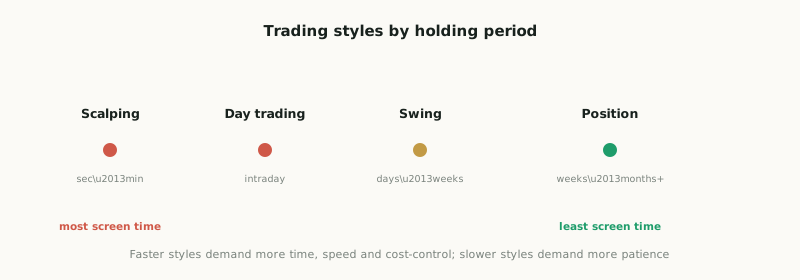
It is the considered middle-slow style on the spectrum from trading styles by timeframe, between day trading and position trading.
Key takeaways
Q: What is swing trading?
A: Swing trading is a style that holds positions for days to weeks, aiming to capture 'swings' — the meaningful price moves that occur within or along a trend. It involves far fewer trades than day trading or scalping and requires much less screen time, making it popular with part-time traders.
Q: Why does swing trading suit part-time traders?
A: Because trades are held for days to weeks and require only periodic monitoring rather than constant attention, swing trading demands far less screen time than faster styles. A part-time trader can analyse and place trades around a job, checking in periodically, which fits the slower pace well.
Q: What are the risks of swing trading?
A: Swing traders hold positions overnight and over weekends, so they are exposed to overnight and weekend risk — gaps and adverse moves that occur while markets are closed or thin. This is the trade-off for capturing larger multi-day moves, and it must be managed with appropriate position sizing and stops.
Swing trading at a glance
What swing trading is
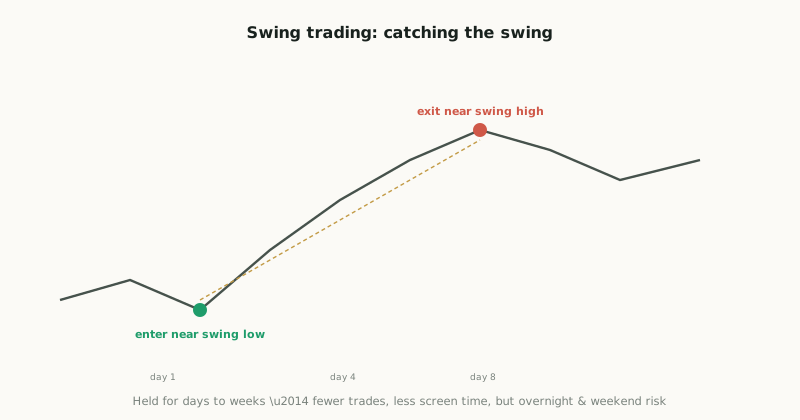
Swing trading aims to capture swings — the meaningful price moves of days to weeks that occur within a larger trend or between levels. A swing trader holds positions for this duration, seeking to enter near the start of a favourable swing (for example, near a swing low in an uptrend) and exit near its end (near a swing high), capturing a substantial portion of the move. Rather than the scalper's few pips or the day trader's intraday moves, the swing trader targets the larger, multi-day price moves, holding through the short-term noise to capture the bigger picture.
This is reflected in the timeframes and frequency. Swing traders typically work from higher timeframe charts (often four-hour and daily charts) to identify swings and trends, and they take relatively few trades — perhaps a few a week — since quality multi-day setups are less frequent than intraday ones and each is held for a while. The style aligns naturally with the trend-following and trend-trading approaches covered elsewhere, as swing traders often look to enter pullbacks within trends or trade swings in the trend's direction. Swing trading thus engages with the larger, more meaningful price structure rather than the moment-to-moment fluctuations, holding positions long enough to let real moves develop — a considered, less hurried approach to capturing market opportunity.
Why it suits part-timers
Swing trading's greatest practical appeal is that it suits part-time traders, and the reason is its modest demand on time and attention. Because positions are held for days to weeks, swing trading requires only periodic monitoring rather than the constant or active attention of the faster styles. A swing trader can do their analysis and place their trades at convenient times (such as in the evening, reviewing daily charts after the close), then check in periodically to manage open positions, without needing to watch the market continuously. This fits naturally around a full-time job, other commitments, or simply a preference not to be glued to screens.
This low screen-time requirement is a decisive advantage for the many people who want to trade but cannot — or do not wish to — dedicate the active hours that day trading or scalping demand. It makes swing trading accessible to those trading alongside a career, and it is a large part of why the style is so popular among retail traders. The slower pace brings further benefits: it allows considered, unhurried decisions (you can analyse a setup carefully without time pressure, and reflect before acting), it is less psychologically intense than the rapid-fire faster styles (fewer trades, more time between decisions, less acute emotional pressure), and it incurs lower trading costs (fewer trades mean less cumulative spread and commission). These qualities also make swing trading a sensible starting point for beginners: the slower pace allows time to think, learn and apply discipline without the pressure of the faster styles, and the lower demands suit those still building their skills — which is why this site repeatedly suggests newcomers begin with swing trading rather than the faster, more demanding approaches.
Overnight and weekend risk
The trade-off for capturing multi-day moves is that swing traders hold positions overnight and over weekends, accepting the overnight and weekend risk that day traders deliberately avoid. Holding through these closed or thin periods exposes the swing trader to gaps (price jumping between the close and the next open) and to adverse moves driven by news or events occurring while they cannot react. A position held over a weekend, in particular, is exposed to two days of potential developments, with the market reopening at whatever price the weekend's events dictate — possibly gapping well beyond a stop.
This overnight and weekend risk is inherent to swing trading and cannot be eliminated — it is the necessary price of holding long enough to capture the larger moves. It can, however, be managed, and managing it well is part of swing trading competently. Appropriate position sizing is key: sizing trades conservatively (the risk-management lessons) limits the damage a gap can do, since a gap through your stop hurts far less on a small position than a large one. Stop-losses remain essential, with the awareness that gaps can cause slippage beyond them (so they limit but do not perfectly cap gap risk). Some swing traders also take account of scheduled events and weekends in their planning — being cautious about holding through known high-impact events, or sizing down before weekends. The key understanding is that overnight and weekend risk is an accepted, managed feature of swing trading, not a flaw — the cost of accessing the multi-day moves the style targets, kept within tolerable bounds by sound position sizing and risk management. Day traders avoid this risk entirely but forgo the larger moves; swing traders accept and manage it to capture them.
Swing trading's low screen-time demand is its superpower: by holding for days to weeks and checking in periodically, it lets people trade seriously around a full-time job — and gives beginners time to think, learn and stay disciplined without the pressure of the faster styles. The price is overnight and weekend gap risk, managed (not eliminated) by conservative position sizing.
Where swing trading fits
Swing trading suits a broad range of traders, which is part of why it is so widely practised. It is ideal for part-time traders who cannot commit active hours but can monitor positions periodically; for beginners, who benefit from its slower, less pressured pace while building skills; and for anyone who prefers considered, unhurried decision-making over the intensity of the faster styles. Its balance of meaningful engagement with the markets (regular trades, real opportunities) against modest time demands (periodic monitoring, lower costs, less psychological strain) makes it a versatile, accessible and popular approach.
Its main requirement is the willingness to accept and manage overnight and weekend risk, and the patience to hold positions for days to weeks without the constant action of faster trading (which some find dull, though that very quality is a strength for disciplined trading). For those who want intraday action and to avoid overnight exposure, day trading fits better; for those wanting even longer-term, lower-frequency trading, position trading is the slower neighbour. But for the large population of traders balancing trading against other commitments — and for most beginners finding their feet — swing trading is frequently the best fit on the spectrum: slow enough to be manageable and considered, active enough to be engaging and opportunity-rich, and forgiving enough to be a sound place to learn. It is, for good reason, one of the most popular and recommended styles, and a natural default for anyone whose circumstances do not specifically point to a faster or slower approach.
How swing traders find trades
In practice, swing traders look for setups that promise a multi-day move, and several recurring approaches serve this well. The most common is the trend pullback: in an established trend (identified on the daily chart), the swing trader waits for a temporary pullback against the trend and enters as it resumes — buying a dip in an uptrend near support or a moving average, aiming to ride the next swing in the trend's direction. This aligns swing trading naturally with the trend-following approach, capturing the trend one swing at a time with favourable entries.
Swing traders also work swing highs and lows and support and resistance directly — entering near a well-defined support level with a target near resistance (or the reverse), capturing the swing between the levels. Chart patterns and candlestick signals (from the technical analysis section) help identify and time these entries on the higher timeframes, and indicators such as the RSI or stochastic can flag momentum and divergence at potential turning points. Because swing trades target larger moves, the reward-to-risk maths tends to be favourable: a multi-day swing can offer many times the risk taken, supporting the kind of positive expectancy the risk section emphasises.
The workflow that supports all this is typically a periodic chart routine rather than constant watching: many swing traders review the daily charts once a day (often after the New York close), identifying setups, planning entries, and setting orders and stops — then let the trades work over the following days, checking in periodically to manage them. This evening-review routine is exactly what makes swing trading compatible with a job: the analysis and decisions happen at a convenient fixed time, and the holding period does the rest. Combined with a clear approach (trend pullbacks, level trades) and sound risk management for the overnight exposure, this routine turns swing trading into a manageable, repeatable process that fits around real life — a large part of its enduring appeal.
Swing trading holds positions for days to weeks to capture meaningful price swings, using higher-timeframe charts and a few trades a week. Its low screen-time demand (periodic monitoring, often a daily evening chart review) makes it ideal for part-time traders and a sound start for beginners, with considered decisions, less psychological strain and lower costs. Swing traders typically trade trend pullbacks and support/resistance swings, with favourable reward-to-risk. The trade-off is overnight and weekend risk — gaps while markets are closed — accepted and managed (not eliminated) through conservative position sizing and stops. A versatile, popular, accessible style and a natural default for many.