Position trading is the slowest and most patient of the trading styles — holding positions for weeks, months, or even years to ride major trends to their full extent. With very few trades, minimal screen time, but maximal patience, it sits at the far slow end of the spectrum, closest of all the styles to long-term investing. The position trader is not interested in intraday wiggles or even multi-day swings; they aim to identify and ride the big, sustained trends driven by fundamental forces, holding through the noise for the largest moves. This guide explains what position trading is, the heavy role fundamentals play, the deep patience it demands, and how it compares to the faster styles and to investing.
It is the slowest style on the spectrum from trading styles by timeframe, and it leans heavily on fundamental analysis.
Key takeaways
Q: What is position trading?
A: Position trading is a long-term style that holds positions for weeks, months or even years to capture major trends. It involves very few trades, relies heavily on fundamental analysis of long-term drivers, and requires minimal screen time but a great deal of patience — the closest trading style to investing.
Q: How is position trading different from investing?
A: They are close cousins. Position trading shares investing's long-term horizon and fundamental focus, but it still uses defined entries, exits, stops and (often) leverage, and may trade either direction. It is more deliberate and risk-managed than passive investing, while sharing the patient, big-picture orientation.
Q: Why does position trading require patience?
A: Because positions are held for months or longer and trades are infrequent, position traders must tolerate long holding periods, ride out large interim fluctuations and drawdowns without reacting, and wait patiently for major trends to play out. Impatience or overreaction to short-term moves undermines the style.
Position trading at a glance
What position trading is
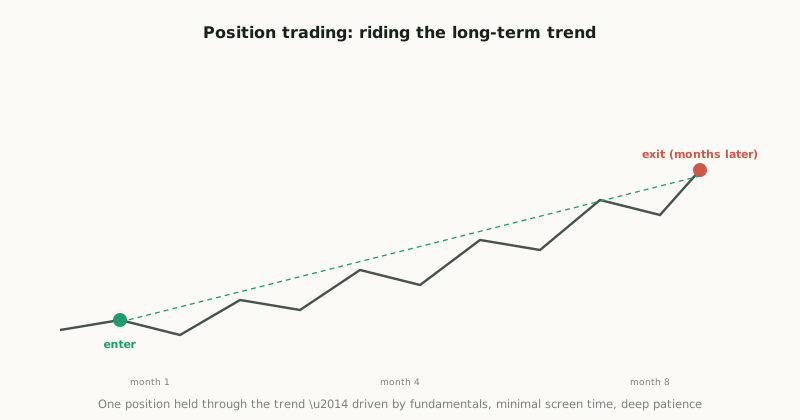
Position trading aims to capture major, long-term trends by holding positions for weeks, months or longer. The position trader identifies a significant trend — typically driven by fundamental forces such as diverging monetary policy or sustained economic shifts — and takes a position to ride it for its full extent, holding through the short- and medium-term fluctuations that would concern faster traders. They work from the highest timeframe charts (daily and weekly), take very few trades (perhaps only a handful a year), and aim for the largest moves, measured in the hundreds or thousands of pips that a major trend can deliver over its lifetime.
This makes position trading the polar opposite of scalping in almost every dimension. Where the scalper takes dozens of trades a day for a few pips each with constant attention, the position trader takes a few trades a year for enormous moves with minimal monitoring. The entire orientation is toward the big picture — the major trend and its fundamental drivers — rather than short-term price action, and the position trader deliberately ignores the intraday and even multi-day noise that dominates faster styles, focusing only on whether the major trend remains intact. It is trading on the grandest, slowest scale available, seeking to profit from the largest, most sustained moves in the market by holding through everything but a genuine change in the long-term picture.
The role of fundamentals
Because position trading targets the major, long-term trends, it relies heavily on fundamental analysis — more so than any other style. The big, sustained trends that position traders seek to capture are driven by fundamental forces: diverging central-bank policy and interest-rate cycles, sustained economic outperformance or underperformance, structural shifts, and the other long-term drivers covered in the fundamental analysis section. To identify which major trend to ride and to judge whether it remains intact, the position trader must understand these underlying drivers, making fundamental analysis central to the style in a way it is not for short-term technical trading.
This is the natural home of the fundamental analysis the site covers: the interest-rate differentials, central-bank policy, economic cycles and structural factors that move currencies over months and years are precisely what determine the major trends a position trader rides. A position trader watches the evolution of these fundamental drivers — the trajectory of monetary policy, the relative health of economies — to form a long-term directional view, and uses technical analysis more for timing entries and exits and confirming the trend than as the primary basis for the trade. The trade thesis itself is usually fundamental: a view that, say, diverging policy will drive one currency stronger than another over the coming months. This heavy reliance on fundamentals distinguishes position trading sharply from the faster, more technically-driven styles, and it means position trading rewards a solid grasp of the macro drivers that the fundamental analysis cluster explains — understanding the forces that create and sustain the major trends is the core skill of the position trader.
The patience required
Position trading's defining personal demand is patience — a great deal of it, of several kinds. First, the patience to hold for long periods: weeks, months, sometimes years, maintaining a position through all the interim ups and downs without succumbing to the urge to exit prematurely. Second, the patience to ride out large interim fluctuations and drawdowns: a major trend does not move in a straight line, and a position trader must tolerate substantial pullbacks and unrealised drawdowns along the way, holding firm as long as the long-term thesis remains intact, without panicking at moves that would alarm a shorter-term trader. Third, the patience to wait for the right major trends: with only a few trades a year, the position trader must wait, often for extended periods, for high-quality long-term opportunities, doing nothing in between.
This makes position trading, despite its minimal screen time, surprisingly psychologically demanding in its own way — not through the rapid-fire pressure of scalping, but through the sustained patience and emotional fortitude to hold large, long-term positions through significant adverse moves without overreacting. The patience and discipline themes from the psychology section apply acutely: the position trader must let winners run on the grandest scale (the ultimate expression of riding a trend), tolerate drawdowns calmly, and resist the constant temptation to react to short-term moves that are irrelevant to the long-term thesis. Ironically, the style that requires the least time requires some of the most patience — the discipline to hold, wait and endure is the position trader's central challenge, far more than any moment-to-moment skill. Conservative position sizing is also essential, since holding through large fluctuations requires positions small enough that the interim drawdowns are survivable and bearable, both financially and emotionally.
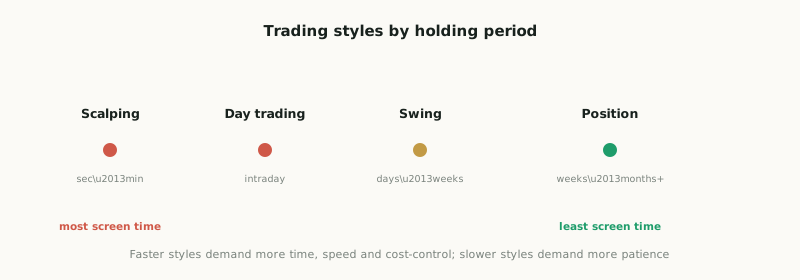
Position trading flips the usual trade-off: it needs the least screen time of any style but the most patience. The challenge isn't moment-to-moment skill — it's the fortitude to hold a position through months of interim drawdowns without flinching, as long as the fundamental thesis holds. It's "let winners run" on the grandest possible scale.
Where position trading fits (and investing)
Position trading suits patient, big-picture, fundamentally-minded traders who want minimal screen time and are content to trade infrequently, holding for the long term. It is ideal for those who cannot or do not wish to monitor markets actively (it requires the least time of any style), who have the temperament to hold through large fluctuations without reacting, and who are interested in the macro, fundamental drivers of long-term currency moves. For someone with patience, a grasp of fundamentals, and no desire for frequent action, position trading is a natural and viable fit.
Position trading is also the style closest to investing, and the comparison is illuminating. Like investing, it has a long-term horizon, relies on fundamental analysis, and seeks to ride major moves with patience. The differences are that position trading still employs defined entries, exits and stop-losses, often uses leverage, and may trade in either direction (profiting from falling as well as rising currencies) — making it more deliberate, tactical and risk-managed than passive buy-and-hold investing, while sharing the patient, big-picture orientation. This kinship means position trading appeals to those with an investor's temperament who want a more active, risk-managed, both-directional approach to long-term trends. As with every style, the right choice depends on your time, temperament and interests (the trading-styles-by-timeframe guide's central message): position trading fits the patient, time-constrained, fundamentally-oriented trader, just as scalping fits the fast and focused, and swing trading the part-timer. Across the full spectrum — from scalping's seconds to position trading's months — there is a style to match almost any trader's circumstances, and position trading anchors the patient, long-term, fundamentals-driven end.
Managing a position trade
The mechanics of managing a long-term position trade differ markedly from shorter-term trading, in ways that follow from the long horizon. Stops are wide: a position held for months must be given room for the large interim fluctuations a major trend contains, so the stop-loss sits far from entry — a tight stop would be hit by ordinary noise and exit the trade prematurely. Because the stop is wide, position size must be small to keep the risk per trade within sensible limits (the position-sizing relationship: wider stop means smaller size for the same risk). This combination — wide stops, small size — is essential and is what makes holding through large drawdowns survivable.
Management is largely about ignoring noise and monitoring the thesis. The position trader does not react to daily or even weekly fluctuations; instead, they periodically review whether the fundamental thesis behind the trade remains intact — is the policy divergence or economic trend still in force? — and hold as long as it is, exiting only when the long-term picture genuinely changes or the wide stop is hit. This periodic, thesis-focused review (perhaps weekly) is all the monitoring required, reinforcing the style's minimal screen-time demand while keeping the trader anchored to what actually matters for a long-term trade.
One distinctive consideration over long holds is the swap/rollover cost or credit. Holding a leveraged position for months accrues overnight swap charges, which can add up significantly — working against you if you hold a negative-carry position, or in your favour if positive (the carry-trade dynamic). A position trader should factor swap into the trade, since over months it becomes material: a position aligned with the interest-rate differential (positive carry) earns a steady credit that adds to the trend profit, while one against it (negative carry) bleeds a cost over time. This long-horizon sensitivity to carry is unique to position trading among the styles — the faster styles barely touch swap, while for the position trader it is a real factor in the trade's economics, linking the style once more to the fundamental interest-rate landscape it already depends on.
Position trading is the longest-term style — holding for weeks, months or years to ride major trends, using daily/weekly charts and very few trades, relying heavily on fundamental analysis. Its central demand is patience: holding through long periods and large interim drawdowns without overreacting. Manage it with wide stops and correspondingly small size, ignoring noise while periodically checking the fundamental thesis, and factoring in swap costs/credits over the long hold (carry matters). It's the style closest to investing but with defined entries/exits, stops, leverage and both directions. Fits patient, big-picture, time-constrained traders.