Major economic releases — an interest-rate decision, an inflation print, an employment report — can move currency markets violently in a matter of seconds. News trading is the approach that tries to profit from this event-driven volatility. The appeal is obvious: huge moves, concentrated into moments, offering the chance of fast, large gains. But the catch is equally real: the very forces that create the opportunity — explosive volatility, widening spreads, violent whipsaws and slippage — also make news trading one of the riskiest approaches in all of trading. This guide explains what news trading is, the two main approaches (anticipating versus reacting), and — with appropriate emphasis — the serious risks that make it a style to approach with great caution, if at all.
It draws directly on the economic indicators and fundamental drivers covered elsewhere, and leans heavily on the risk management the volatility demands.
Key takeaways
Q: What is news trading?
A: News trading is an approach that seeks to profit from the sharp price moves around scheduled economic releases and major events — such as interest-rate decisions, inflation data and employment reports. It trades the volatility these events create, either by positioning beforehand or reacting to the move after.
Q: What are the two main approaches to news trading?
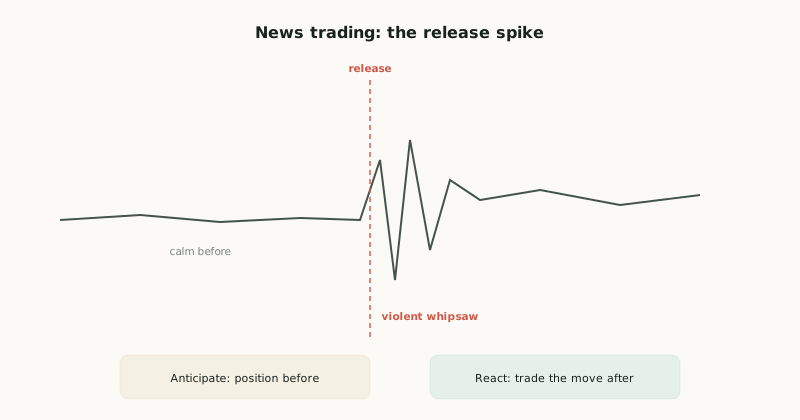
A: The first is to anticipate — taking a position before the release based on a view of the outcome, which is high-risk because the reaction is unpredictable. The second is to react — waiting for the release and trading the resulting move or breakout once direction is clearer, avoiding the binary pre-release gamble.
Q: Why is news trading so risky?
A: Around releases, volatility spikes, spreads widen sharply, and prices can whipsaw violently and gap, causing severe slippage that can blow through stops. The reaction to news is often unpredictable even when the data is known. These conditions make news trading one of the riskiest approaches, unsuitable for beginners.
News trading at a glance
What news trading is
News trading seeks to profit from the sharp price movements that occur around scheduled economic releases and major events. The forex market reacts strongly to the high-impact data and decisions covered in the fundamental analysis section — central-bank interest-rate decisions, inflation reports, employment data (like the US non-farm payrolls), GDP, and other major releases — which can trigger large, rapid moves as the market digests new information and repositions. News traders aim to capture these event-driven moves, focusing their activity around the scheduled times when such releases hit.
This makes the economic calendar central to news trading: practitioners track exactly when high-impact releases are due, along with the expectations (the consensus forecast) for each, since the market's reaction depends heavily on the data relative to expectations, not the absolute number. A release that matches expectations may cause little movement, while a large surprise (data far from forecast) can cause a violent move — so news traders watch both the schedule and the expectations closely. News trading is less a continuous style than an event-focused activity: rather than trading throughout a session, the news trader concentrates on the specific moments around scheduled high-impact events, where the volatility — and the opportunity, and the danger — is concentrated. It connects fundamental analysis (understanding what the data means and how it should affect a currency) with the practical challenge of trading the chaotic moments when that data is released.
Anticipate versus react
There are two broad approaches to news trading, with very different risk profiles. The first is to anticipate — taking a position before the release, based on a view of what the outcome will be or how the market will react. This is essentially a bet on the event, and it is high-risk: even if you correctly predict the data, the market's reaction is notoriously unpredictable (markets can move opposite to what the data would suggest, or barely react to a big surprise, depending on positioning and expectations), and you are exposed to the full violence of the move from a pre-committed position. Anticipating turns the release into a binary gamble, with the added danger that you cannot know how the market will interpret the news. It is the riskier of the two approaches and generally inadvisable.
The second approach is to react — waiting for the release, letting the initial move happen, and then trading the resulting direction or breakout once it becomes clearer. Rather than gambling on the outcome in advance, the reactive trader lets the market reveal its response and then trades that response (for example, trading a breakout in the direction the market moves after digesting the news). This avoids the binary pre-release gamble and trades the actual reaction rather than a prediction of it, which is generally considered the more sensible approach. However, reacting is still far from safe: the post-release environment is chaotic — violent whipsaws, false moves that reverse, widened spreads and slippage — so even reacting to the move carries serious risk, as the initial direction can reverse sharply and the execution conditions are poor. Neither approach is safe; reacting is merely less reckless than anticipating. Both demand the strictest risk management, and both expose the trader to the genuinely hazardous conditions that surround major releases.
Around major releases, spreads can blow out, prices whipsaw violently, and stops can slip badly or gap straight through — you may not get filled anywhere near your intended price. The reaction is often unpredictable even when the data is known. News trading is one of the riskiest approaches in forex: it is not for beginners, demands the strictest risk management, and many experienced traders deliberately stay out of the market around big releases rather than trade them.
The serious risks
News trading's risks deserve direct emphasis, because they are severe and specific. Around major releases, volatility spikes dramatically, producing the large, fast moves that are the opportunity — but also the danger. Spreads widen sharply as liquidity providers pull back amid the uncertainty, so trading costs balloon at exactly the moment of action. Prices whipsaw violently — spiking one way then reversing hard — so an initial move can reverse and stop out a trade that briefly looked right. And critically, slippage becomes severe: in the fast, thin, chaotic post-release market, orders (including stop-losses) may fill far from their intended prices, so stops can slip well beyond their levels or gap straight through, causing losses much larger than planned. The risk-control tools that work in normal conditions are compromised precisely when they are most needed.
Compounding all this is the unpredictability of the reaction: as noted, the market's response to news is genuinely hard to predict, often defying what the data would logically suggest, because it depends on prior expectations, positioning and interpretation. So even a trader who correctly forecasts the data can be wrong about the market's reaction. The combination — spiking volatility, ballooning spreads, violent whipsaws, severe slippage that undermines stops, and unpredictable reactions — makes the moments around major releases some of the most hazardous conditions a trader can face. This is why news trading is firmly an advanced, high-risk approach, emphatically not for beginners, and why it demands the strictest risk management: conservative position sizing (so the slippage and whipsaw risk is contained), clear plans, and full awareness that stops may not protect as intended. Notably, many experienced traders take the opposite lesson and deliberately avoid trading around major releases altogether — flattening positions or standing aside through the chaos — judging that the hazardous conditions are best avoided rather than traded. That this is a common stance among the experienced speaks volumes about the risks.
Where news trading fits
News trading suits only experienced, calendar-driven traders who understand the fundamental data, have the skill and discipline to operate in extremely volatile conditions, and apply rigorous risk management — and even for them, it remains a high-risk specialism rather than a core approach. For such traders, the reactive approach (trading the move after the release, with strict risk control) is the more defensible way to engage, capturing event-driven volatility while avoiding the pure pre-release gamble. It requires close attention to the economic calendar and expectations, the ability to act in chaotic conditions, and acceptance that the risk-control tools are compromised in the post-release environment.
For most traders — and certainly all beginners — news trading is not advisable, and the more prudent relationship with major releases is one of caution and often avoidance. The recurring guidance across this site applies with full force here: the immediate aftermath of high-impact news is dangerous, with wide spreads, whipsaws and slippage, so most traders are better served treating scheduled releases as risk events to be aware of and cautious around — avoiding holding positions through them unprepared, being mindful of upcoming releases when in trades — rather than as opportunities to trade. Understanding news and its market impact is valuable for all traders (it informs the fundamental analysis behind any approach), but actively trading the releases is a hazardous specialism best left to the experienced and well-prepared, approached with the strictest risk management. Indeed, recognising when not to trade — standing aside through the chaos of a major release rather than gambling in it — is often the wiser choice, and is itself a mark of trading maturity.
Using the economic calendar wisely
Even traders who never deliberately trade the news — the large majority for whom that is the right choice — should make the economic calendar a routine part of their preparation, because the releases that news traders chase are risk events for every open position. The calendar lists upcoming high-impact releases and their scheduled times, and consulting it lets any trader see when volatility is likely and plan defensively around it. This is the calendar's most valuable use for most people: not to trade the releases, but to avoid being caught out by them.
Defensive use takes a few forms. A swing or position trader holding through a major release should be aware they are exposed to its volatility and size accordingly, or consider whether to hold through it at all. A day trader will note the day's scheduled releases and may stand aside or reduce exposure around them, knowing the conditions will turn hazardous. The general principle, consistent across this site, is that the moments around high-impact news are dangerous — wide spreads, whipsaws, slippage — so the prudent default is to be aware of upcoming releases and cautious around them, rather than caught unprepared in a position when the market lurches. Checking the calendar as part of trade planning is a simple, universally valuable habit.
News trading seeks to profit from the sharp moves around scheduled economic releases (rate decisions, inflation, jobs data), centred on the economic calendar and expectations. Two approaches: anticipate (position before — a high-risk binary gamble on an unpredictable reaction) or react (trade the move after — less reckless but still dangerous). The risks are severe: spiking volatility, widening spreads, violent whipsaws, and slippage that undermines stops. It's an advanced, high-risk specialism, not for beginners, and many experienced traders prudently avoid trading around major releases. But all traders should track the economic calendar defensively — to be aware of and cautious around releases, not caught out by them.