GDP — Gross Domestic Product — is the broadest measure of an economy's health, and the intuition is straightforward: a growing economy tends to attract capital and a stronger currency, while a shrinking one tends to repel it. But the relationship is subtler than "growth up, currency up." The link runs largely through interest-rate expectations, it's relative growth (against other countries) that counts, and GDP is a lagging indicator — looking backward while markets look ahead. This guide explains GDP and economic growth as a currency driver: why strong growth tends to support a currency, the rate-expectations channel, why relative growth matters, and GDP's real limits as a predictor.
It complements the business cycle (whose phases GDP growth defines), works mainly through interest rates, and is one of the key releases covered in economic indicators.
Key takeaways
Q: How does GDP growth affect a currency?
A: Strong GDP growth tends to support a currency: it attracts foreign investment and raises expectations that the central bank will keep interest rates higher or hike them, both of which draw capital. Weak growth or recession tends to weigh on a currency, via expectations of rate cuts and reduced investment appeal.
Q: Why does relative growth matter for currencies?
A: Because exchange rates are relative — a currency's value is always against another. What matters is a country's growth compared with its peers: a country growing faster than others tends to see its currency supported (attracting capital and rate-hike expectations), while one growing more slowly tends to see its currency weigh, regardless of its absolute growth rate.
Q: Why is GDP a limited currency predictor?
A: Because GDP is a lagging indicator — released quarterly and with a delay, it reports the past rather than the future, so markets often anticipate it via leading indicators. The market reaction also depends on GDP versus expectations (the surprise), and safe-haven currencies can strengthen in a global downturn despite weak domestic growth.
How growth affects the currency
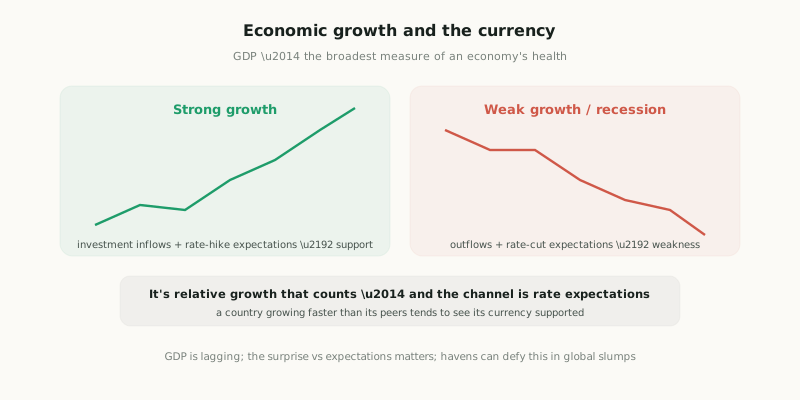
GDP measures the total value of goods and services an economy produces — the headline gauge of economic size, and, via its growth rate, of economic health. Its effect on the currency follows the broad pattern below.
Growth and the currency
Strong growth generally supports a currency for a few reinforcing reasons. A growing economy is attractive to foreign investment (capital flows toward economies that are expanding and offering opportunities), creating currency demand. It also raises expectations that the central bank will keep interest rates higher or raise them — a strong, possibly overheating economy is one the central bank may need to tighten to contain inflation, and (as the interest-rates and bond-yields guides explain) higher rate expectations attract capital and support the currency. And strong growth reflects underlying economic strength and confidence, which is currency-positive. Weak growth or recession, conversely, tends to weigh on a currency: the economy is less attractive for investment, and expectations shift toward rate cuts (the central bank loosening to stimulate a weak economy), which reduces the currency's yield appeal and weighs on it. Recessions are commonly associated with currency weakness and falling rates. (One important caveat: in a global downturn, safe-haven currencies — the dollar, yen, franc — can strengthen despite domestic weakness, because risk-off flows seek their safety, overriding the growth signal. The growth-currency link assumes other things equal, which a global risk-off episode is not.)
Relative growth and the rate channel
Two refinements make the growth-currency link precise. First, as always in currencies, it's relative growth that counts, not absolute. Because an exchange rate is always one currency against another, what matters is how a country's growth compares with its peers. A country growing faster than others tends to see its currency supported (it's the relatively attractive destination for capital, and the more likely to see rate hikes); a country growing more slowly than others tends to see its currency weigh — even if its absolute growth is positive. So a trader compares growth differentials between economies, much as with yield differentials. A currency can fall on "good" growth if another economy is growing even faster, and rise on mediocre growth if peers are doing worse — it's the relative standing that drives the relative price.
Second, the main channel is interest-rate expectations. Much of GDP's effect on the currency is transmitted through what it implies for monetary policy: strong growth raises expectations the central bank will hike or hold rates higher (currency-supportive), while weak growth raises expectations of cuts (currency-negative). In other words, growth matters largely because of what it means for rates — the market reads a strong GDP figure as "more likely rate hikes" and buys the currency, and a weak figure as "more likely cuts" and sells it. This is why GDP releases that shift the interest-rate outlook move currencies most, and why GDP is best understood as feeding into the rate-expectations machinery (the interest-rates and bond-yields material) rather than affecting the currency through some separate channel. Growth, rates and the currency are tightly linked: growth drives rate expectations, and rate expectations drive the currency.
GDP's limits as a predictor
For all its importance, GDP has real limits as a currency indicator that the honest trader must respect. First, GDP is a lagging indicator: it's reported quarterly and with a delay (the data describes a period that has already ended), so it tells you about the past, not the future. Markets, which look ahead, often anticipate the growth picture through faster, forward-looking leading indicators (surveys, PMIs, and the like — the economic-indicators guide) well before the GDP figure confirms it. By the time GDP is released, much of its message may already be "priced in," limiting its impact and predictive value. Second, the market reaction depends on GDP versus expectations — the surprise, not the raw number. A GDP figure that simply matches what the market expected may move the currency little (it's already priced); a figure that beats expectations tends to support the currency, and one that misses tends to weigh on it, because what moves markets is new information relative to the consensus (a key principle from the economic-indicators material). So a "strong" GDP number can still see a currency fall if it was weaker than the market had hoped.
Third, as noted, safe-haven dynamics can override the growth signal in global risk-off episodes. And, like all single indicators, GDP is one factor among many — it doesn't determine a currency's path on its own, but feeds into a broader fundamental picture alongside inflation, rates, the current account, risk sentiment and the rest. The honest, practical framing: GDP and economic growth are a core fundamental driver — strong growth tends to support a currency, weak growth or recession to weigh on it — but the link runs mainly through interest-rate expectations, it's relative growth that counts, and GDP's status as a lagging indicator (with the surprise versus expectations mattering, and safe-haven dynamics able to override it) means it's far from a simple or standalone predictor. Used with that nuance — watching relative growth, reading it through the rate-expectations lens, attending to the surprise rather than the raw figure, and treating it as one input among many — GDP is a valuable part of fundamental currency analysis. Treated as a mechanical "growth up, currency up" rule, it will frequently mislead.
Beyond the headline number
A more sophisticated read of growth looks past the single GDP figure. A few points help. First, GDP versus leading indicators: because GDP is lagging, markets lean heavily on faster, forward-looking gauges to anticipate growth — purchasing managers' indices (PMIs), business and consumer confidence surveys, and the like (the economic-indicators material) — which signal the direction of growth before GDP confirms it. A trader gauging growth momentum watches these leading indicators closely, often treating them as more market-moving than the backward-looking GDP release itself. By the time GDP lands, the leading indicators have usually already shifted expectations.
Second, what's inside GDP: the headline growth rate can mask the composition of growth, which matters for how durable and currency-relevant it is. Growth driven by strong consumer spending and business investment is generally read as healthier and more sustainable than growth flattered by one-off factors or unsustainable government spending — so analysts look at the components, not just the top-line number. Third, real versus nominal: "real" GDP strips out inflation to show genuine output growth, whereas "nominal" GDP includes price rises; markets focus on real growth as the measure of true economic expansion. Fourth, recession definitions: a common rule of thumb defines a recession as two consecutive quarters of contracting (negative) real GDP, though in practice recessions are judged more broadly (by employment, output and other measures). A clear slide into recession typically weighs on a currency via rate-cut expectations — though, again, safe havens can defy this in a global downturn. The practical upshot: treat the headline GDP figure as one (lagging) input, anticipate growth via leading indicators, look at the composition and the real (inflation-adjusted) rate, and read it all through the relative-growth and rate-expectations lens. Growth analysis done well is about the trajectory and quality of growth relative to peers, not a single quarterly number — which is how to extract genuine currency insight from GDP rather than being misled by the headline.
GDP is the broadest measure of economic health, and growth is a core currency driver. Strong growth tends to support a currency (attracting investment and raising rate-hike expectations); weak growth or recession tends to weigh on it (rate-cut expectations, less investment appeal) — though safe havens can strengthen in a global downturn despite weak domestic growth. Two refinements: it's relative growth (a country growing faster than its peers) that counts, and the main channel is interest-rate expectations (growth matters largely for what it implies about rates). GDP's limits: it's a lagging indicator (backward-looking, often anticipated by leading indicators and priced in), and the market reacts to GDP versus expectations (the surprise), not the raw number — so strong growth can still see a currency fall if it missed hopes. A core fundamental, read relatively and through the rate lens — one factor among many, not a mechanical rule.