Economies breathe. They expand and contract in a recurring rhythm — growing, peaking, declining, bottoming and recovering — known as the business cycle. This cycle is the grand framework that ties together nearly every fundamental force covered in this section: interest rates, inflation, growth, central bank policy and risk sentiment all move with the cycle in characteristic ways. Knowing roughly where an economy sits in its cycle therefore helps anticipate what its central bank will do and how its currency is likely to behave. And because forex is relative, the divergence between two economies' cycles is a powerful driver of currency pairs. This guide explains the cycle's phases, how currencies behave through each, and why divergent cycles matter.
It synthesises the forces covered across fundamental analysis — the interest rates and central bank policy that move with the cycle.
Key takeaways
Q: What is the business cycle?
A: The business cycle is the recurring pattern of expansion and contraction in an economy: growth (expansion), a high point (peak), decline (contraction or recession), a low point (trough), and then recovery. Economies move through these phases over time, affecting interest rates, inflation and currency values.
Q: How does the business cycle affect currencies?
A: Central banks tend to raise rates during expansions (to control inflation) and cut them during contractions (to support growth), and currencies broadly follow — often supported in expansions and pressured in contractions. Risk sentiment also shifts, favouring risk currencies in expansions and safe havens in contractions.
Q: Why do divergent business cycles drive currency pairs?
A: Because forex is relative, what matters is the difference between two economies' cycles. If one economy is expanding while the other contracts, their monetary policies diverge — one tightening, the other easing — which widens the interest rate differential and tends to drive the pair strongly in the expanding economy's favour.
The phases of the cycle
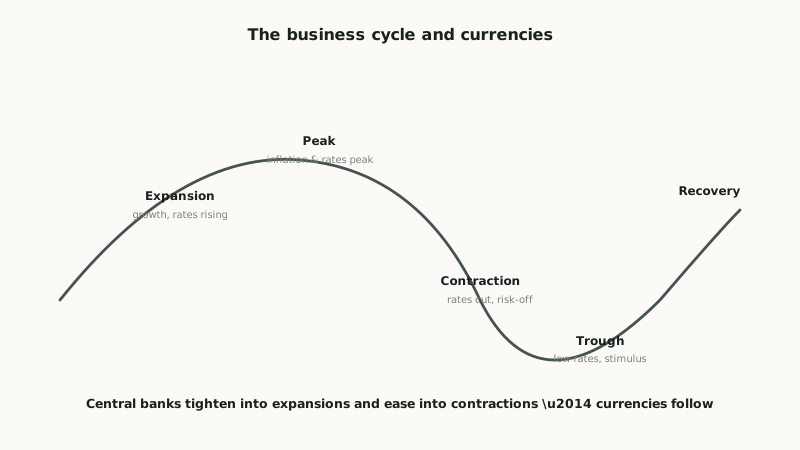
The business cycle moves through recurring phases. Expansion is the growth phase: the economy grows, employment rises, confidence builds, and spending increases. As expansion matures, it approaches the peak — the high point, where growth is strong but inflationary pressures typically build as the economy runs hot. Then comes contraction (a recession if severe and sustained): growth slows or reverses, employment falls, and confidence drops. The contraction bottoms out at the trough — the low point — after which recovery begins and the economy returns toward expansion, restarting the cycle.
These phases do not follow a fixed timetable — cycles vary greatly in length and intensity — but the sequence is recurring and recognisable, and each phase has characteristic economic conditions. Expansion brings rising growth and eventually rising inflation; the peak brings high inflation and an overheating economy; contraction brings falling growth and rising unemployment; the trough brings depressed conditions ripe for recovery. Understanding this sequence matters because the economic data covered in the indicators guide — GDP, inflation, employment — is essentially measuring where in the cycle an economy currently sits, and that position shapes what comes next, particularly the central bank's response.
Central banks through the cycle
The crucial link from the cycle to currencies runs through central bank policy, because central banks adjust monetary policy in response to where the economy is in its cycle — and rates, as the interest rates guide establishes, are the dominant currency driver. The pattern is broadly counter-cyclical, leaning against the cycle's extremes. During expansions, as growth strengthens and inflation pressures build, central banks tend to raise rates (tighten) to prevent overheating — which tends to support the currency. As the cycle turns down into contraction, central banks tend to cut rates (ease) and add stimulus to support the flagging economy — which tends to pressure the currency.
This gives a broad mapping: a currency is often supported during its economy's expansion (rising rates) and pressured during contraction (falling rates), tracking the monetary policy that responds to the cycle. The connection runs cycle → inflation and growth → central bank response → rates → currency. This is why understanding the cycle helps anticipate currency direction: if you can judge that an economy is in a strengthening expansion with building inflation, you can anticipate that its central bank is likely to lean toward tightening, which tends to support its currency — well before the actual rate decisions. The cycle provides the big-picture context within which the central bank's specific decisions unfold, turning the scattered economic data into a coherent narrative about policy direction.
Risk sentiment and the cycle
The business cycle also drives risk sentiment, connecting to the risk-on/risk-off framework. Broadly, the optimistic expansion phase corresponds to risk-on conditions — confidence is high, growth is strong, and capital is willing to take risk — which favours the risk currencies (the commodity and emerging-market currencies). The fearful contraction phase corresponds to risk-off conditions — fear rises, growth falls, and capital flees to safety — which favours the safe havens. So the cycle drives currencies through two channels at once: the rate channel (via central bank policy) and the sentiment channel (via risk appetite), and these typically reinforce each other.
The US dollar deserves special mention for its sometimes counter-cyclical, safe-haven behaviour. While most currencies broadly follow their economy's cycle, the dollar's role as the global safe haven means it can strengthen during global contractions — even when the Federal Reserve is easing — because the worldwide flight to safety drives capital into dollars. This can make the dollar behave differently from the simple "expansion strong, contraction weak" pattern, strengthening in global downturns due to safe-haven demand. The interplay between the cycle's rate channel and its sentiment channel, and the dollar's special role within it, adds richness (and complexity) to cycle analysis — but the broad framework holds: expansions favour risk currencies and tightening-supported currencies, contractions favour safe havens, with the dollar's haven status a notable wrinkle.
The business cycle drives currencies through two reinforcing channels: rates (central banks tighten in expansions, ease in contractions) and sentiment (risk-on in expansions, risk-off in contractions). Knowing an economy's cycle position helps anticipate its central bank — and thus its currency — before the decisions arrive. The dollar is the wrinkle: as the global haven, it can strengthen even in downturns.
Divergent cycles drive pairs
The most important application of cycle analysis to forex flows from the relative nature of currencies: what matters for a pair is the divergence between the two economies' cycles. Because a currency pair reflects two economies, the powerful currency moves come when the two are at different points in their cycles — because that drives their monetary policies apart. If one economy is in a strong expansion (central bank tightening) while the other is in contraction (central bank easing), their policies diverge sharply: one raising rates, the other cutting. This widens the interest rate differential strongly in the expanding economy's favour, tending to drive the pair powerfully in its direction.
This is why cycle divergence can produce the large, sustained currency trends that trend-following strategies thrive on. A pair where one central bank is hiking and the other cutting — a direct result of divergent cycle positions — has a strong, persistent fundamental bias that can drive a long trend, exactly the kind of fundamentally-driven move the trend-following guide describes. Conversely, when two economies are at similar cycle stages with aligned policies, their pair may lack a strong directional driver and tend to range. The practical upshot: for any pair, consider not just where each economy is in its cycle, but the gap between them and which way it is widening or narrowing. Divergent and diverging cycles signal potential trends; converging or aligned cycles suggest weaker directional bias. This relative-cycle view ties the business cycle directly to the rate differentials that drive pairs, completing the connection from the grand economic rhythm down to the specific currency trade.
Reading the cycle in practice
Knowing the cycle matters only if you can judge where in it an economy currently sits — and that is genuinely difficult in real time. The phases are clear in hindsight but murky as they happen: peaks and troughs are only definitively identified well after they occur, and an economy that looks like it is still expanding may already be rolling over. This real-time uncertainty is a fundamental limitation of cycle analysis, and it is why the framework is best used for broad context and bias rather than precise timing. Humility about exactly where the cycle stands is appropriate.
That said, certain indicators help read the cycle's position. Leading indicators — data that tends to turn before the broad economy, such as the forward-looking PMI business surveys, building permits, and stock markets — give early hints of where the cycle is heading. Coincident indicators (like employment and current GDP) confirm the present phase, while lagging indicators (like inflation, which often peaks after the cycle has) confirm phases after the fact. The yield curve — the relationship between short- and long-term bond yields — is a closely watched cycle signal, as certain shapes have historically tended to precede recessions. Watching the leading indicators in particular helps anticipate cycle turns before they are obvious in the headline data.
For the forex trader, the practical approach is to use the cycle as a broad strategic backdrop rather than a precise timing tool. Form a rough view of where the major economies sit in their cycles and, crucially, how they sit relative to each other (since divergence drives pairs), then use that big-picture context to frame the shorter-term analysis of rates, data and sentiment. A view that one economy is late-cycle with peaking rates while another is early in recovery suggests a likely policy divergence and directional bias, providing strategic context for trades that the technical and shorter-term tools then time. The cycle is the slow, grand rhythm beneath the faster forces — imprecise in real time, but invaluable for understanding the large, sustained currency trends that divergent cycles produce, and for keeping individual trades anchored in the bigger economic picture.
The business cycle — expansion, peak, contraction, trough, recovery — ties together growth, inflation, rates and sentiment. Central banks tighten in expansions (supporting the currency) and ease in contractions (pressuring it); sentiment runs risk-on then risk-off, reinforcing the move; the dollar can buck this as a global haven. Because forex is relative, divergent cycles drive pairs and can fuel strong trends. Judging cycle position in real time is hard — use leading indicators (PMIs, the yield curve) and treat the cycle as broad strategic context, not precise timing.