A long wick is the market rejecting a price. When price pushes hard in one direction during a period and is then driven all the way back before the close, it leaves a long wick — a visible record that one side tried to take control there and failed. The hammer and the shooting star are the candlestick patterns built on this single, powerful idea of rejection. They are among the most useful reversal signals there are — but they come with a crucial twist: the very same shape can mean a bullish reversal or a bearish one, depending entirely on where it appears. This guide explains both, the context that flips their meaning, and how to trade them.
They are single-candle rejection patterns within the framework of candlestick patterns explained, and close relatives of the dragonfly and gravestone doji.
Key takeaways
Q: What is a hammer candlestick?
A: A hammer is a single candle with a small body near the top and a long lower wick, forming after a downtrend. The long lower wick shows sellers pushed price down but buyers rejected those lows and drove it back up, signalling a potential bullish reversal.
Q: What is a shooting star candlestick?
A: A shooting star has a small body near the bottom and a long upper wick, forming after an uptrend. The long upper wick shows buyers pushed price up but sellers rejected those highs and drove it back down, signalling a potential bearish reversal.
Q: What is the difference between a hammer and a hanging man?
A: They are the same shape — a small body with a long lower wick. The difference is context: after a downtrend it is a bullish hammer, but after an uptrend the identical candle is a bearish hanging man. Context determines the meaning.
The hammer
A hammer forms after a downtrend and signals a potential bullish reversal. Its shape is distinctive: a small body near the top of the candle's range, with a long lower wick (typically at least twice the length of the body) and little or no upper wick. The story it tells is one of rejection at the lows. During the period, sellers pushed price down sharply — hence the long lower wick — but buyers stepped in with force and drove price all the way back up to close near the high. The sellers tried to extend the downtrend and were decisively rejected.
This rejection of the lows, coming after a downtrend, is what gives the hammer its bullish significance. It suggests that the selling pressure that had been driving the trend down has met strong buying and been overcome, at least for this period — a potential turning point. The longer the lower wick relative to the body, the more emphatic the rejection and the stronger the signal. A hammer at a significant support level, after a genuine downtrend, is a high-quality bullish reversal candle.
The shooting star
The shooting star is the hammer's mirror, forming after an uptrend and signalling a potential bearish reversal. Its shape is a small body near the bottom of the range, with a long upper wick and little or no lower wick. The story is rejection at the highs. During the period, buyers pushed price up sharply — the long upper wick — but sellers overwhelmed them and drove price back down to close near the low. The buyers tried to extend the uptrend and were decisively rejected.
Coming after an uptrend, this rejection of the highs is bearish: it suggests the buying pressure driving the trend has met strong selling and been overcome. The longer the upper wick relative to the body, the stronger the signal. A shooting star at a significant resistance level, after a genuine uptrend, is a high-quality bearish reversal candle — the exact counterpart of the hammer at support.
Why context flips the meaning
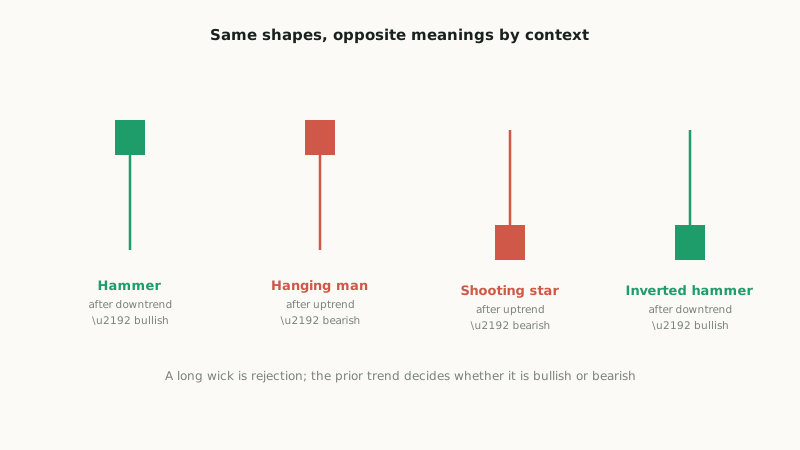
Here is the crucial subtlety: these candle shapes are defined by their context, not just their form. The hammer's shape — small body, long lower wick — is bullish after a downtrend, where it is called a hammer. But the identical shape appearing after an uptrend is a bearish signal called a hanging man: the same long lower wick now warns that sellers were able to push price down sharply even at the top of an uptrend, hinting at weakness. Same candle, opposite meaning, determined entirely by the prior trend.
The shooting star has the same dual identity. Its shape — small body, long upper wick — is bearish after an uptrend, where it is the shooting star. The identical shape after a downtrend is a potentially bullish signal called an inverted hammer: the long upper wick shows buyers managed to push price up sharply even during a downtrend, hinting at strength. This is the clearest possible illustration of the central lesson of candlestick analysis — that context decides everything. The wick tells you a rejection happened; the prior trend tells you whether that rejection is bullish or bearish. A trader who reads the shape without the context will get the meaning exactly backwards half the time.
The same long-wicked candle is a hammer or a hanging man, a shooting star or an inverted hammer — depending only on the trend that preceded it. The shape shows a rejection; the context tells you whose rejection it is. Never read these candles without first asking: what was the trend before this?
Trading hammers and shooting stars
The practical approach follows the now-familiar discipline. First, context: a hammer matters after a downtrend at support; a shooting star after an uptrend at resistance. Establish the trend and level before looking for the candle. Second, quality: favour candles with a long wick (at least twice the body), little wick on the opposite side, and a small body — the cleaner the rejection, the stronger the signal. Third, confirmation: because single candles are less reliable than multi-candle patterns, waiting for the next candle to follow through in the reversal direction substantially improves the odds.
The trade is structured with a stop beyond the wick — below the hammer's low, above the shooting star's high — since a break of that extreme would mean the rejection failed. The target is the next significant level. The long wick can make for a tight, well-defined stop right at the rejection point, which is part of what makes these candles attractive: they offer a clear invalidation level and often a favourable risk-to-reward when they form at the right place. As always, they are strongest in confluence — a hammer at support that is also a Fibonacci level or an order block is far more compelling than one in isolation.
On forex
Hammers and shooting stars work well on currencies, needing no volume and forming on every timeframe. As ever, higher-timeframe examples at significant levels are far more reliable than low-timeframe ones, where a long wick over a few minutes means little. The 24-hour forex market produces these rejection candles frequently, especially around news events and session opens when sharp pushes and reversals are common.
The workflow is the universal one: identify the trend and significant levels, watch for a high-quality rejection candle in the right context (hammer at support after a downtrend, shooting star at resistance after an uptrend), wait for confirmation, and trade with a stop beyond the wick and sensible position sizing. Above all, always check the prior trend before interpreting the candle — the single most important habit with these patterns, given how completely context flips their meaning. Read correctly, hammers and shooting stars are among the most practical and precise reversal-timing tools the forex trader has.
What makes a high-quality rejection candle
Hammers and shooting stars vary enormously in quality, and learning to grade them is what separates a reliable signal from a false one. The most important feature is the wick-to-body ratio. The rejecting wick should be long — ideally at least twice, and better three times, the length of the body. A long wick reflects a powerful, decisive rejection; a wick only slightly longer than the body shows a half-hearted one. The longer the wick relative to the body, the more emphatic the rejection and the stronger the signal.
The second feature is the opposite wick, which should be small or absent. A textbook hammer has a long lower wick and almost no upper wick, showing that price was rejected at the lows and closed near the high without much pushback. A hammer with a long lower wick and a long upper wick is more ambiguous — closer to a long-legged doji — because price was rejected at both extremes, muddying the signal. The cleanest rejection candles push one way, get rejected, and close near the opposite extreme with little wick on the closing side.
The third and decisive feature, as always, is location. Even a perfectly-formed hammer means little in the middle of a range; the same hammer at a significant support level, after a genuine downtrend, and ideally in confluence with a Fibonacci level or prior structure, is a high-quality signal. A strong rejection candle combines a long rejecting wick, a minimal opposite wick, a small body, and a significant location in line with a reversal. Grading candles against these criteria — and waiting for confirmation on the borderline ones — is how a trader filters the genuine rejections from the many that lead nowhere.
The hammer (long lower wick, after a downtrend) is a bullish rejection of the lows; the shooting star (long upper wick, after an uptrend) is a bearish rejection of the highs. The same shapes after the opposite trend are the hanging man and inverted hammer — context flips the meaning. A high-quality rejection candle has a long rejecting wick (2–3× the body), a minimal opposite wick, a small body, and a significant location. Trade at key levels with confirmation, a stop beyond the wick, and always check the prior trend first.