Some reversal signals are subtle; the engulfing pattern is emphatic. When one candle's body completely swallows the previous candle's body, it means control of the market changed hands decisively within a single period — the side that had been winning was not just stopped but overwhelmed and reversed. That clarity makes the engulfing pattern one of the most reliable and widely-used reversal signals in candlestick analysis, and an excellent pattern for beginners to learn first. This guide explains the bullish and bearish versions, what separates a strong engulfing from a weak one, and how to trade them.
It is a two-candle reversal pattern within the framework of candlestick patterns explained, and it was introduced as a key signal in price action trading.
Key takeaways
Q: What is an engulfing candlestick pattern?
A: An engulfing pattern is a two-candle reversal signal in which the second candle's body completely engulfs the first candle's body. A bullish engulfing has a down candle followed by a larger up candle; a bearish engulfing has an up candle followed by a larger down candle.
Q: Is a bullish engulfing pattern reliable?
A: A bullish engulfing is among the more reliable candlestick reversal signals, especially when it forms at a significant support level after a downtrend and is confirmed by follow-through. Like all candlestick patterns, it is far less reliable in isolation or without context.
Q: What makes a strong engulfing pattern?
A: A strong engulfing pattern has a second candle that fully and decisively engulfs the first, appears at a significant level in line with a reversal of the prior trend, has a large engulfing body relative to recent candles, and is followed by confirmation in the same direction.
The bullish engulfing
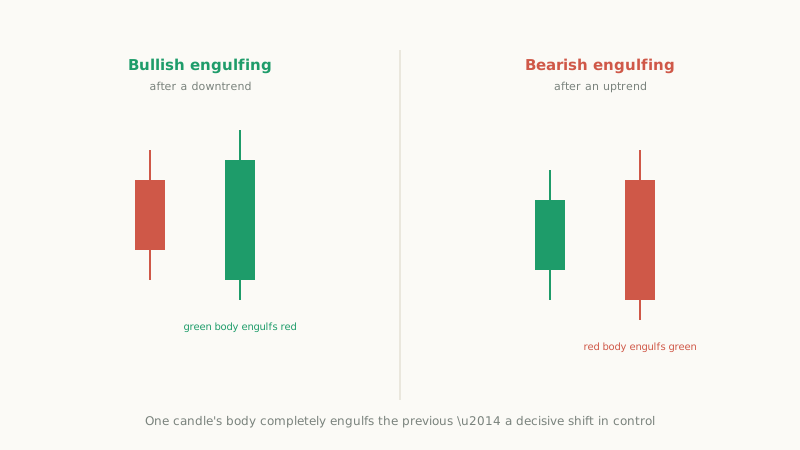
A bullish engulfing pattern forms after a downtrend and signals a potential reversal to the upside. It consists of two candles: first a bearish (down) candle, continuing the downtrend, then a bullish (up) candle whose body completely engulfs the body of the previous one — opening at or below the prior close and closing at or above the prior open. The large green body swallowing the prior red body is the visual signature.
The story it tells is a swift and complete shift in control. The first candle shows sellers still in charge, extending the downtrend. The second candle shows buyers arriving in force — not merely halting the decline but reversing the entire prior period and more, closing above where the selling began. In a single period, the sellers' control was overwhelmed by buyers. When this happens at a significant support level after a downtrend, it is a strong signal that the selling pressure has been exhausted and a reversal up may be underway.
The bearish engulfing
The bearish engulfing is the exact mirror, forming after an uptrend and signalling a potential reversal to the downside. It consists of a bullish (up) candle continuing the uptrend, followed by a bearish (down) candle whose body completely engulfs the previous one — opening at or above the prior close and closing at or below the prior open. The large red body swallowing the prior green body is the signature.
The story is the reverse: the first candle shows buyers still in control, extending the uptrend, while the second shows sellers arriving in force and overwhelming them, reversing the entire prior period and closing below where the buying began. The buyers' control was decisively broken. When a bearish engulfing forms at a significant resistance level after an uptrend, it is a strong warning that buying pressure has been exhausted and a reversal down may be beginning. Everything that applies to the bullish version applies in reverse.
What makes a strong engulfing
Not all engulfing patterns are equal, and several features distinguish a strong, tradeable one from a weak signal. The most important is the completeness of the engulfing: the second candle's body should fully and decisively cover the first's, ideally by a clear margin. A second candle that only just engulfs the first, or that has a large body but a tiny prior candle, is less convincing than a powerful candle that emphatically swallows a substantial prior one.
The second feature is size and conviction: a large engulfing candle, big relative to recent candles, shows more decisive force than a modest one. The third, and most important of all, is context — a bullish engulfing at a significant support level after a genuine downtrend, or a bearish engulfing at resistance after an uptrend, is far stronger than the same pattern appearing mid-range. An engulfing pattern that combines a decisive, large engulfing body with a significant location in line with a trend reversal is a high-quality signal; one missing these is best ignored.
The engulfing pattern works because it shows a complete takeover in one period — not just a pause, but a full reversal of the prior candle and more. The bigger and more decisive the engulfing, and the more significant the level it forms at, the more convincing the change of control.
Trading the engulfing pattern
The practical approach combines the pattern with the discipline that runs through all candlestick trading. First, establish the context: a mature trend and a significant level where a reversal makes sense — support for a bullish engulfing, resistance for a bearish one. Second, identify a clear, decisive engulfing pattern at that level. Third, decide on confirmation: many traders enter on the close of the engulfing candle itself, since the pattern is already a strong signal, while more conservative traders wait for the next candle to follow through in the reversal direction.
The trade is structured with a stop beyond the extreme of the engulfing pattern — below the low of a bullish engulfing, above the high of a bearish one — the level that would invalidate the reversal. The target is the next significant structural level or a Fibonacci projection. Because the engulfing candle is often large, the stop can be wider than for some patterns, so position sizing must account for this to keep risk to a small, fixed fraction of the account. Traded at the right location with appropriate risk control, the engulfing pattern is one of the most dependable candlestick signals available.
The engulfing pattern on forex
On currencies, the engulfing pattern works particularly well and is among the most popular candlestick signals. It needs no volume data, forms on every timeframe, and — because forex trades 24 hours — the second candle typically opens very near the first's close, so the "engulfing" is judged on the bodies cleanly without the complication of gaps. Higher-timeframe engulfing patterns (daily, four-hour) at significant levels are considerably more reliable than those on low timeframes, in keeping with the general dominance of higher-timeframe signals.
The workflow is the universal one: read the trend, mark the significant levels, watch for a decisive engulfing pattern at a level in line with a reversal, and trade it with a stop beyond the pattern and a sensible position size. Combined with confluence — an engulfing pattern at a level that is also a Fibonacci retracement, an order block, or a prior structural level — it becomes a high-probability entry trigger. The engulfing pattern's clarity and reliability make it an excellent foundation for candlestick-based entries on forex.
Engulfing, outside bars and the harami
It helps to distinguish the engulfing pattern from two closely-related formations it is often confused with. The first is the outside bar. A strict engulfing pattern is defined by the bodies — the second candle's body engulfs the first's body. An outside bar is a broader idea defined by the entire range — the second candle's high-to-low range engulfs the first's, wicks included. Every body-engulfing candle that also engulfs the wicks is an outside bar, but the classic engulfing pattern only requires the bodies to be engulfed. The body-based definition is the one most candlestick traders use, since the body reflects the period's net result; the range-based outside bar is a slightly different, sometimes stronger, variant.
The second, and more important to distinguish, is the harami — which is essentially the engulfing pattern reversed. In a harami, a large candle comes first and a small candle forms second, contained within the body of the large first candle. Where an engulfing shows the second candle overwhelming the first (a decisive takeover), the harami shows the second candle shrinking inside the first (a sudden loss of momentum). Both can signal reversals, but they tell different stories: the engulfing is an emphatic change of control, while the harami is a stalling of the prior trend's force — closer in spirit to a doji's indecision.
The practical takeaway is to read the relationship between the two candles precisely. A second candle that engulfs the first's body is an engulfing pattern — a strong, decisive reversal signal. A second candle that sits inside the first is a harami — a gentler warning of fading momentum. Confusing the two, or mistaking a candle that merely closes near the prior one for a true engulfing, leads to misreading the strength of the signal. The engulfing's power lies specifically in the complete swallowing of the prior body, so insisting on a genuine, decisive engulfing rather than a near-miss is what keeps the signal reliable.
An engulfing pattern is a two-candle reversal where the second body completely engulfs the first: bullish (down then larger up, after a downtrend) or bearish (up then larger down, after an uptrend), signalling a decisive change of control. Distinguish it from the outside bar (range-based, not just body) and the harami (the reverse — a small candle inside the prior, signalling fading momentum). A strong engulfing fully engulfs the body at a significant level; trade it with a stop beyond the pattern's extreme.