The best reversal signals tell a complete story, and the morning star and evening star tell theirs in three candles: a strong move in the trend's direction, a pause of indecision, and then a strong move the other way. That three-act structure — conviction, doubt, reversal — captures a turning point more fully than any single candle can, which is why these are among the most reliable reversal patterns in candlestick analysis. This guide explains both patterns, the meaning of the all-important middle candle, and how to trade them.
They are three-candle reversal patterns within the framework of candlestick patterns explained, and they combine the trend candles and the indecision of a doji into a single sequence.
Key takeaways
Q: What is a morning star pattern?
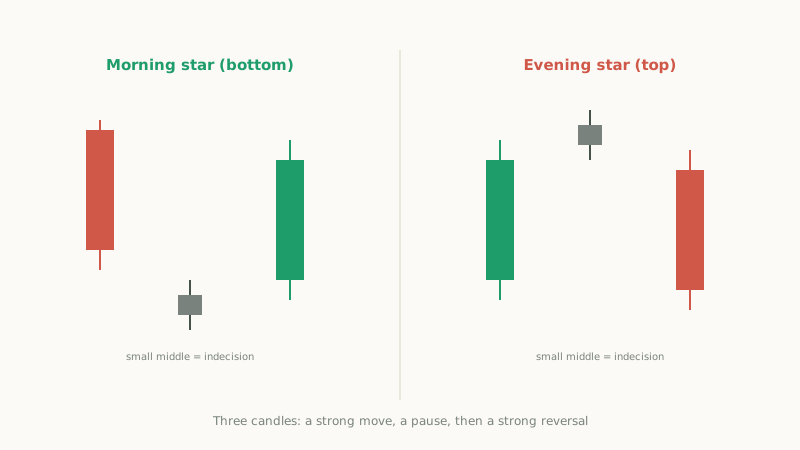
A: A morning star is a three-candle bullish reversal pattern forming at the bottom of a downtrend: a large bearish candle, then a small-bodied candle of indecision, then a large bullish candle that closes well into the first candle's body. It signals a likely reversal to the upside.
Q: What is an evening star pattern?
A: An evening star is the bearish mirror, forming at the top of an uptrend: a large bullish candle, then a small-bodied candle of indecision, then a large bearish candle closing well into the first candle's body. It signals a likely reversal to the downside.
Q: What does the middle candle of a star pattern mean?
A: The small middle candle represents indecision — the moment the prior trend's momentum stalls and the balance shifts. It is the pivot of the pattern, between the strong trending first candle and the strong reversing third candle.
The morning star
A morning star forms at the bottom of a downtrend and signals a bullish reversal — the dawn after the dark, as the name suggests. It unfolds across three candles. First, a large bearish (down) candle, continuing the downtrend with conviction — the sellers are firmly in control. Second, a small-bodied candle that represents indecision: the strong selling stalls, and buyers and sellers reach a momentary balance. Third, a large bullish (up) candle that closes well up into the body of the first candle — the buyers have decisively taken over and reversed much of the prior decline.
The three candles together narrate a complete shift. The first shows the downtrend in full force; the second shows that force suddenly stalling into indecision; the third shows control passing emphatically to the buyers. The deeper the third candle closes into the first candle's body, the stronger the reversal signal, because it shows the buyers reclaimed more of the lost ground. A morning star at a significant support level, after a genuine downtrend, is a high-quality bullish reversal.
The evening star
The evening star is the exact mirror, forming at the top of an uptrend and signalling a bearish reversal — dusk after the day. Its three candles: first, a large bullish candle continuing the uptrend with conviction; second, a small-bodied candle of indecision as the buying stalls; third, a large bearish candle closing well down into the body of the first, as sellers take decisive control.
The story is the reverse of the morning star: the uptrend in full force, then a sudden stall into indecision, then an emphatic reversal as sellers take over. As with the morning star, the deeper the third candle closes into the first candle's body, the stronger the signal. An evening star at a significant resistance level, after a genuine uptrend, is a high-quality bearish reversal. The two patterns are perfect mirrors, and everything that applies to one applies in reverse to the other.
The crucial middle candle
The middle candle is the pivot of the pattern, and understanding it is key to reading the star patterns well. It is small-bodied — sometimes a doji — and represents the precise moment the prior trend's momentum stalls and the balance tips. The first candle shows the trend at full strength; the third shows the reversal in full force; but it is the second candle, the pause, that marks the transition between them. Without that indecisive middle candle, the pattern is just two opposing candles; with it, the pattern captures the full arc of a trend losing momentum and turning.
The smaller the middle candle's body, the more complete the indecision and the more significant the pause — which is why a doji in the middle position (sometimes called a "morning doji star" or "evening doji star") is considered an especially strong version of the pattern. In markets that produce gaps, the middle candle classically gaps away from the first and third, emphasising the isolation of the indecision; on the 24-hour forex market, where gaps are rare, the pattern instead relies on the body relationships — a small middle body between two large opposing bodies — which works just as well. The principle is the same: a clear pause of indecision flanked by strong conviction in opposite directions.
The star patterns are powerful because they show the whole reversal, not just a moment of it: trend, then doubt, then turn. The middle candle is the hinge — the instant momentum dies. A small, indecisive middle candle (ideally a doji) between two strong, opposing candles is the heart of the signal.
Trading the star patterns
The practical approach combines the pattern's strength with the usual discipline. First, context: a morning star matters at support after a downtrend, an evening star at resistance after an uptrend — establish the trend and level first. Second, quality: favour patterns with a clear small middle candle (a doji is ideal) and a strong third candle that closes deep into the first candle's body. Third, because the star is already a three-candle pattern that includes its own confirmation (the strong third candle), many traders enter on the close of that third candle, though waiting for additional follow-through is the more conservative choice.
The trade is structured with a stop beyond the extreme of the pattern — below the low of a morning star, above the high of an evening star — and a target at the next significant level. Because the star patterns are relatively reliable and contain their own confirmation in the third candle, they are among the more dependable candlestick entries, particularly when they form in confluence with a key level, a Fibonacci retracement, or a larger chart pattern. As always, position size is set so the stop represents only a small, fixed fraction of the account.
Star patterns on forex
On currencies, the morning and evening star work well, with the one adaptation already noted: because spot forex rarely gaps, the patterns are read through the body relationships of the three candles rather than literal gaps around the middle candle. A small middle body between two large opposing bodies is the forex version, and it carries the same meaning. The patterns need no volume data and form on every timeframe, with higher-timeframe examples at significant levels being the most reliable.
The workflow is the universal one: identify the trend and significant levels, watch for a three-candle star pattern forming at a level in line with a reversal, favour examples with a clear indecisive middle candle and a strong third candle, and trade with a stop beyond the pattern's extreme and a sensible position size. As complete, three-act reversal stories, the morning and evening star are among the most satisfying and dependable candlestick patterns to trade — and a fitting capstone to the candlestick toolkit.
Variants and related three-candle patterns
The star patterns have a few notable variants worth recognising. The strongest is the morning doji star (and its mirror, the evening doji star), in which the small middle candle is specifically a doji — the purest possible expression of the indecision pivot. Because a doji middle represents the most complete stalling of momentum, these doji-star versions are considered especially reliable. A rarer and more dramatic variant is the abandoned baby, where the middle candle is a doji that gaps away from both neighbours, completely isolated — a very strong but uncommon reversal, and one that barely appears on the gapless forex market.
Beyond the stars, two other three-candle patterns are worth knowing as relatives. Three white soldiers is a bullish reversal or continuation made of three consecutive strong bullish candles, each opening within the prior body and closing higher — a sustained, decisive takeover by buyers. Three black crows is the bearish mirror: three consecutive strong bearish candles marching lower. These show not a single pivot but a sustained, multi-period shift in control, and they carry weight precisely because three strong candles in a row are hard to dismiss as noise.
All of these share the morning and evening star's underlying logic: multiple candles telling a more complete story than any single one can. The more candles that align in a coherent narrative — conviction, pause, reversal, or three consecutive strong moves — the more significant the signal, because a multi-candle pattern captures a fuller shift in the balance between buyers and sellers. As with every pattern, though, context remains decisive: even a textbook morning doji star matters only at a significant level after a genuine trend, and is best confirmed and traded with a defined stop, just like its simpler relatives.
The morning star (bullish, at a bottom) and evening star (bearish, at a top) are three-candle reversals: a strong trend candle, a small indecision candle (a doji makes the strongest "doji star" variant), then a strong reversal candle closing deep into the first. Related three-candle patterns include three white soldiers and three black crows. On forex, read body relationships rather than gaps. Trade at significant levels with a stop beyond the pattern's extreme; the strong third candle provides built-in confirmation.