The doji is the candle of indecision. It forms when price opens and closes at virtually the same level, leaving a tiny body or none at all — a tug-of-war between buyers and sellers in which neither side won the period. On its own, a doji says only one thing: the market paused, undecided. But appearing at the right place — after a strong trend, at a key level — that pause can be the first sign that a move is running out of breath. This guide explains what a doji means, the main types and what each signals, and how to read one in the context that gives it value.
It is a single-candle pattern within the framework of candlestick patterns explained, and it pairs closely with the rejection candles of the hammer and shooting star.
Key takeaways
Q: What is a doji candlestick?
A: A doji is a candlestick where the open and close are at virtually the same price, producing a very small or non-existent body. It represents indecision — a balance between buyers and sellers in which neither side won the period — and can signal a potential pause or reversal depending on context.
Q: What are the types of doji?
A: The main types are the standard doji (small body, balanced wicks), the long-legged doji (long wicks both ways, strong indecision), the dragonfly doji (long lower wick, potential bullish reversal at support), and the gravestone doji (long upper wick, potential bearish reversal at resistance).
Q: Is a doji bullish or bearish?
A: A doji is neutral on its own — it signals indecision rather than a direction. Its implication depends on context: a doji after a strong trend can warn of exhaustion, and dragonfly and gravestone dojis carry directional hints at support and resistance respectively.
What a doji means
A doji forms when the open and close are essentially equal, so the candle has little or no body — often appearing as a cross, a plus sign or a thin horizontal line with wicks. This shape captures a precise market condition: over the course of the period, buyers and sellers fought to a draw. Price may have travelled up and down (the wicks show how far), but it ended where it began. Neither side could claim the period, which is the very definition of indecision.
This indecision is significant mainly because of what it can interrupt. In the middle of a quiet, directionless market, a doji is unremarkable — indecision in an already-indecisive market means little. But a doji appearing after a strong, sustained trend is far more telling: it signals that the one-sided conviction driving the trend has suddenly given way to balance. The buyers who had been in firm control (in an uptrend) have, for this period at least, been matched by sellers. That sudden shift from conviction to indecision is the doji's real message, and it is why a doji after a long run can be an early warning that the trend is tiring.
The four main types
Dojis come in several varieties, distinguished by the position and length of their wicks, and each carries a slightly different nuance:
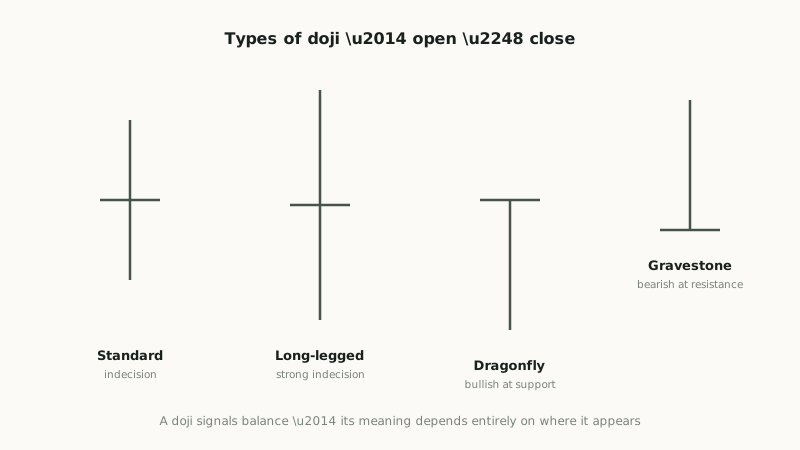
- Standard doji — a small body with modest wicks on both sides, the basic expression of indecision and balance.
- Long-legged doji — long wicks extending both above and below, showing that price travelled far in both directions before settling back to the open. This is strong indecision and high volatility — a vigorous battle that ended in a stalemate.
- Dragonfly doji — a long lower wick with the open and close near the high, and little or no upper wick. It shows sellers pushed price down hard but buyers rejected the lows entirely, pulling price back up to the open. At support, this carries a bullish hint.
- Gravestone doji — the mirror: a long upper wick with open and close near the low. Buyers pushed up but sellers rejected the highs, driving price back down. At resistance, this carries a bearish hint.
The dragonfly and gravestone are essentially doji versions of the hammer and shooting star — rejection candles — while the standard and long-legged dojis are purer expressions of indecision.
Reading a doji in context
As with every candlestick pattern, a doji's meaning is determined by context, and trading one without regard to location is the classic mistake. The key questions are: where in the trend does this doji appear, and at what level? A doji after an extended uptrend, right at a resistance level or a Fibonacci extension, is a meaningful warning of potential exhaustion. The same doji in the middle of a choppy range is noise. A dragonfly doji at major support, or a gravestone doji at major resistance, gains directional significance precisely because of where it forms.
This is why the doji is best understood as a warning or a prompt rather than a signal to act. It says "the conviction has paused here — pay attention," not "reverse your position now." The disciplined response to a doji at a significant level is to watch closely for what comes next: confirmation, in the form of the following candle moving decisively in one direction, turns the doji's indecision into an actionable signal. A doji followed by a strong bearish candle at resistance, for instance, confirms that the indecision resolved in the sellers' favour.
A doji is a question, not an answer. It tells you the trend's conviction has wavered at this spot — but not which way the resolution will go. The candle after the doji usually answers the question. Wait for that answer rather than guessing at it.
Trading the doji
The practical approach to trading a doji follows directly from its nature as a context-dependent warning. First, it only matters after a meaningful trend and at a significant level — so the setup begins with identifying those, not with the doji itself. Second, because a doji signals indecision rather than direction, you wait for confirmation: the candle following the doji moving decisively in the anticipated reversal direction. Third, the trade is structured with a stop beyond the doji's extreme (the far end of its wicks) and a target at the next significant level.
A doji is rarely a trade on its own; it is most powerful as part of a larger picture — confirming exhaustion at a level where other evidence already suggests a turn, or forming the indecisive middle candle of a larger reversal pattern like the morning or evening star. Used this way, as a sensitive indicator of where conviction falters, the doji is a valuable addition to the toolkit. Used as a standalone reversal signal traded anywhere it appears, it produces far more false alarms than profits, because most indecision leads nowhere.
The doji on forex
On currencies, dojis form readily and are read exactly as on any market — they require no volume data and appear on every timeframe. The one consideration is the timeframe: a doji on a daily forex chart, representing a full day of indecision, is far more significant than a doji on a one-minute chart, where indecision over sixty seconds means very little. Higher-timeframe dojis at significant levels carry real weight; low-timeframe dojis are mostly noise, in keeping with the general principle that higher-timeframe signals dominate.
The workflow is the familiar one: establish the trend and mark significant levels, watch for a doji to form at one of those levels after a meaningful move, wait for the next candle to confirm the direction, and trade with a defined stop beyond the doji and a target at the next level. Treated as a context-dependent warning of faltering conviction — rather than a standalone signal — the doji is a useful early indicator that a forex trend may be reaching its end.
Common mistakes with the doji
The doji is so simple to spot that it is easy to misuse, and a few recurring mistakes account for most of the trouble. The first and most common is trading every doji. Dojis appear constantly — on any chart, on any timeframe, the market frequently pauses for a period — and the overwhelming majority lead nowhere. Treating each one as a reversal signal means acting on endless false alarms. A doji is only worth attention after a strong trend, at a significant level; everywhere else it is just the routine ebb and flow of indecision.
The second mistake is ignoring the timeframe. A doji on a weekly or daily chart represents a meaningful period of genuine indecision and carries real weight; a doji on a one-minute chart represents sixty seconds of balance and is essentially noise. Reading a low-timeframe doji as if it carried the significance of a high-timeframe one is a reliable way to get whipsawed. The higher the timeframe, the more a doji means.
A third, subtler error is confusing a doji with a spinning top. A true doji has open and close at virtually the same price (essentially no body); a spinning top has a small but real body with wicks on both sides. Both signal indecision, but the doji is the purer, stronger version. The distinction matters less for trading than the broader point it illustrates: precision in reading the candle matters, and the doji's power comes from the completeness of its indecision. Avoiding these mistakes — trading dojis only in context, respecting timeframe, and reading the shape precisely — is what turns the doji from a source of false signals into a genuine early warning of faltering conviction.
A doji forms when open and close are nearly equal — the candle of indecision. Types: standard and long-legged (pure indecision), dragonfly (bullish at support) and gravestone (bearish at resistance). It only matters after a strong trend at a significant level, on a meaningful timeframe — don't trade every doji, and don't confuse it with a spinning top. It is a question, not an answer: wait for the next candle to confirm direction, with a stop beyond the doji's extreme.