Every candlestick on a chart is the story of a single battle between buyers and sellers, told in four numbers — where price opened, how high it reached, how low it fell, and where it closed. Learn to read that story, and the chart stops being a meaningless wiggle and starts speaking a language you can understand. Candlestick patterns are simply the recurring shapes — made by one candle or several together — that reveal shifts in momentum and hint at reversals or continuations. This guide explains how to read a candle's anatomy, the families of patterns, and the principle that governs all of them: context decides everything.
Candlesticks are the most granular expression of the raw-price reading covered in price action trading, and they complement the larger formations in chart patterns explained.
Key takeaways
Q: What are candlestick patterns?
A: Candlestick patterns are formations made by one or more candles that traders use to gauge momentum and anticipate reversals or continuations. Each candle shows the open, high, low and close for a period, and the shapes they form — doji, engulfing, hammer and others — reflect the balance between buyers and sellers.
Q: How do you read a candlestick?
A: A candle's body shows the open-to-close range — bullish if the close is higher, bearish if lower — while the wicks show the high and low reached beyond the body. A long body signals strong directional movement, a small body signals indecision, and a long wick signals rejection of that price.
Q: Do candlestick patterns work?
A: Candlestick patterns are useful for reading momentum and timing entries, but single candles are unreliable in isolation. They work best in context — at significant levels, in line with the trend, and with confirmation — rather than as standalone signals.
The anatomy of a candle
Each candlestick represents one period of trading — a minute, an hour, a day — and encodes four prices: the open, high, low and close. The body spans the distance between the open and the close. When the close is higher than the open, the candle is bullish (conventionally drawn green or white); when the close is lower, it is bearish (red or black). The thin lines extending above and below the body are the wicks (or shadows), marking the highest and lowest prices reached during the period.
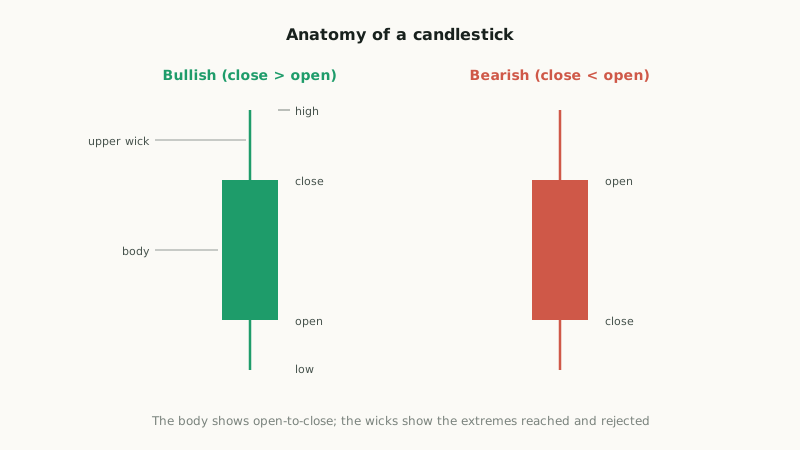
The shape of a candle immediately tells you something about the period's character. A long body means price moved decisively in one direction — strong conviction. A small body means the open and close were close together — indecision, a balance between buyers and sellers. A long wick means price pushed to an extreme and was then rejected, pulled back before the close — a sign that one side tried to take control there and failed. Reading these three features — body size, body colour, and wick length — is the foundation of all candlestick analysis, and the building block for every pattern.
Single and multi-candle patterns
Candlestick patterns come in two structural types. Single-candle patterns are formed by one candle whose shape carries meaning on its own — the doji (indecision), the hammer and shooting star (rejection). Multi-candle patterns are formed by two or more candles in sequence, where the relationship between them tells the story — the engulfing pattern (two candles), the morning and evening star (three candles). The more candles involved, generally the more significant the signal, because a multi-candle pattern captures a more complete shift in the balance of power.
Cutting across this structural division is the same reversal-versus-continuation distinction that organises chart patterns. Most of the famous candlestick patterns are reversal signals — they appear at the end of a move and suggest it may turn — though continuation patterns exist too. As with chart patterns, the first question to ask of any candlestick signal is what it implies: is this telling me the move is likely to reverse, or to continue? The dedicated guides cover the key patterns: the doji, the engulfing pattern, the hammer and shooting star, and the morning and evening star.
Context decides everything
Here is the single most important lesson in candlestick analysis, and the one beginners most consistently ignore: a candlestick pattern means almost nothing on its own. A hammer in the middle of a directionless range is just a candle with a long wick; the same hammer at a significant support level, after a downtrend, is a meaningful bullish reversal signal. The candle is identical — what changes is the context, and context is what gives the pattern its meaning.
This is why candlestick patterns should never be traded in isolation. Their power comes from appearing at the right place: at a significant support or resistance level, at a Fibonacci level, at the end of an extended trend, in line with the larger structure. A reversal candle at a key level after a mature trend is a high-quality signal; the same candle floating in the middle of nowhere is noise. The disciplined approach is to identify the meaningful levels and trend first, and then use candlestick patterns to time entries at those levels — the candle is the trigger, the level and trend are the reason.
A candlestick pattern is a timing tool, not a standalone signal. It tells you when something might be happening at a level you already care about — not whether to care about a level in the first place. Trade candles at significant locations in line with the trend, and ignore them everywhere else.
Confirmation and reliability
Even at a good location, a single candlestick pattern is best treated as a prompt rather than a command, and many traders wait for confirmation before acting — typically the next candle continuing in the expected direction. A bullish reversal candle at support is more trustworthy once the following candle closes higher, confirming that buyers have indeed taken control. This confirmation step filters out the many patterns that form and then fail to follow through, at the cost of a slightly later entry.
The honest caveats that apply to all technical tools apply here too. Candlestick patterns are subjective at the margins (how long must a wick be to count as a hammer?), they fail regularly, and they likely owe part of their effectiveness to being self-fulfilling — watched and acted upon by a large crowd. There are also dozens of named patterns, many obscure and unreliable, so it pays to focus on the handful of well-established, high-probability ones rather than memorising an exhaustive catalogue. Used as context-dependent timing tools with confirmation, the core patterns are genuinely valuable; treated as a magic dictionary of guaranteed signals, they disappoint.
Candlesticks on forex
Candlestick analysis translates perfectly to forex, with one structural quirk worth noting. Because the spot forex market trades essentially 24 hours a day, it rarely produces the price gaps (jumps between one candle's close and the next's open) that appear in markets with daily sessions like stocks. Some classical candlestick patterns were originally described with gaps as part of their definition — the star patterns, for instance — so on forex these patterns rely on the body relationships between candles rather than literal gaps. The patterns still work; they just look slightly different without the gaps.
Beyond that, candlesticks need no volume data and so suffer none of the limitations that affect Wyckoff or Dow's volume tenet on forex. The practical workflow is the universal one: read the trend and mark the significant levels first, then watch for high-quality candlestick patterns at those levels, in line with the trend, and wait for confirmation before entering. Used this way, candlestick patterns are an excellent timing tool — the finest-grained way to read the ongoing battle between buyers and sellers and to time entries with precision.
Continuation candlestick patterns
Most of the famous candlestick patterns are reversal signals, but a smaller family signals continuation — that the trend is likely to resume after a brief pause. These are worth knowing, if only so you do not mistake them for reversals. The simplest is the marubozu, a candle with a large body and little or no wick in either direction, showing one side dominated the entire period from open to close with no rejection — a strong continuation signal in the direction of the body. A bullish marubozu in an uptrend says the buyers are firmly in control.
More involved are patterns like the rising three methods (bullish) and falling three methods (bearish): a strong trend candle, followed by a few small candles that drift gently against the trend (a brief pause), followed by another strong candle resuming the trend — essentially a candlestick depiction of a flag. The small counter-trend candles represent a shallow consolidation that the trend then overwhelms, much like the chart-pattern flag does on a larger scale.
The practical point is that the reversal-versus-continuation distinction applies to candlestick patterns just as it does to chart patterns: the first question to ask of any candle signal is whether it implies the trend turns or resumes. A continuation pattern in the direction of an established trend can be a sound entry to join or add to a position, while the reversal patterns warn of a turn. Recognising which family a candle belongs to — and never reading a continuation marubozu as a reversal, or vice versa — is part of reading candles in their proper context.
A candlestick shows open, high, low and close: the body is the open-to-close range (green up, red down), the wicks are the rejected extremes. Long body = conviction, small body = indecision, long wick = rejection. Patterns are single- or multi-candle and split into reversal (most famous ones) and continuation (marubozu, three methods) — but they mean almost nothing in isolation. Trade them only at significant levels in line with the trend, with confirmation. On forex they work without volume, though gap-based patterns rely on body relationships.