
Hedging sounds like the ultimate risk-management tool: open an offsetting position and neutralise your risk, protecting yourself from adverse moves. It has genuine, legitimate uses — but it is also one of the most misunderstood and overused techniques among retail traders, who often reach for it when a simpler tool would serve better. The uncomfortable truth is that, for most retail speculators, hedging frequently achieves nothing that closing the position wouldn't achieve more cheaply and simply. This guide explains what hedging is, the main types, the real costs and caveats, and why — for most traders — sound position sizing and stop-losses are a better answer than hedging. The honest framing matters, because hedging's intuitive appeal often exceeds its practical value.
It draws on the currency correlations covered in the pairs section and sits within risk management alongside stop-losses.
Key takeaways
Q: What is hedging in forex?
A: Hedging is opening a position to offset or reduce the risk of another position. A direct hedge opens an opposite position in the same pair; a correlation hedge uses a correlated pair to partially offset exposure. The aim is to reduce risk, though it also reduces potential reward.
Q: Is hedging better than using a stop-loss?
A: For most retail traders, no. A direct hedge often just locks in the current profit or loss, which closing the position would also do — more simply and cheaply. Good position sizing and stop-losses achieve risk management more directly than hedging for typical speculative trading.
Q: What are the downsides of hedging?
A: Hedging incurs costs (spreads and swap on both positions), ties up margin, adds complexity, and can create a false sense of security. Correlation hedges are imperfect and carry basis risk. Often, simply closing or reducing a position achieves the same risk reduction more cheaply.
What hedging is
Hedging means opening a position to offset or reduce the risk of another position you hold. The general idea is to take on an exposure that moves opposite to your existing one, so that a loss on the first is partly or fully compensated by a gain on the second, reducing your net risk. Hedging is borrowed from the world of commercial finance, where businesses genuinely need to protect against currency movements — and that origin is a clue to where it is most legitimately useful, as we will see.
The crucial thing to understand from the outset is the fundamental trade-off: hedging reduces risk, but it also reduces reward. By offsetting your exposure, you protect against adverse moves — but you equally give up favourable ones, because the offsetting position loses when your original position wins. A perfect hedge neutralises both downside and upside, leaving you with no net exposure at all. This is the key insight that deflates much of hedging's intuitive appeal: it is not a way to protect profits while keeping upside; it is a way to reduce net exposure, with all that implies. Understanding that hedging trades away reward along with risk is essential to evaluating whether it is actually useful in any given situation.
Direct hedging
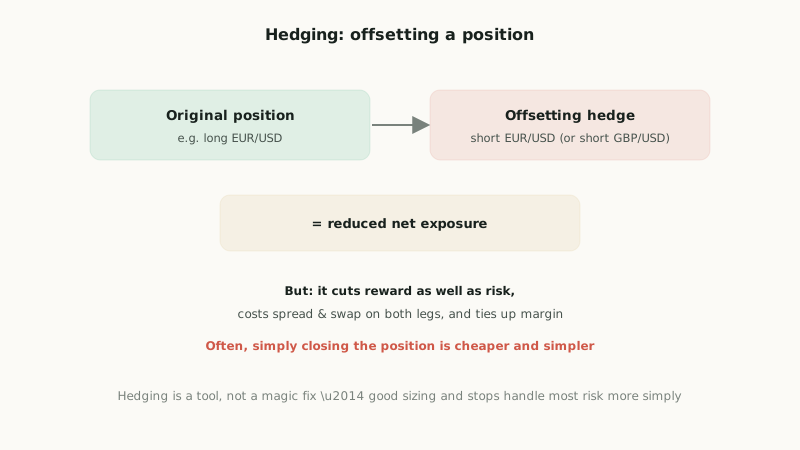
The simplest form is the direct hedge: opening an opposite position in the same currency pair — for instance, holding both a long and a short position in EUR/USD simultaneously. With equal and opposite positions, your net exposure is zero: whatever the pair does, the gain on one position offsets the loss on the other. The direct hedge effectively locks in your current profit or loss at the moment you place it, freezing your position.
And here is the catch that exposes the direct hedge's main weakness: if a direct hedge simply locks in your current profit or loss, then in most cases you could achieve the identical result by simply closing the position — more simply, and without paying to hold two opposing trades. Closing realises your current profit or loss and frees your margin; the direct hedge merely freezes it while continuing to incur costs on both legs. For this reason, the direct hedge is often pointless for retail traders — a more complex, more expensive way to do what closing does cleanly. (There are also practical constraints: some jurisdictions and brokers restrict or effectively prohibit holding direct hedges, treating offsetting orders as closing the original.) The direct hedge's intuitive appeal — "I'll hedge instead of closing, keeping my options open" — usually does not survive scrutiny, since the supposed flexibility rarely justifies the added cost and complexity over simply closing or reducing the position.
Correlation hedging
A more genuinely distinct form is the correlation hedge: using a different but correlated pair to offset exposure, rather than the same pair. For example, given the strong positive correlation between EUR/USD and GBP/USD (from the correlations guide), a trader long EUR/USD might partially hedge by going short GBP/USD — since the two tend to move together, the short GBP/USD position would tend to gain if EUR/USD (and GBP/USD) fell, offsetting some of the loss. Negatively correlated pairs can be hedged by taking positions in the same direction.
Correlation hedging is more nuanced than a direct hedge because it does not simply lock the position — it creates a partial offset based on the relationship between two different pairs, which can be tuned and which leaves some residual exposure. But it carries a significant weakness: basis risk — the risk that the correlation is imperfect or shifts. Because the two pairs are not identical, they do not move in perfect lockstep; the hedge is approximate, and if the correlation weakens or breaks down (which, as the correlations guide stresses, it can), the hedge fails to protect as expected and may even add risk. The trader is now exposed to the relationship between two pairs, with all the instability that entails. Correlation hedging has legitimate uses in sophisticated hands, but its imperfection and the shifting nature of correlations make it tricky and far from a guaranteed protection.
A direct hedge usually just locks in your current profit or loss — which closing the position does too, more cheaply. Hedging cuts reward as much as risk, costs spread and swap on both legs, and ties up margin. For most retail traders, the honest answer is that good position sizing and a stop-loss manage risk more simply and cheaply than hedging ever will.
The costs and caveats
Hedging carries real costs and pitfalls that further temper its appeal. Costs: holding two positions means paying the spread on both, and potentially swap/rollover charges on both overnight — you are paying double the trading costs to hold offsetting trades, a drag that accumulates. Margin: both positions tie up margin, consuming the free margin that (as the margin guide explains) is your cushion. Complexity: managing multiple offsetting positions is more complicated and error-prone than a single position with a clear stop. And perhaps most insidiously, hedging can create a false sense of security — the comforting feeling of being "protected" that leads traders to hold losing positions they should simply exit, or to overcomplicate situations that a stop-loss would handle cleanly.
These caveats explain why hedging is often the wrong tool for retail speculators. The most legitimate use of hedging is genuinely commercial — businesses and institutions with real underlying currency exposures (from international operations, say) hedging to protect those exposures, where the cost of the hedge is justified by the certainty it provides for their core business. For a retail trader speculating on currency moves, the situation is different: the "exposure" being hedged is itself a voluntary speculative position, and the cleaner tools — reducing position size, setting a stop-loss, or simply closing — usually achieve the desired risk management more directly and cheaply than constructing a hedge. Recognising this distinction — commercial hedging of real exposures versus retail over-complication of speculative trades — cuts through much of the confusion around hedging.
The verdict for most traders
For most retail traders, the honest conclusion is that hedging is a tool, not a magic fix, and usually not the right tool. The risk-management goals that draw traders to hedging — limiting losses, controlling exposure, protecting capital — are achieved more simply and cheaply by the core disciplines this section teaches: sound position sizing (so no single trade can hurt you much), stop-losses (to define and cap losses cleanly), and the willingness to simply close or reduce a position when you want to cut risk. These tools are direct, cheap, and effective, and they do not carry hedging's costs, complexity and false comfort.
This is not to say hedging is never useful — it has its place, particularly for managing genuine exposures, navigating specific situations (such as protecting a position through a brief, uncertain event without closing), or in the hands of sophisticated traders who understand exactly what they are doing and why. But the retail trader's instinct to hedge is more often a sign of overcomplicating risk management than of managing it well. The disciplined approach is to reach first for the simple, proven tools — size positions sensibly, use stops, close when you want out — and to consider hedging only when there is a clear, specific reason that those simpler tools cannot address. Understanding hedging is valuable, including understanding why it is usually unnecessary; for the vast majority of retail trading, good position sizing and stop discipline are the better, simpler answer to the question hedging claims to solve.
A simple scenario
A concrete situation shows why the simpler tools usually win. Suppose you are long EUR/USD with a healthy floating profit, but a major economic release is due in an hour and you are nervous about the volatility. The hedging instinct says: open a short EUR/USD to "protect" the profit through the news. But consider what this actually does — it locks in your current profit by neutralising your exposure, while you now pay the spread on the new short, potentially incur swap on both legs, and tie up additional margin. After the news, you must then close one leg to re-establish a direction, paying yet more spread.
Compare the alternatives. You could simply close part or all of the position, banking the profit cleanly and freeing your margin — if you are nervous, taking the profit off the table is direct and cheap. Or you could tighten your stop-loss to just below the current price, locking in most of the profit while leaving room to benefit if the news goes your way — keeping upside that the hedge would have killed. Both of these achieve the goal (protecting the profit) more simply and cheaply than the hedge, and the stop-loss approach even preserves some upside that the fully-hedged position sacrifices entirely.
This is the pattern that recurs whenever a retail trader considers hedging: there is almost always a simpler, cheaper tool — closing, reducing, or adjusting a stop — that achieves the actual goal without the hedge's double costs, margin drain and complexity. The exceptions, where hedging genuinely earns its place, tend to involve specific constraints (regulatory, tax, or genuine commercial exposures) that the simple tools cannot address — situations rare in ordinary retail speculation. Working through scenarios like this one is the best way to see why, for most traders most of the time, the honest answer to "should I hedge?" is "just close or reduce the position instead."
Hedging opens an offsetting position to reduce risk — but it cuts reward too. A direct hedge (opposite position, same pair) usually just locks in your current profit/loss, which closing does more cheaply, while a tighter stop even preserves upside. A correlation hedge (using a correlated pair) is partial and carries basis risk if the correlation shifts. Hedging costs spread and swap on both legs, ties up margin, and can create false security. For most retail traders, sound position sizing, stop-losses and simply closing or reducing manage risk more directly and cheaply — hedging is a tool, not a magic fix.