The economic calendar tells you when the market is about to get moved — and by what. It is a schedule of upcoming economic data releases and events, from interest-rate decisions to inflation and jobs reports, that can shift currencies sharply. Learning to read it is a basic, essential skill for any trader: at minimum, it lets you see high-impact events coming, so you're never blindsided by a sudden burst of volatility, and at best it helps you understand the forces driving the market. This guide explains what the calendar's columns mean, why the comparison of actual versus forecast drives the market's reaction, and — most importantly for beginners — how to use the calendar practically.
It is the practical companion to the economic indicators and employment data guides (which explain what the events mean), and essential reading alongside news trading.
Key takeaways
Q: What is an economic calendar?
A: An economic calendar is a schedule of upcoming economic data releases and events — such as interest-rate decisions, inflation (CPI) and jobs reports — that can move the markets. It shows when each event is released, which currency it affects, how impactful it tends to be, and the expected and actual figures.
Q: What do the columns on an economic calendar mean?
A: Typically: the time of release, the currency/country affected, the event name, an impact rating (high/medium/low volatility expected), and three figures — previous (last reading), forecast (what analysts expect), and actual (the released number). The market reacts mainly to how the actual compares to the forecast.
Q: How should a beginner use an economic calendar?
A: Primarily to know when high-impact events are coming, so you can avoid being caught in sudden volatility — by checking the calendar before trading, watching the impact ratings, and being cautious around or standing aside during major releases. Set the times to your own timezone so you don't miss them.
What the columns mean
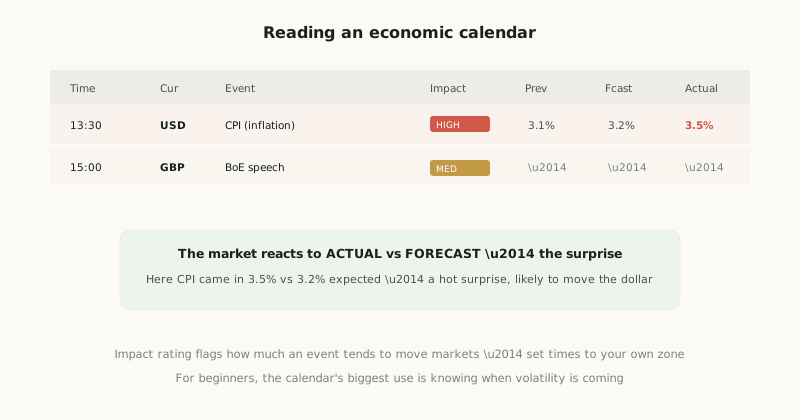
An economic calendar is laid out as a table, with each row an upcoming event and the columns giving its key details. Understanding each column is all it takes to read the calendar.
The economic calendar's columns
The time tells you when the release is scheduled — and it's important to set the calendar to your own timezone, so you correctly know when events hit your trading day (a common beginner slip is reading times in the wrong zone and being caught out). The currency column shows which currency or country the event concerns — a US release primarily affects the dollar, a UK release the pound, and so on — so you can see which of your pairs might be moved. The event names the data or occurrence: interest-rate decisions, inflation (CPI), employment reports (like Non-Farm Payrolls), GDP, central-bank speeches, and many more (the indicators and employment guides explain what these mean). The impact rating — usually shown as high, medium or low (often colour-coded, e.g. red/amber/yellow) — flags how much the event tends to move markets: high-impact events (rate decisions, CPI, NFP) typically cause the biggest moves and volatility, while low-impact ones barely register. This rating is the single most useful column for a beginner, because it tells you when significant volatility is likely. Finally, three figures: previous (the last reading of this data), forecast (the consensus of what analysts expect this time), and actual (the figure once released, filled in at the scheduled time). These three numbers are what the market trades — and how they relate is the key to the reaction.
Why actual versus forecast drives the move
The crucial insight for reading the calendar is that the market reacts not to the raw number, but to the actual figure compared to the forecast — the surprise. Markets are forward-looking and have already priced in what they expect (the forecast), so a release that simply matches expectations often causes little movement (no new information). What moves the market is a deviation from the forecast: an actual that comes in notably better or worse than the forecast surprises the market and forces a repricing, causing the currency to move. This is why the forecast column matters so much — it's the benchmark against which the actual is judged.
The direction of the move depends on the indicator and what the surprise implies (the indicators guide covers the logic), but the general pattern is: an actual that is "better" for the currency than forecast (stronger economy, higher inflation implying rate hikes, etc.) tends to push the currency up, while a "worse" actual tends to push it down — and the bigger the surprise (the larger the gap between actual and forecast), the bigger the move. In the diagram's example, US inflation came in at 3.5% against a 3.2% forecast — a hotter-than-expected surprise that would likely move the dollar (as the inflation guide explains, typically stronger, via rate-hike expectations). The previous figure gives context (is the trend rising or falling?), but it's the actual-versus-forecast surprise that drives the immediate reaction. High-impact events combined with a big surprise produce the sharpest, most volatile moves — which is exactly what the impact rating warns you about. Understanding this — that the calendar's three figures matter because the market trades the surprise (actual vs forecast), and that high-impact events with large surprises move markets most — is what turns the calendar from a confusing table into a meaningful guide to when and why the market may move.
How beginners should use it
For a beginner, the economic calendar's most valuable use is simple and defensive: knowing when high-impact events are coming, so you're never blindsided by volatility. You don't need to trade the events (indeed, trading the moment of a release is high-risk and generally inadvisable, as the news-trading guide warns); you just need to be aware of them. The core habit is to check the calendar before you trade — glance at the day's (and week's) high-impact events for the currencies you trade, so you know when significant moves are likely. This single habit prevents the classic beginner shock of being caught in a sudden, violent move with no idea why — it was a scheduled high-impact release you could have seen coming.
The practical guidelines follow. Watch the impact ratings — focus on the high-impact events (rate decisions, CPI, NFP, GDP), which cause the biggest moves; low-impact items rarely matter much. Be cautious around major releases — understand that holding a position through a high-impact event exposes you to its volatility (and the slippage and spread-widening that come with it), so many traders reduce exposure or simply stand aside through the immediate release rather than gamble on the reaction. Set the calendar to your own timezone so you correctly know when events hit. Use it to understand, not just to avoid — over time, watching how the market reacts to releases (and reading the indicators guides) builds your understanding of the fundamental forces driving currencies, valuable context for any trading style. Economic calendars are freely available from many financial websites, with filters for currency, impact and date. The honest, beginner-friendly takeaway: the economic calendar is a simple, essential tool — a schedule of market-moving events with their likely impact and the expected-versus-actual figures that drive reactions. Read it by understanding its columns and that the market trades the actual-versus-forecast surprise; use it primarily to know when high-impact volatility is coming so you can avoid being blindsided, checking it before you trade, watching the impact ratings, being cautious around major releases, and setting it to your timezone. Master this small habit early, and you'll trade with awareness of the scheduled forces that move the market, rather than being repeatedly surprised by them.
The events that matter most
Not all calendar entries are equal — a handful of high-impact event types do most of the market-moving, and knowing them helps you focus. Interest-rate decisions from central banks are typically the most important of all: the rate itself, and the accompanying statement and tone (hawkish or dovish), directly drive currency value through the interest-rate channel, so these are top-tier events (the central-banks guide explains why). Inflation data — chiefly CPI — is a marquee release because it shapes expectations of those rate decisions (the inflation guide covers the surprising way it moves currencies). Employment reports, above all the US Non-Farm Payrolls (first Friday of the month), are famously volatile and closely watched as a gauge of economic health and a policy input (the employment-data guide details them).
Other high-impact events to watch: GDP (the broadest measure of economic growth), central-bank speeches and minutes (where officials signal future policy — often market-moving even without a decision), PMI surveys (timely indicators of business activity), and retail sales (consumer spending health). Lower down the impact scale sit a long tail of secondary data that individually move markets less. The practical point for a beginner is to focus your attention on the high-impact events for the currencies you trade — rate decisions, CPI, jobs reports, GDP and major central-bank communications — since these are the ones likely to cause the volatility you most need to be aware of. The economic-indicators guide explains what each of these means and why it moves currencies; the calendar simply tells you when they're coming and how big a reaction to expect. Together, knowing the key events and watching for them on the calendar lets you trade with awareness of the scheduled forces that drive the market — the core benefit the calendar provides.
An economic calendar is a schedule of market-moving events. Columns: time (set to your zone), currency affected, event name, impact rating (high/med/low — the most useful column), and previous/forecast/actual figures. The market reacts to the surprise — actual versus forecast — not the raw number; bigger surprises and higher-impact events move markets most. The events that matter most: interest-rate decisions, inflation (CPI), employment reports (NFP), GDP, central-bank speeches/minutes, PMIs and retail sales — focus on the high-impact ones for the currencies you trade. For beginners, the calendar's key use is defensive: know when high-impact events are coming so you're never blindsided. Build the habit — check it before trading, focus on high-impact events, be cautious around major releases, and set it to your timezone.