
Few scheduled releases move forex like the jobs report. When the US Non-Farm Payrolls hits on the first Friday of each month, currencies can lurch within seconds, because employment data is a window into the health of an economy and a direct input to central-bank policy — the two things that drive currencies most. A single number can shift the entire market's expectation of where interest rates are heading. This guide explains why employment data is so important to forex, what the key figures (Non-Farm Payrolls, the unemployment rate, wage growth) signal, and how to handle these notoriously high-volatility events — building on the economic-indicators and central-bank material at the core of fundamental analysis.
It is a deep dive into the most important of the economic indicators, a classic news-trading event, and tightly linked to central-bank policy.
Key takeaways
Q: Why does employment data move currencies?
A: Employment is a key gauge of economic health and a direct input to central-bank policy. Strong jobs data signals a robust economy and supports the case for tighter policy (higher rates), tending to strengthen the currency; weak data signals slowing and easier policy, tending to weaken it.
Q: What is Non-Farm Payrolls (NFP)?
A: Non-Farm Payrolls is a monthly US report showing the number of jobs added or lost in the economy, excluding farming. Released on the first Friday of the month, it is one of the most important and market-moving economic releases, often causing sharp volatility across currencies.
Q: Why does wage growth matter in jobs data?
A: Wage growth (average hourly earnings) matters because rising wages can fuel inflation, which feeds into central-bank rate decisions. Strong wage growth raises expectations of tighter policy to contain inflation, so it is watched alongside the headline jobs number for its implications for the rate path.
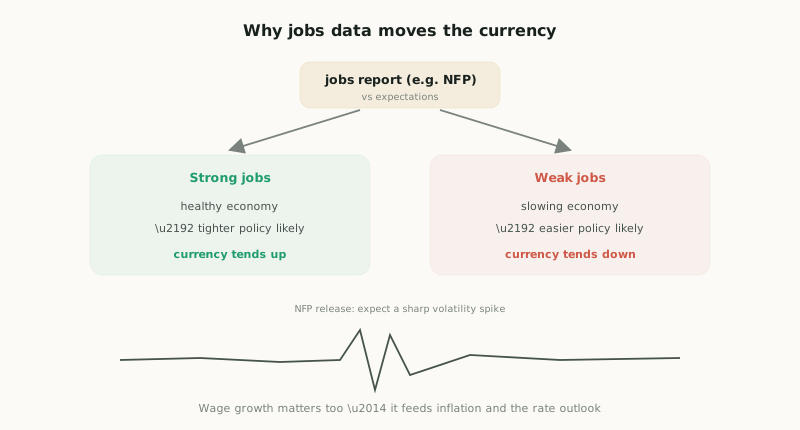
Why jobs data moves markets
Employment data is among the most important economic data for forex because it sits at the intersection of the two things that matter most for a currency: the health of the economy and the direction of central-bank policy. Employment is one of the clearest gauges of economic health — a strong, growing economy creates jobs, while a weakening one sheds them — so jobs data gives a direct read on how the economy is faring. And critically, employment is a direct input to central-bank policy: central banks care deeply about the labour market (the US Federal Reserve, for instance, has a "dual mandate" that explicitly includes maximum employment alongside price stability), so jobs data feeds directly into their interest-rate decisions.
This dual significance is why jobs data moves currencies so forcefully. The transmission runs: jobs data signals economic health, which shapes expectations of central-bank policy, which drives the currency (via the interest-rate channel). Strong jobs data signals a healthy, perhaps overheating economy, supporting the case for tighter policy (higher rates) — which tends to strengthen the currency. Weak jobs data signals a slowing economy, supporting easier policy (lower rates or stimulus) — which tends to weaken the currency. So traders watch jobs data not merely for what it says about the economy, but for what it implies the central bank will do — and since rate expectations are a dominant currency driver, a surprising jobs number that shifts those expectations moves the currency sharply. As with all such data, it is the figure relative to expectations that matters: a number far from the consensus forecast causes the biggest moves, because it forces the market to revise its rate-path expectations. This combination — a key economic gauge that directly informs the rate decision — makes employment data some of the most market-moving information in forex.
The key figures
Several figures within the employment data matter, each adding a dimension to the picture. The headline ones, focusing on the closely-watched US reports, are summarised below.
Key employment figures
Non-Farm Payrolls (NFP) is the headline figure: the number of jobs added or lost in the US economy in the month, excluding the farming sector (which is volatile and seasonal). Released on the first Friday of each month, NFP is the marquee employment release and one of the single most market-moving scheduled events in all of forex — a strong NFP (more jobs than expected) is typically dollar-positive, a weak one dollar-negative. The unemployment rate — the percentage of the workforce without a job — is released alongside it and gives another angle on labour-market health (a falling rate signals strength, a rising one weakness). And average hourly earnings (wage growth) is increasingly important: rising wages can fuel inflation (wage-push pressure), so strong wage growth raises expectations of tighter policy to contain inflation — linking the jobs report directly to the inflation story (and sometimes the wage figure moves the market more than the headline jobs number, when inflation is the market's focus). Together these figures — how many jobs, the unemployment rate, and how fast wages are rising — paint a picture of labour-market health and its implications for policy. Other economies have their own equivalent jobs reports (employment change, unemployment rate, wage data), which move their respective currencies similarly; the principles are the same, with the US NFP simply being the most prominent globally given the dollar's central role.
Handling the volatility
Employment releases, NFP above all, are famous for causing sharp volatility — sudden, large currency moves in the seconds and minutes around the release, often with the violent spikes, whipsaws, widening spreads and slippage that characterise major news events. This makes the jobs report a quintessential news-trading event, and everything the news-trading guide cautions applies here with full force: the post-release environment is hazardous, the reaction can be unpredictable (the market may move counterintuitively, or react more to the wage or revision figures than the headline number, or reverse sharply after an initial spike), and trying to trade the moment of release directly is high-risk and generally inadvisable, especially for beginners.
The prudent approach to employment data, for most traders, is therefore one of awareness and caution rather than aggressive trading. Know when it is coming — mark NFP (first Friday of the month) and other key jobs releases on your economic calendar (the calendar habit from the news-trading guide), since these are major scheduled risk events. Be cautious around the release — be aware that holding positions through NFP exposes you to its volatility, so consider reducing exposure, widening awareness of risk, or standing aside through the immediate aftermath rather than being caught in the chaos. Respect the unpredictability — even if you correctly guess the jobs number, the market's reaction is not guaranteed to follow, so pre-positioning on a forecast is a gamble. For those who do trade these events, the reactive approach (waiting for the dust to settle and trading the clearer subsequent move, with strict risk management) is far more sensible than gambling on the release itself, and many experienced traders simply avoid trading the immediate NFP reaction altogether. The broader value of employment data for most traders is informational: it is a key input to understanding the economic and policy backdrop that shapes a currency's longer-term direction (the fundamental picture behind position and swing trading), even if the volatile moment of release is best treated with caution rather than traded directly. Understanding what the jobs data means — for the economy, for central-bank policy, and thus for the currency — is valuable to every trader; trading the chaotic instant of its release is a specialist, high-risk activity to approach warily, if at all.
Jobs data in the wider picture
While the US Non-Farm Payrolls dominates attention, employment data is a global consideration: every major economy releases its own jobs figures — employment change, unemployment rate and wage data — and these move their respective currencies on the same logic (strong jobs supporting a firmer currency via tighter-policy expectations, weak jobs the reverse). A trader following, say, the British pound watches UK employment data; one trading the Australian dollar watches Australian jobs figures. The US NFP simply carries outsized global weight because of the dollar's central role and its influence on broad risk sentiment, but the principle is universal. When trading any currency, knowing its economy's key jobs releases — and the market's expectations for them — is part of reading its fundamental backdrop.
It is also important to read jobs data in context rather than in isolation. A single month's figure can be noisy, and the market weighs it against the recent trend, the revisions to prior months (which can be as significant as the headline number), and the other components (a strong headline jobs number with weak wage growth tells a different story than strong on both). The market also interprets the data through the lens of what the central bank is focused on: when inflation is the dominant concern, the wage-growth figure may move the currency more than the jobs count; when growth is the concern, the headline number and unemployment rate carry more weight. This is why the same NFP figure can produce different reactions at different times — the market reads it relative to expectations and relative to what it implies for the specific policy debate of the moment.
For most traders, then, the enduring value of employment data is as a key input to the fundamental picture that shapes a currency's medium-term direction — part of building the macro view that underlies swing and position trading and informs which way the fundamental winds are blowing. A run of strong jobs data building the case for tighter policy is a currency-supportive backdrop; deteriorating employment pointing toward easing is a currency-negative one. Watching the employment trend (not just isolated releases), alongside inflation and the central bank's stance, helps a trader understand the fundamental forces behind a currency's longer-term path — valuable context regardless of whether one trades the volatile release itself. Combined with awareness of the release as a scheduled high-volatility risk event (to be cautious around), this gives the complete, practical handling of employment data: read the trend and meaning for the fundamental picture, and respect the release as a risk event.
Employment data moves currencies because it gauges economic health and directly informs central-bank policy. The chain: jobs data → economic-health signal → rate-path expectations → currency. Strong jobs → tighter-policy case → currency tends up; weak jobs → easier-policy case → currency tends down (relative to expectations). Key US figures: Non-Farm Payrolls (NFP — the marquee release, first Friday monthly), the unemployment rate, and average hourly earnings (wage growth, an inflation signal); every major economy has its own equivalents. NFP causes sharp volatility — a classic high-risk news event to know about and be cautious around. Read jobs data in context (trend, revisions, what the central bank is focused on), not isolated prints. Its biggest value for most traders is informational — understanding the economic/policy backdrop — rather than trading the chaotic release itself.