Inflation — the rate at which prices rise and money loses purchasing power — is one of the most important fundamental drivers in forex, but its effect on a currency is more subtle than it first appears. Inflation pulls a currency in two opposite directions at once: in the short term it can strengthen the currency (by prompting interest-rate hikes), while in the long term it erodes the currency's value. Grasping this tension — and what decides which force wins — is the key to reading inflation correctly, and it explains why high-inflation news sometimes sends a currency up when intuition says it should fall. This guide explains both forces, the central role of the central bank's response, why CPI releases matter, and how to make sense of it all.
It connects tightly to interest rates and central-bank policy (the short-term channel) and to purchasing power parity (the long-term one).
Key takeaways
Q: How does inflation affect a currency?
A: Inflation affects a currency through two opposing forces. In the short term, rising inflation often prompts the central bank to raise interest rates, which tends to strengthen the currency. In the long term, inflation erodes the currency's purchasing power, which tends to weaken it. Which dominates depends on the central bank's response.
Q: Why does higher inflation sometimes strengthen a currency?
A: Because in the modern policy regime, higher-than-expected inflation raises expectations that the central bank will hike interest rates to control it — and higher rates attract yield-seeking capital, increasing demand for the currency. So a credible central-bank response to inflation can strengthen the currency, at least in the near term.
Q: What is CPI and why does it matter for forex?
A: CPI (the Consumer Price Index) is the main measure of inflation, tracking the change in prices of a basket of goods and services. CPI releases are major market events because they shape expectations of central-bank interest-rate policy — a key driver of currency value — so surprises can move currencies sharply.
The short-term force: rate hikes
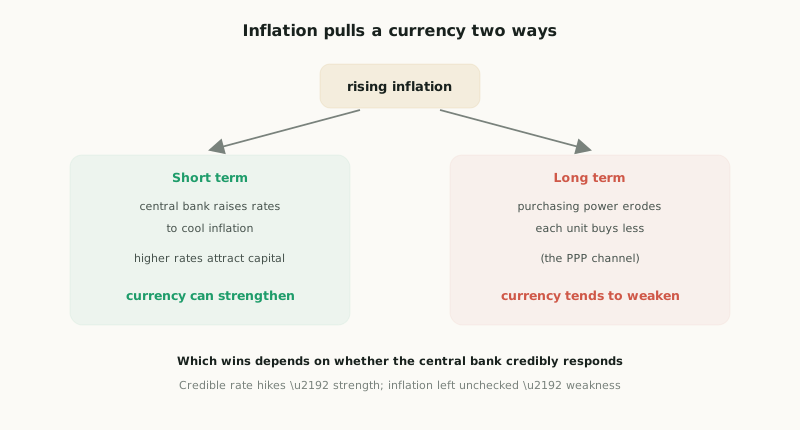
The first and most immediate way inflation affects a currency runs through the central bank's interest-rate response, and it often works in a counterintuitive direction. In the modern monetary regime, central banks have an inflation target (commonly around 2%) and a mandate to control inflation — so when inflation rises above target, the central bank typically responds by raising interest rates to cool the economy and bring inflation back down. And higher interest rates, as the interest-rates guide explains, tend to strengthen the currency by attracting yield-seeking international capital. So the chain is: higher inflation → expected rate hikes → currency strength.
This is why, in practice, a higher-than-expected inflation reading often causes a currency to rise, not fall — a result that puzzles newcomers who reason that inflation "devalues" money. The market is forward-looking: it sees high inflation and immediately anticipates the central bank raising rates (or raising them faster/further) to combat it, and it bids the currency up on those rate-hike expectations. The currency strengthens not because of the inflation itself, but because of the policy response the inflation is expected to trigger. This short-term, expectations-driven, rate-hike channel is usually the dominant force in the immediate market reaction to inflation data in economies with credible, responsive central banks — which is most major economies. It is the key to understanding why inflation news so often moves currencies in the "wrong" direction relative to naive intuition: in the short run, the market trades the expected central-bank response, and a central bank credibly fighting inflation with higher rates is currency-supportive. This makes inflation data, especially CPI, a major market-moving event watched precisely for what it implies about the rate path.
The long-term force: erosion
The second force runs in the opposite direction and operates over the long term: inflation erodes a currency's purchasing power. This is the more intuitive effect — if prices are rising, each unit of the currency buys less over time, so the currency is losing real value. Sustained inflation debases the currency: a money that loses, say, 10% of its purchasing power each year is fundamentally worth less, and over time this erosion tends to be reflected in a weaker exchange rate. This is the channel captured by purchasing power parity (PPP), the theory (covered in its own guide) that exchange rates adjust over the long run to reflect relative price levels — so currencies of persistently higher-inflation countries tend to depreciate against those of lower-inflation countries, as the higher inflation erodes their relative value.
So over the long run, high inflation is currency-negative: a country with chronically high inflation will tend to see its currency weaken, because the currency is genuinely losing value relative to goods and to lower-inflation currencies. This is the force that intuition grasps — inflation devalues money — and it is real and powerful over extended horizons. The apparent contradiction with the short-term force is the crux of understanding inflation in forex: in the short term, rising inflation can strengthen a currency (via expected rate hikes), while in the long term, sustained high inflation weakens it (via erosion of purchasing power). The two forces operate on different horizons and through different channels — short-term policy response versus long-term value erosion — and a complete understanding holds both in mind.
Inflation's two effects work on different clocks. Short term: rising inflation → expected rate hikes → currency often strengthens (the market trades the policy response). Long term: sustained inflation erodes purchasing power → currency weakens (PPP). This is why a hot CPI print can send a currency up today even though inflation "devalues" money over years — the market is pricing the central bank's reaction, not the erosion.
What decides which wins
If inflation pulls the currency both ways, what determines the net effect? The decisive factor is the central bank's response — specifically, whether it credibly acts to control inflation. This is the key that resolves the tension. If the central bank responds to rising inflation credibly and decisively — raising rates enough to bring inflation back toward target — then the short-term strengthening force tends to prevail and inflation can be currency-positive: the market trusts that rates will rise and that inflation will be controlled, so it bids the currency up on the higher-rate expectation, and the long-term erosion is contained by the central bank's action. A credible inflation-fighting central bank, in effect, converts an inflation problem into a rate-hike (currency-supportive) story.
But if the central bank fails to respond adequately — if it is "behind the curve," unwilling or unable to raise rates enough (perhaps for political reasons, or because the economy is too fragile), or if inflation is spiralling out of control — then the picture inverts and inflation becomes currency-negative: with rates not rising enough to compensate, the erosion of purchasing power dominates, confidence in the currency erodes, and it weakens (in extreme cases, runaway inflation can collapse a currency entirely). So the resolution is: credible central-bank response → inflation can strengthen the currency (short-term rate-hike channel wins); inadequate response or out-of-control inflation → inflation weakens the currency (erosion channel wins). This is why the quality and credibility of a country's central bank and monetary policy matters so much for how its currency responds to inflation — and why the same inflation reading can be bullish for a currency with a credible central bank and bearish for one without. The practical reading: when inflation data arrives, the market's reaction hinges on what it implies the central bank will do, so traders watch not just the inflation number but its implications for the rate path and the central bank's likely response. For currencies of credible major economies, the short-term rate-hike channel usually dominates the immediate reaction; the long-term erosion channel asserts itself over time and especially where central-bank credibility is weak.
CPI and trading inflation
Inflation is measured chiefly by the Consumer Price Index (CPI), which tracks the change in prices of a representative basket of goods and services — the headline inflation gauge (related measures include core CPI, which strips out volatile food and energy, and producer prices). For the forex trader, CPI releases are major market events (among the most important economic indicators, as the indicators guide notes), precisely because they shape expectations of central-bank interest-rate policy — the dominant short-term driver. A CPI reading relative to expectations is what moves markets: inflation higher than expected typically raises rate-hike expectations and tends to strengthen the currency (the short-term channel), while inflation lower than expected eases rate-hike expectations and tends to weaken it. Because of this, CPI days often bring sharp volatility, making them significant for news trading (with all the cautions that entails) and important risk events for any open position.
The practical, honest framing for using inflation in forex pulls the threads together. Understand that inflation works through two opposing forces on different horizons — short-term rate-hike strength and long-term erosion — and that the central bank's credible response usually decides which dominates. In the short term and for major credible-central-bank currencies, focus on what an inflation reading implies for the rate path: higher inflation generally means a more hawkish central bank and a firmer currency (the rate channel), which explains the common "hot CPI, stronger currency" reaction. Over the long term and especially for weak-credibility currencies, remember that sustained high inflation erodes value and tends toward depreciation (the PPP channel). Watch CPI as a key event, read it relative to expectations and through the lens of the likely central-bank response, and respect the volatility it brings. Inflation, properly understood, is not simply "good" or "bad" for a currency — it is a force whose currency effect depends on horizon and, above all, on how credibly the central bank responds. That nuanced understanding, rather than the naive "inflation devalues money" or the equally naive "high inflation always lifts the currency," is what allows a trader to read this crucial driver correctly.
Inflation affects a currency through two opposing forces. Short term: rising inflation → expected central-bank rate hikes → currency often strengthens (the market prices the policy response — why a hot CPI can lift a currency). Long term: sustained inflation erodes purchasing power → currency weakens (the PPP channel). What decides the net effect is the central bank's credible response: a decisive inflation-fighting bank lets the strengthening channel win; an inadequate response or out-of-control inflation lets erosion win and weakens the currency. CPI is the key measure and a major market event — read relative to expectations and through the likely rate-path response. Inflation isn't simply good or bad for a currency; its effect depends on horizon and central-bank credibility.