If the same basket of goods costs noticeably more in one country than in another, something, in theory, has to give. Purchasing power parity (PPP) is the elegant idea that exchange rates should adjust so that identical goods cost the same everywhere — that currencies should be valued according to what they can actually buy. It is one of the foundational theories of currency valuation, the basis of the famous Big Mac Index, and a useful long-run anchor for judging whether a currency is cheap or expensive. It is also, as we will see, a poor short-term predictor that currencies can defy for years. This guide explains what PPP is, its forms, the Big Mac Index, and how to use it sensibly.
It is one of the classic valuation theories within fundamental analysis, and it pairs with its sibling theory, interest rate parity.
Key takeaways
Q: What is purchasing power parity?
A: Purchasing power parity (PPP) is an economic theory that exchange rates should adjust so that an identical basket of goods costs the same across countries. If goods are cheaper in one country, its currency is considered undervalued and, in theory, should appreciate over the long run until prices equalise.
Q: What is the Big Mac Index?
A: The Big Mac Index, created by The Economist, is a light-hearted application of PPP that compares the price of a Big Mac across countries. If a Big Mac is much cheaper in one country, its currency may be undervalued against the dollar by that theory — a simple, intuitive gauge of over- or undervaluation.
Q: Does purchasing power parity work for forex trading?
A: PPP is a long-run concept, not a short-term trading tool. Currencies can deviate from PPP for years because capital flows, interest rates and sentiment dominate the short term. PPP is useful as an anchor for judging whether a currency is broadly over- or undervalued over long horizons.
The core idea
Purchasing power parity builds on a simple principle called the law of one price: an identical good should cost the same in different countries once you account for the exchange rate, because otherwise people would buy where it is cheap and sell where it is dear until the prices converged. Extend this from a single good to a whole basket of goods, and you get PPP: the exchange rate between two currencies should, in theory, equal the ratio of the price levels in the two countries, so that the basket costs the same in both.
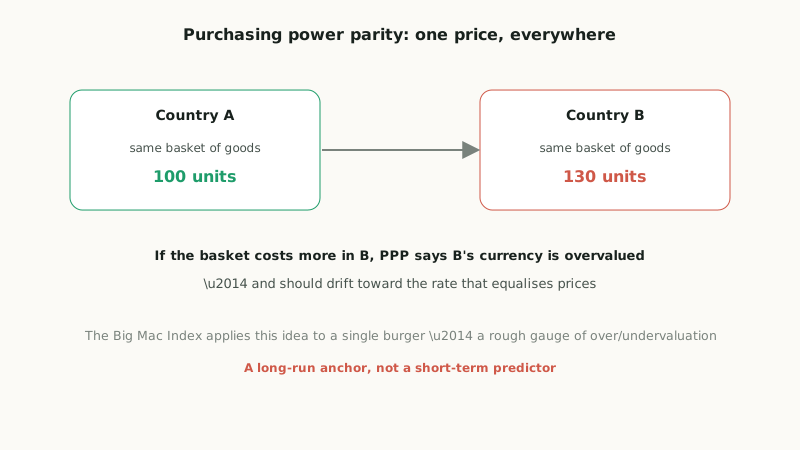
The practical implication is a way to judge whether a currency is over- or undervalued. If a basket of goods costs more in Country B than in Country A at the current exchange rate, then by PPP, Country B's currency is overvalued — it should, over the long run, depreciate toward the rate that equalises the prices. Conversely, a country where goods are cheap has an undervalued currency that should appreciate. PPP thus provides a theoretical "fair value" for an exchange rate, anchored in the relative cost of living and goods between two economies, against which the actual market rate can be compared.
Absolute and relative PPP
PPP comes in two forms. Absolute PPP is the strong version described above: that exchange rates should equalise the price levels of identical baskets, so the actual cost is the same in both countries. Absolute PPP rarely holds precisely in reality, for reasons we will cover, but it provides the conceptual ideal. Relative PPP is the weaker, more practical version: it focuses on changes rather than levels, holding that the change in an exchange rate over time should track the difference in inflation rates between the two countries.
Relative PPP is the more useful and empirically supported form. Its logic: if Country B has higher inflation than Country A, B's goods become relatively more expensive over time, so B's currency should depreciate against A's by roughly the inflation differential to keep purchasing power aligned. This links PPP directly to inflation — a currency in a high-inflation country tends, over the long run, to weaken against one in a low-inflation country. This is one of the more durable insights of currency economics: persistently higher inflation tends to erode a currency's value over time, a connection that also underlies why inflation matters so much in fundamental analysis and why "real" (inflation-adjusted) returns matter for interest rates.
The Big Mac Index
The most famous and accessible application of PPP is the Big Mac Index, created by The Economist as a light-hearted but genuinely instructive gauge. The idea is delightfully simple: a Big Mac is a roughly standardised product sold in many countries, so comparing its local price across countries gives a quick, intuitive PPP comparison. If a Big Mac costs much less (converted at the current exchange rate) in one country than in another, that country's currency may be undervalued by the Big Mac measure, and vice versa.
The Big Mac Index works because it sidesteps the difficulty of defining and pricing a complex basket of goods — it uses one familiar item as a proxy. It is not meant to be taken too seriously as a precise valuation (a single burger is hardly a full economy), but it brilliantly illustrates the PPP concept and provides a memorable, rough sense of which currencies look cheap or expensive against the dollar. Its enduring popularity shows the intuitive appeal of PPP: the idea that a currency's value should ultimately relate to what it can actually buy in the real world, reducible even to the price of a hamburger. For learning the PPP concept, the Big Mac Index is the perfect entry point.
PPP says a currency is "worth" what it can buy — so if goods are cheap in a country, its currency is undervalued and should rise over the long run, and vice versa. The Big Mac Index makes this tangible with a single burger. But "long run" is the crucial caveat: currencies can ignore PPP for years.
The limitations
PPP's limitations are as important as its insights, and they explain why it is a long-run anchor rather than a trading tool. First, not all goods are tradeable: services, housing, haircuts and many other things cannot be bought in one country and sold in another, so their prices need not equalise, and they make up a large part of any real basket. Second, transport costs, tariffs and trade barriers prevent the arbitrage that PPP assumes would equalise prices. Third, productivity differences between rich and poor countries systematically affect price levels (the Balassa-Samuelson effect), so prices legitimately differ.
Most importantly for traders, in the short and medium term, currency values are dominated not by relative prices but by capital flows, interest rates and sentiment — the very forces covered elsewhere in this section. Money moving for yield, safety or speculation swamps the slow, goods-based logic of PPP, so currencies can deviate from their PPP "fair value" for years. This is why PPP is useless as a short-term trading signal: a currency that is "overvalued" on PPP can keep rising for a long time if capital keeps flowing to it. PPP's proper role is as a long-run anchor — a sense of fair value that exchange rates tend to drift toward over many years, and a useful piece of context, but never a timing tool or a short-term prediction.
Using PPP sensibly
For the forex trader, PPP is best understood as background context rather than an actionable signal. It offers a sense of whether a currency is broadly cheap or expensive on a long-term, fundamental basis — useful perspective for a position trader thinking in terms of months and years, or for understanding the deep, slow forces that may eventually pull a stretched currency back toward fair value. But it says nothing about when any such reversion will occur, and trading on PPP alone, against the powerful short-term forces of rates and sentiment, is a recipe for being early and wrong for a long time.
The sensible synthesis is to treat PPP as one input among many: a long-run valuation reference that complements the shorter-term analysis of interest rates, central bank policy, risk sentiment and economic data. A currency that is both fundamentally overvalued on PPP and showing signs of capital flight or a shift in rate expectations is a more compelling case than either signal alone. PPP reminds us that, beneath the daily churn of flows and sentiment, there is an anchor of real economic value — currencies represent purchasing power — even if that anchor exerts its pull only slowly and over long horizons. Understanding PPP deepens one's grasp of what a currency fundamentally is, which is valuable even though it rarely tells you what to do today.
The real exchange rate and competitiveness
A concept closely related to PPP, and valuable in its own right, is the real exchange rate — the exchange rate adjusted for the difference in price levels (inflation) between two countries. Where the nominal exchange rate is the headline rate you see quoted, the real exchange rate accounts for what each currency can actually buy, reflecting the relative purchasing power that PPP is concerned with. It is, in effect, a measure of how far the actual rate sits from its PPP-implied fair value, and of a country's price competitiveness in international trade.
This connects PPP to the trade balance and competitiveness. When a currency is "overvalued" relative to PPP — a high real exchange rate — the country's goods are expensive on world markets, which tends to hurt its exports and widen its trade deficit; an "undervalued" currency (low real exchange rate) makes exports cheap and competitive, supporting the trade balance. Over long horizons, these trade effects are part of the mechanism that can slowly pull a currency back toward PPP fair value: a persistently overvalued currency's deteriorating trade position can eventually weigh on it. This is why economists and policymakers watch real exchange rates as gauges of competitiveness, and why a country with a chronically overvalued real exchange rate may face pressure for its currency to weaken over time.
For the trader, the real exchange rate deepens the PPP idea from a simple price comparison into a richer measure of competitiveness and long-run pressure — still a slow, long-horizon force rather than a trading signal, but a meaningful piece of the fundamental picture. It reinforces PPP's core lesson: beneath the short-term churn of flows and sentiment, there is a real-economy anchor of purchasing power and competitiveness that exerts a slow pull on exchange rates over the long run, even as the faster forces dominate day to day.
Purchasing power parity says exchange rates should adjust so identical goods cost the same across countries — a currency where goods are cheap is undervalued and should rise long-term. Relative PPP links currency changes to inflation differentials. The Big Mac Index makes it tangible, and the real exchange rate (nominal adjusted for inflation) measures competitiveness and distance from fair value. But PPP is a long-run anchor, not a short-term tool: capital flows, rates and sentiment dominate for years, so use it for context and fair-value perspective, never as a timing signal.