
Interest rate parity (IRP) is the "no free lunch" theory of currencies. It says that the advantage of holding a higher-interest-rate currency should be exactly offset by that currency weakening in the future — so that you cannot make a risk-free profit simply by borrowing where rates are low and investing where they are high. When IRP holds, the apparent free money from interest differentials evaporates. When it fails, as one version frequently does, the carry trade is born. IRP is thus both a cornerstone of currency theory and the key to understanding why the carry trade works. This guide explains the theory, its two forms, and the famous puzzle at its heart.
It is the sibling valuation theory to purchasing power parity, and it directly explains the carry trade covered in this section.
Key takeaways
Q: What is interest rate parity?
A: Interest rate parity is a theory linking interest rates to spot and forward exchange rates. It holds that the interest rate difference between two countries should equal the difference between the forward and spot exchange rates, so that no risk-free profit can be made from borrowing in a low-rate currency to invest in a high-rate one.
Q: What is the difference between covered and uncovered interest rate parity?
A: Covered interest rate parity uses a forward contract to hedge the exchange-rate risk and holds very tightly in practice, as it is an arbitrage condition. Uncovered interest rate parity is unhedged and predicts the high-rate currency will depreciate on average — but it often fails empirically, which is what makes the carry trade profitable.
Q: Why does interest rate parity matter for the carry trade?
A: The carry trade is essentially a bet that uncovered interest rate parity will not hold — that a high-yield currency will not depreciate enough to offset its interest advantage. Because uncovered parity frequently fails in the short to medium term, carry traders can profit from the interest differential.
The core idea
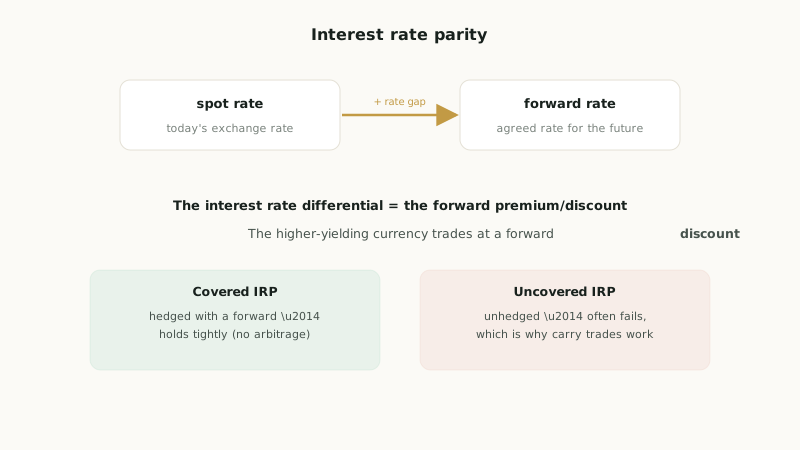
Interest rate parity links three things: the interest rates of two countries, the spot exchange rate (today's rate), and the forward exchange rate (a rate agreed now for exchanging currencies at a future date). The theory holds that the interest rate differential between two countries should equal the difference between the forward and spot rates. In plainer terms: if one currency offers a higher interest rate, its forward rate should be at a discount to its spot rate — the market is pricing in that the high-rate currency will be worth less in the future, by just enough to offset its interest advantage.
The logic is an arbitrage argument. Suppose Country B offers higher interest than Country A. An investor could borrow in A's low-rate currency, convert to B's currency, and earn B's higher rate — seemingly free profit. IRP says this cannot be a risk-free gain, because the forward exchange rate (or the currency's expected future move) will price in a depreciation of B's currency that exactly cancels the interest advantage. If it did not, traders would pour into the trade until the rates adjusted. The higher interest is, in effect, the market's compensation for an expected currency loss — the two offset, leaving no free lunch. This is why a high-yielding currency typically trades at a forward discount.
Covered interest rate parity
Covered interest rate parity (CIRP) is the version where the exchange-rate risk is hedged using a forward contract. The investor borrowing in the low-rate currency and investing in the high-rate one simultaneously locks in a forward contract to convert back at a known future rate, eliminating the uncertainty about where the exchange rate will be. With the risk hedged away, CIRP becomes a pure arbitrage condition: if it did not hold, traders could lock in a guaranteed risk-free profit, so any deviation is rapidly arbitraged away.
For this reason, covered interest rate parity holds very tightly in practice, especially in liquid major currencies under normal conditions. It is one of the most reliable relationships in international finance, precisely because it is enforced by riskless arbitrage — the forward rate adjusts to make the hedged returns equal, leaving no free profit. (Deviations can appear during financial crises when the arbitrage machinery is stressed, but in normal times CIRP is close to an iron law.) The practical takeaway: forward exchange rates are not predictions of the future spot rate so much as the mathematical consequence of interest rate differentials, set by the no-arbitrage logic of covered parity. The forward discount on a high-yield currency simply reflects its interest advantage.
Uncovered interest rate parity and the puzzle
Uncovered interest rate parity (UIRP) is the version without hedging — and here things get interesting. UIRP predicts that, on average, the high-interest-rate currency will actually depreciate by the interest differential, so that the unhedged investor earns no excess return: the extra interest is exactly eaten by the currency falling. This is the same offsetting logic as covered parity, but applied to the expected actual future exchange rate rather than a hedged forward rate.
The famous problem is that uncovered interest rate parity frequently does not hold in the real world, at least over the short to medium term — an anomaly known as the "forward premium puzzle." Empirically, high-interest-rate currencies often do not depreciate as UIRP predicts; they may hold steady or even appreciate, so unhedged investors in high-yield currencies frequently earn the interest differential without the offsetting currency loss the theory predicts. This persistent failure of UIRP is one of the most studied anomalies in finance, and it has a direct, practical consequence: it is precisely what makes the carry trade profitable. The carry trade — borrowing low-yield, investing high-yield, unhedged — is in essence a bet that UIRP will fail, that the high-yield currency will not depreciate enough to cancel the carry. Because UIRP does fail much of the time, the carry trade often works — until, in the violent unwinds covered in the carry trade guide, the market abruptly enforces the depreciation UIRP predicted all along.
The two versions diverge sharply in reality. Covered parity (hedged) holds almost ironclad — it's pure arbitrage. Uncovered parity (unhedged) often fails — high-yield currencies frequently don't fall as predicted, which is the entire reason the carry trade can profit. The carry trade is a bet against uncovered interest rate parity.
What this says about forward rates
A valuable practical insight from IRP concerns the nature of forward exchange rates. Because covered parity holds so tightly, the forward rate is determined almost entirely by the interest rate differential — it is the spot rate adjusted for the rate gap, not a market forecast of where the currency will actually go. This is a common point of confusion: people assume a forward rate showing a currency at a discount means the market "expects" that currency to fall. In truth, the forward discount is just the mechanical consequence of the interest differential under covered parity, not a genuine prediction.
This matters because it clarifies what forward rates do and do not tell you. They do not reliably predict future spot rates — indeed, the failure of uncovered parity means the forward rate is often a biased predictor, systematically over-predicting the depreciation of high-yield currencies. Understanding this prevents the error of treating forward rates as the market's exchange-rate forecast. The forward rate is an interest-rate-derived construct; the actual future spot rate is driven by the full range of forces — rates, sentiment, flows, the cycle — covered throughout this section, and frequently defies what the forward rate "implied." IRP teaches that interest rates and exchange rates are deeply linked, but not in the simple, predictive way one might first assume.
Using IRP as a trader
Like PPP, interest rate parity is more a framework for understanding than a direct trading signal. Its practical value lies in illuminating why the relationships traders observe exist: why high-yield currencies trade at forward discounts, why forward rates behave as they do, and — most usefully — why the carry trade can be profitable yet carries the lurking risk of a violent correction. A trader who understands that the carry trade is a bet against uncovered parity also understands its fundamental risk: that the market can, and periodically does, enforce the parity that carry traders bet against, producing the sharp unwinds that wipe out accumulated carry.
IRP also reinforces the central role of interest rates in forex and connects the dots between the interest rates guide, the carry trade guide, and the behaviour of forward markets. For most traders, the key takeaways are conceptual: covered parity is reliable (forward rates are interest-derived, not forecasts), uncovered parity often fails (creating carry opportunities and their attendant risks), and the deep link between rates and currencies is more subtle than "high rates mean a strong currency forever." Holding these ideas clearly — alongside PPP's long-run valuation anchor — gives a trader a sophisticated grasp of the theoretical scaffolding beneath the everyday forces of forex, even if the theories themselves are rarely traded directly.
How the two parity theories fit together
Interest rate parity and purchasing power parity are the two great currency-valuation theories, and they fit together as complementary parts of a bigger picture. PPP anchors exchange rates to relative prices and inflation over the long run — the slow, goods-based pull toward a fair value where purchasing power is equalised. IRP links exchange rates to interest rates through the forward market, operating on the financial side rather than the goods side. Together they connect a currency's value to both the real economy (prices, via PPP) and the financial economy (rates, via IRP).
There is even a deep consistency between them. Inflation and interest rates are themselves linked — higher inflation tends to bring higher nominal interest rates — so the two theories are looking at related forces from different angles. A high-inflation country tends to have both higher nominal interest rates (relevant to IRP, implying a forward discount) and a currency that should depreciate over time (relevant to relative PPP, also implying weakness). The theories thus point in broadly the same direction: the currency of a high-inflation, high-nominal-rate economy is expected to weaken over time, whether you reach that conclusion through PPP's inflation logic or IRP's forward-rate logic. This coherence is reassuring — the two foundational theories of currency valuation, approached from the goods side and the financial side, broadly agree.
For the trader, the combined lesson is humbling and useful. Both theories describe forces that operate reliably only over long horizons or under arbitrage-enforced conditions (covered IRP), while the unhedged, short-term reality (uncovered IRP, short-run PPP deviations) is dominated by capital flows, sentiment and the cycle — and frequently defies the theories. This is precisely why these elegant theories are frameworks for understanding rather than trading signals: they reveal the slow anchors and the no-arbitrage constraints beneath the market, while the day-to-day action is driven by the faster forces covered throughout this section. Knowing both the anchors and the forces that pull against them is what a sophisticated fundamental understanding provides.
Interest rate parity links interest rates, spot and forward exchange rates: the rate differential equals the forward premium/discount, so a high-yield currency trades at a forward discount. Covered IRP (hedged) holds tightly as arbitrage; uncovered IRP (unhedged) often fails — which is why the carry trade profits and risks violent unwinds. It complements PPP: IRP works through rates and forwards, PPP through prices and inflation, and both imply high-inflation, high-rate currencies weaken over time. Both are long-run/arbitrage frameworks, not short-term signals.