
A rectangle is the market taking a breather: price bouncing between flat support and resistance while buyers and sellers reach a temporary stalemate. It's the most basic pattern of all — simply a defined trading range — and its power lies in what happens when the stalemate finally breaks. As a chart pattern, the rectangle is neutral until the breakout: it can resolve into a continuation of the prior trend or a reversal, depending on which way price eventually breaks. This guide explains how rectangles form, why they're neutral until resolution, and the two main ways to trade them — deepening the chart-patterns material with the simplest, most fundamental consolidation pattern.
It's a deep-dive within chart patterns, built directly on support and resistance (a rectangle is a range bounded by them), and central to range trading.
Key takeaways
Q: What is a rectangle chart pattern?
A: A rectangle is a consolidation pattern where price moves sideways between roughly horizontal support and resistance levels, bouncing between the two for a period. It represents a pause or balance between buyers and sellers, and resolves when price eventually breaks out of the range.
Q: Is a rectangle a continuation or reversal pattern?
A: A rectangle can be either. Most often it's a continuation pattern — price pauses then resumes the prior trend — but it can also mark a reversal. The pattern itself is neutral until the breakout; the direction price breaks out determines whether it's a continuation or a reversal.
Q: How do you trade a rectangle pattern?
A: Two main ways: range-trade within it (buying near support, selling near resistance), or trade the breakout when price decisively breaks out of the range. The breakout approach often uses a measured target of the rectangle's height projected from the breakout, with a stop on the other side.
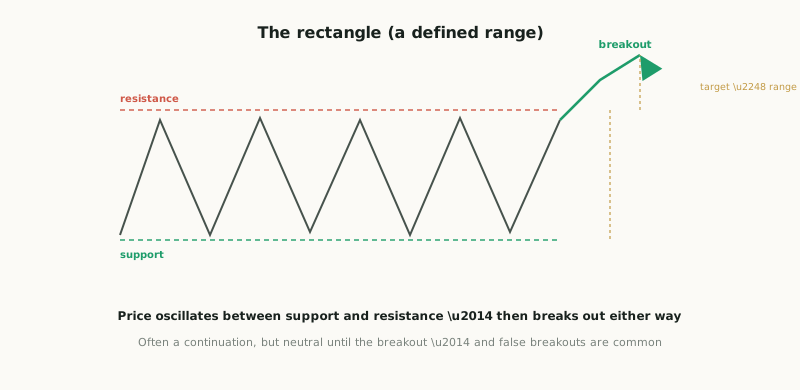
What a rectangle is
A rectangle is a consolidation pattern in which price moves sideways between roughly horizontal support and resistance levels, bouncing back and forth between the two for a period of time. Connecting the highs gives a flat (horizontal) resistance line, and connecting the lows gives a flat support line, forming a rectangle shape — hence the name. Price oscillates within this range, repeatedly testing both boundaries (ideally touching each a few times), neither breaking out higher nor lower, until it eventually does. The rectangle is, in essence, a clearly defined trading range drawn as a pattern.
What a rectangle represents is a pause or balance between buyers and sellers — a period of consolidation, equilibrium, or indecision after a prior move. Within the range, neither side can gain the upper hand: every rally to resistance is met by sellers, every dip to support is met by buyers, so price churns sideways in a temporary stalemate. This consolidation can reflect the market digesting a prior trend (catching its breath before continuing), or a battle being fought that will determine the next direction (accumulation or distribution). The rectangle thus captures a moment of equilibrium and indecision — a pause in the action — whose resolution (the breakout) reveals which side ultimately won and where price goes next. Because it's such a basic, common formation, the rectangle appears constantly across all timeframes, and recognising it — a clean sideways range between flat support and resistance — is one of the most fundamental pattern-reading skills.
Neutral until the breakout
The crucial point about the rectangle is that it is neutral until the breakout — the pattern itself doesn't tell you which way price will go; the breakout direction does. This sets it apart from patterns with a built-in bias (like a head and shoulders, which is bearish, or a falling wedge, which is bullish): a rectangle is direction-agnostic, a pause that could resolve either way.
A rectangle is most often a continuation pattern — price pauses in the range, then breaks out in the same direction as the prior trend and resumes it (an uptrend pausing then continuing up, a downtrend pausing then continuing down). But it can also be a reversal — the range marking a top or bottom, with price breaking out against the prior trend. Crucially, you don't know which until price breaks out: the rectangle is neutral, and the breakout direction reveals whether it was a continuation or a reversal. So don't assume — wait for the break, then follow it.
This neutrality has a clear practical consequence: don't pre-judge the direction. While rectangles lean toward being continuation patterns (so the prior trend is a reasonable default expectation), the honest stance is to treat the pattern as undecided until price actually breaks one boundary or the other, and then to follow the confirmed direction. The breakout is the moment of resolution — it reveals which side won the stalemate and sets the next move. A breakout above resistance signals price heading higher (continuation of an uptrend, or reversal of a downtrend); a breakout below support signals price heading lower (continuation of a downtrend, or reversal of an uptrend). Until then, the rectangle is just a range, and its eventual direction is unknown. This is why patient confirmation matters so much with rectangles: acting on an assumed direction before the breakout is guessing, whereas trading the actual breakout follows what the market reveals.
Two ways to trade it
Because a rectangle is a defined range that eventually breaks, there are two main ways to trade it, suited to different styles. The first is to range-trade within it: while price is oscillating between the boundaries, buy near support (expecting a bounce up toward resistance) and sell near resistance (expecting a rejection back down toward support) — the classic range-trading approach (covered in the range-trading guide), profiting from the back-and-forth within the rectangle. This works while the range holds, but carries the risk that the range eventually breaks (so a position near a boundary can be caught by a breakout in that direction — stops just beyond the boundaries manage this). The second is to trade the breakout: wait for price to break decisively out of the range (above resistance or below support), and trade in the breakout's direction, capturing the move that follows the resolution of the stalemate. This suits those who prefer to trade the trend that emerges from consolidation rather than the chop within it.
For the breakout approach, the conventional measured move projects the height of the rectangle (the distance between support and resistance) from the breakout point as a rough target, with a stop placed back inside the range (beyond the broken boundary) so a false breakout is cut quickly. And false breakouts are a real and common hazard with rectangles — price can briefly poke beyond a boundary and then snap back into the range (a "fakeout"), trapping breakout traders — which is why confirmation (a convincing close beyond the boundary, supportive volume, or confluence) is especially valuable here, and why stops are essential. The honest framing applies as to all patterns: the rectangle is a probabilistic tool, not a guarantee; it's neutral until resolved, prone to false breakouts, and must be traded with confirmation and risk management. Used well — recognising the range, deciding whether to trade within it or wait for the breakout, demanding confirmation (especially against fakeouts), using a measured target and protective stops — the rectangle is one of the most useful and common patterns, marking the market's pauses and, on the breakout, its next move. As the simplest pattern, it's also a foundation: master the rectangle, and you understand the consolidation-and-breakout dynamic that underlies much of chart-pattern trading.
Rectangles in context
A few further points help in using rectangles well. On timeframes, rectangles appear across all of them — from a few bars of intraday consolidation to multi-month ranges on the daily or weekly chart — and the pattern's significance generally scales with its size and duration: a long, well-defined rectangle on a higher timeframe, tested several times on each side, marks a more meaningful level of consolidation (and a more significant eventual breakout) than a brief intraday pause. The more touches of each boundary and the longer the range holds, the more robust the support and resistance lines, and the more telling the breakout when it comes. This connects rectangles directly to the broader support-and-resistance and multi-timeframe ideas: a rectangle is essentially a well-defined range, and the same level may be visible across timeframes.
On volume and the build-up, volume often contracts during a rectangle as the range matures (the market quiet during consolidation, with diminishing participation as the stalemate persists), and a genuine breakout is more convincing when accompanied by an expansion in volume — a surge of participation as the range resolves and one side finally wins. A breakout on thin volume is more suspect (more prone to being a fakeout). Some traders also watch for the range to tighten toward the end (a "coiling" or squeeze), which can precede a more forceful breakout. Finally, on distinguishing rectangles from other patterns: a rectangle has flat, horizontal boundaries (parallel support and resistance), which separates it from triangles (converging lines), wedges (converging, same-direction-sloping lines) and channels (parallel but sloping lines). The horizontal, parallel boundaries are the rectangle's signature. Keeping these in view — timeframe and size, the volume pattern, and the horizontal-boundary identification — helps a trader read rectangles accurately and weigh the reliability of their breakouts, rather than treating every sideways wiggle as a significant pattern.
A rectangle is a consolidation pattern — price oscillating sideways between roughly horizontal support and resistance — representing a pause or balance between buyers and sellers. It's neutral until the breakout: most often a continuation but sometimes a reversal, and only the breakout direction reveals which, so don't pre-judge. Two ways to trade it: range-trade within it (buy support, sell resistance, stops beyond the boundaries), or trade the breakout (decisive break, target the rectangle's height from the breakout, stop back inside). False breakouts are common, so confirmation (a convincing close, expanding volume, confluence) and stops are essential — volume often contracts in the range and should expand on a real breakout. Significance scales with size, duration and number of touches; horizontal parallel boundaries are its signature (vs converging triangles/wedges or sloping channels). Probabilistic, not guaranteed — trade with confirmation and risk management.