Support and resistance is the most fundamental concept in technical analysis — the levels where price tends to pause, reverse, or break. Almost every chart-based method rests on it: chart patterns are built from it, ranges are bounded by it, breakouts are breaks of it, and countless strategies use it to place entries, stops and targets. If you understand support and resistance well, the rest of technical analysis makes far more sense; if you don't, much of it will seem arbitrary. This guide explains what these levels are, why they form, the important phenomenon of role reversal, and how to identify and trade them — the foundation on which the whole technical-analysis toolkit is built.
It underpins market structure, range trading and breakouts, and is a key ingredient of confluence.
Key takeaways
Q: What are support and resistance?
A: Support is a price level or zone where buying interest tends to halt or reverse a decline; resistance is a level where selling tends to halt or reverse a rise. They are areas where price has repeatedly struggled to move beyond, marking where supply and demand shift the balance.
Q: Why do support and resistance levels form?
A: They form from concentrations of supply and demand, market memory (traders remember and react to past levels), clustered orders (stops and targets gather around them), and psychological round numbers. Prior swing highs and lows often become future resistance and support as traders watch and act on them.
Q: What is role reversal in support and resistance?
A: Role reversal (or polarity) is when a broken support level becomes resistance, or a broken resistance becomes support. Once price breaks through a level, the orders and psychology around it flip, so the level often acts in the opposite role when price returns to test it.
What support and resistance are
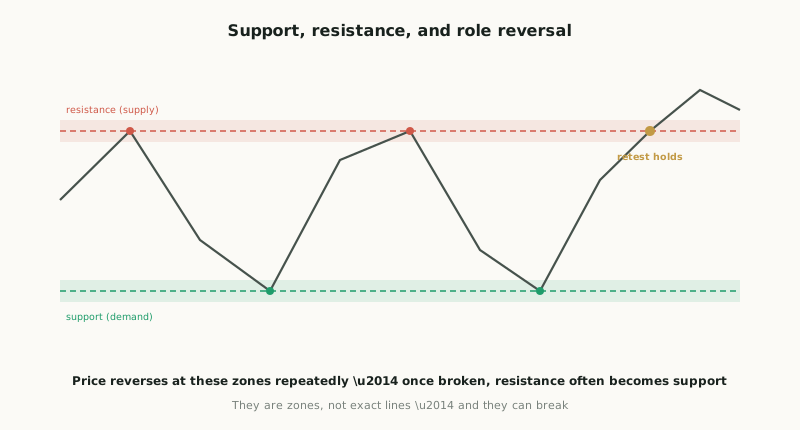
Support is a price level or zone where buying interest tends to be strong enough to halt or reverse a decline — a "floor" where falling price meets enough demand to stop falling and bounce. Resistance is the mirror image: a level or zone where selling interest tends to halt or reverse a rise — a "ceiling" where rising price meets enough supply to stop rising and turn down. In essence, support marks where demand overwhelms supply (halting falls), and resistance marks where supply overwhelms demand (halting rises). These are the levels at which the balance between buyers and sellers shifts enough to stop or reverse price's movement.
A crucial refinement: support and resistance are best understood as zones, not exact lines. Price rarely reverses at a precise, to-the-pip level; rather, it tends to turn within an area around a level, so it is more accurate (and more useful) to think of support and resistance as bands or zones than as exact prices. Treating them as precise lines leads to frustration when price overshoots slightly before reversing; treating them as zones reflects how they actually behave. This is why the diagrams on this site show shaded zones rather than thin lines. Understanding support and resistance as areas where the supply-demand balance tends to halt or reverse price — floors of demand and ceilings of supply, operating as zones rather than exact levels — is the foundational idea from which everything else follows.
Why they form
Support and resistance levels form for several interconnected reasons, all rooted in how markets and traders actually behave. The most fundamental is supply and demand: at certain prices, there is simply more willingness to buy (creating support) or to sell (creating resistance), whether from large institutional interest, accumulated orders, or the collective judgement that a price is "cheap" or "expensive." These concentrations of buying or selling interest are what physically halt price. The supply-and-demand framing (covered in its own theory guide) is the deepest explanation: support is a demand zone, resistance a supply zone.
Reinforcing this is market memory and self-fulfilling behaviour. Traders remember levels where price previously reversed, and they act on that memory — placing buy orders near a level that has held as support before, expecting it to hold again. Because many traders watch the same obvious levels (prior swing highs and lows especially) and act on them similarly, their collective action makes the levels work: the level becomes support because enough traders buy there expecting support (the self-fulfilling effect from the does-technical-analysis-work discussion). Clustered orders amplify this — stop-losses, take-profits and entry orders tend to gather around obvious levels (such as round numbers and prior highs/lows), creating real pools of buying or selling that reinforce the level. And psychological round numbers (like 1.2000 in EUR/USD) act as natural support and resistance because traders gravitate to them for orders and decisions. Prior swing highs and lows are perhaps the most reliable source: a previous peak often becomes future resistance (traders who bought there and got trapped sell to break even when price returns; others expect resistance and sell), and a previous trough often becomes future support. These forces — genuine supply/demand, market memory, self-fulfilling action, clustered orders, round numbers, and prior turning points — combine to create the levels at which price tends to halt and reverse. They are not magic, but the natural product of how supply, demand and trader psychology interact around significant prices.
Role reversal
One of the most important and useful phenomena in support and resistance is role reversal (also called polarity): when a broken support level becomes resistance, or a broken resistance becomes support. Once price decisively breaks through a level, that level often switches roles — former resistance, once broken to the upside, tends to act as support when price falls back to test it; former support, once broken to the downside, tends to act as resistance when price rises back to it. This is why, in the diagram, the broken resistance level later holds as support on the retest.
The reason for role reversal lies in the same forces that create the levels in the first place — the orders and psychology flip. Consider resistance that breaks to the upside: before the break, sellers defended the level (creating resistance); after price breaks above and returns to it, the psychology inverts — traders who missed the breakout now see the level as a buying opportunity, those who sold at the resistance and were proven wrong may buy to cover, and the level that was a ceiling becomes a floor. The collective behaviour around the level reverses, turning old resistance into new support. This role reversal is enormously practical: it means broken levels remain significant (a broken resistance is not "gone" but becomes a support to watch), it provides high-quality trade locations (the retest of a broken level — buying former resistance now acting as support — is a classic, favourable entry), and it explains price behaviour that would otherwise seem puzzling. The "break and retest" pattern, in which price breaks a level, returns to test it in its new role, and continues — is one of the most reliable and widely-used setups in technical trading, and it rests entirely on role reversal. Understanding that levels switch roles when broken — and that a broken level becomes a level of the opposite type to watch — is a key insight that elevates support-and-resistance analysis from static lines to a dynamic understanding of how price interacts with significant prices over time.
A broken level doesn't vanish — it flips. Resistance that breaks becomes support; support that breaks becomes resistance, because the orders and psychology around it invert. This "role reversal" is why the break-and-retest (price breaks a level, returns to test it in its new role, then continues) is one of trading's most reliable setups. Broken levels stay significant; they just switch sides.
Identifying and trading them
Identifying support and resistance is a matter of reading the chart for the levels described above. The most reliable are prior swing highs and lows (previous turning points that are likely to matter again), levels tested multiple times (a level price has reversed at repeatedly is more significant — though, importantly, also more likely to eventually break, as each test consumes some of the orders defending it), and round numbers. Mark these as zones rather than exact lines, focusing on the obvious, clear levels that many traders will see (since their significance comes partly from being widely watched) rather than cluttering the chart with marginal ones. Higher-timeframe levels carry more weight than lower-timeframe ones (the multi-timeframe principle).
There are two primary ways to trade these levels. The first is to trade the bounce (a mean-reversion approach): anticipating that price will reverse at the level, buying near support or selling near resistance, ideally with confirmation that price is actually reversing there (a reversal candlestick, say) rather than assuming the level will hold blindly — this is the basis of range trading. The second is to trade the break (a momentum approach): when price decisively breaks through a level, trading in the direction of the break, expecting continuation — this is the basis of breakout trading, and the break-and-retest (entering on the retest of the broken level in its new role) is a refined, higher-confidence version using role reversal. In both cases, support and resistance also provide logical places for stops and targets: stops go just beyond a level (so that if the level fails, you are out with a contained loss), and targets are often set at the next level (where price may stall). Several caveats apply, consistent with the site's honest stance: levels are zones not exact prices; they can and do break (no level holds forever, and more-tested levels are more prone to eventual breaks); false breaks (fakeouts) are common, where price briefly breaches a level then reverses, trapping breakout traders; and so support and resistance, like every tool here, is probabilistic, not certain — it identifies levels where reversals or breaks are more likely, to be used with confirmation and strict risk management, not as guaranteed turning points. Used this way — as high-probability zones for reversals, breaks, stops and targets, applied with confirmation and risk control — support and resistance is the indispensable foundation of practical chart trading, underpinning the patterns, ranges, breakouts and strategies built upon it.
Support is a zone where demand halts/reverses a decline (a floor); resistance is where supply halts/reverses a rise (a ceiling) — think zones, not exact lines. They form from supply/demand, market memory, self-fulfilling action, clustered orders, round numbers and prior swing highs/lows. Role reversal (polarity): a broken support becomes resistance and vice versa, because the orders/psychology flip — making the break-and-retest a reliable setup. Trade bounces (mean reversion, with confirmation) or breaks (momentum), and use levels for logical stops (just beyond) and targets (the next level). But levels are zones, they break (more-tested ones eventually), and fakeouts are common — so use confirmation and risk management. It's the foundational concept underpinning most of technical analysis.