Before a single indicator is added to the chart, price itself already tells you the trend — through the pattern of its highs and lows. Market structure is the skill of reading that pattern: recognising whether the market is building a staircase of rising peaks and troughs (an uptrend), a descending staircase (a downtrend), or going sideways (a range), and spotting when that structure breaks. It is one of the most fundamental price-action skills, underlying trend identification, much of Dow Theory and smart-money concepts, and the basic discipline of trading with the trend. This guide explains how highs and lows define trend, what a break of structure signals, and how to read the market's direction from price alone — a skill that needs no indicators and works on any market and timeframe.
It builds on support and resistance (swing points are key levels), echoes Dow Theory's trend definitions, and is essential to trend-following.
Key takeaways
Q: What is market structure?
A: Market structure is the framework of swing highs and lows that defines a market's trend. An uptrend is a series of higher highs and higher lows; a downtrend is lower highs and lower lows; a range is roughly equal highs and lows. Reading this structure reveals the trend directly from price.
Q: What is a break of structure?
A: A break of structure (BOS) occurs when price breaks the pattern that defined the current trend — for example, in an uptrend, when price makes a lower low, breaking the sequence of higher lows. It signals that the existing trend structure has failed and a trend change may be underway.
Q: Why is market structure important?
A: It lets you read the trend directly from price action, without relying on lagging indicators. Identifying whether the market is making higher highs/lows or lower highs/lows tells you the trend and when it may be changing, which is fundamental to trading with the trend and to most price-action methods.
How highs and lows define trend
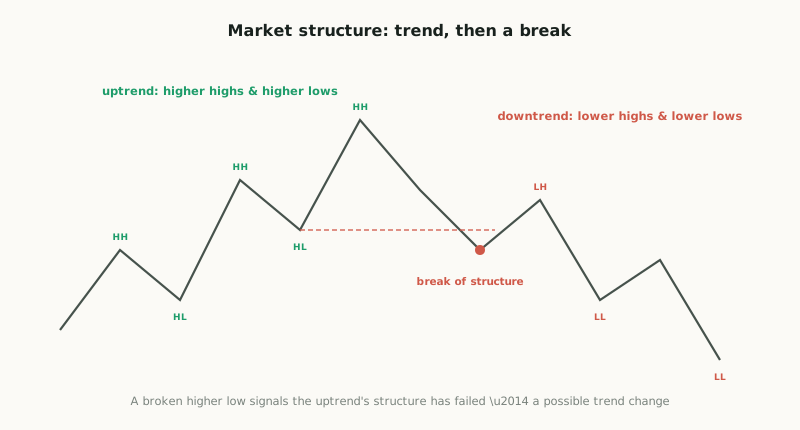
The core of market structure is beautifully simple: trend is defined by the pattern of swing highs and swing lows. A swing high is a peak (a high with lower highs on either side); a swing low is a trough. The relationship between successive swing highs and lows defines the trend, in three cases. An uptrend is a series of higher highs and higher lows (HH and HL) — each peak higher than the last, each trough higher than the last, forming a rising staircase. A downtrend is a series of lower highs and lower lows (LH and LL) — each peak and trough lower than the last, a descending staircase. A range (or consolidation) is roughly equal highs and lows — no clear progression up or down, price oscillating sideways between levels.
This gives you a direct, indicator-free way to read the trend: look at the sequence of peaks and troughs. If they are stepping up (HH, HL), the trend is up; if stepping down (LH, LL), the trend is down; if flat, the market is ranging. The table below summarises this. The power of this approach is that it reads trend from price itself — the most direct and immediate information — rather than from lagging indicators derived from price. It works on any market and any timeframe, requires nothing but the chart, and reflects the actual behaviour of price rather than a calculated abstraction. This is why market structure is foundational: it is the most basic, robust way to answer the most basic question in trading — which way is the trend? — and it connects directly to Dow Theory, which defined trends in exactly this way (by the succession of higher or lower peaks and troughs) long before modern indicators existed.
Reading trend from structure
| Structure | Highs | Lows | Trend |
|---|---|---|---|
| Rising staircase | Higher highs (HH) | Higher lows (HL) | Uptrend |
| Falling staircase | Lower highs (LH) | Lower lows (LL) | Downtrend |
| Sideways | Roughly equal | Roughly equal | Range |
The break of structure
Trends do not last forever, and market structure provides a clear signal of when one may be ending: the break of structure (BOS). A break of structure occurs when price breaks the pattern that defined the current trend. In an uptrend defined by higher highs and higher lows, the structure is intact as long as price keeps making higher highs and, crucially, keeps holding above its prior higher lows. The structure breaks when price makes a lower low — falling below the prior swing low, breaking the sequence of higher lows that defined the uptrend. This break signals that the uptrend's structure has failed and a trend change may be underway. Conversely, in a downtrend (lower highs and lower lows), a break of structure occurs when price makes a higher high, breaking the sequence of lower highs.
The break of structure is a key concept because it gives an objective, price-based signal of potential trend change, derived directly from structure rather than from a lagging indicator. While an uptrend keeps making higher highs and higher lows, you trade it as an uptrend; when it makes a lower low (a BOS), you have an early, structural warning that the uptrend may be over and a downtrend beginning — a signal to reassess, tighten risk, or prepare to trade the other direction. This makes market structure not just a way to read the current trend but a way to detect changes in trend, which is invaluable: many traders lose money by continuing to trade a trend after its structure has clearly broken, or by failing to recognise a new trend forming. The break of structure is also central to smart-money concepts (covered in the strategies section), which lean heavily on identifying BOS to read shifts in the market's direction. A note of nuance, in keeping with the site's honesty: not every break of structure leads to a sustained new trend (some are false or lead only to a range, and structure can be read subjectively — which swings "count" involves some judgement), so a BOS is a significant signal to be weighed with context and confirmation, not an infallible trend-change guarantee. But as a clear, price-based framework for recognising both the prevailing trend and warnings of its change, the break of structure is one of the most useful concepts in reading a chart.
Using market structure
Reading market structure has immediate practical uses across trading. Most fundamentally, it tells you which way to trade: identifying the trend via structure (HH/HL = up, LH/LL = down) lets you align trades with the trend, the basis of trend-following and a recurring principle across the site (trade with the structure, not against it). It helps you locate entries: in an uptrend, the higher lows are natural places to look for buying opportunities (buying the pullback to a higher low, the trend-following entry), since structure suggests the uptrend should resume from there. It informs stops: a logical stop in an uptrend sits below the most recent higher low (if price falls below it, that's a break of structure invalidating the long), tying stop placement directly to the structure that defines the trade's premise. And it provides trend-change warnings via the break of structure, telling you when to reassess.
Market structure also combines powerfully with the other concepts in this cluster. The swing highs and lows that define structure are support and resistance levels (a prior swing high is resistance, a swing low is support), so structure and support/resistance are deeply linked. Reading structure across multiple timeframes (the multi-timeframe principle) gives a complete picture — the higher-timeframe structure sets the dominant trend, while lower-timeframe structure helps with entries — and aligning structure across timeframes is a form of confluence. The practical discipline is to read the structure first on any chart you analyse: identify the swing highs and lows, determine the trend (up, down, or range) from their pattern, note the key swing levels, and watch for breaks of structure that signal change. This grounds all subsequent analysis in the most basic and robust reading of what price is doing. As always, the honest caveats apply: structure reading involves some subjectivity (which swings count), trends can be ambiguous or choppy, and a break of structure is a probabilistic signal, not a certainty — so market structure, like every tool here, is used with judgement, context and risk management. But as the foundational, indicator-free skill of reading trend and trend-change directly from price, market structure is one of the most valuable things a technical trader can learn, and it underlies a great deal of the price-action approach.
Ranges and trend transitions
Markets do not trend all the time — they spend much of their time in ranges, and reading structure includes recognising these and the transitions between trending and ranging conditions. A range, in structural terms, is an absence of the clear higher-high/higher-low or lower-high/lower-low progression — instead, highs and lows are roughly equal, with price oscillating sideways between a resistance ceiling and a support floor. Recognising a range from its flat structure is as important as recognising a trend, because (as the mean-reversion-vs-momentum guide stresses) the right approach differs entirely: ranges call for mean-reversion tactics (fading the edges), trends for momentum tactics (trading with them). Misreading a range as a trend, or vice versa, leads directly to the costly regime-mismatch error.
Crucially, markets transition between these states, and structure reveals the transitions. A trend often gives way to a range as it pauses or consolidates (the higher highs and lows stop progressing and flatten into equal highs and lows), and a range often resolves into a new trend when price breaks out of it and begins a fresh progression of higher highs/lows or lower highs/lows. The cycle — trend, then range (consolidation), then trend again — plays out repeatedly, and reading structure lets you follow it: you can see an uptrend's higher-high/higher-low progression stall into a range, then watch for the breakout and the new structural progression that signals the next trending phase. This connects to the accumulation and distribution ideas in the Wyckoff material (ranges where the market builds positions before a new trend) and to the break-of-structure concept (a range breakout that begins a new higher-high/higher-low sequence is itself a structural development). The practical upshot: read structure not as a fixed label but as an evolving story — is the market trending (and which way) or ranging, and is it transitioning between the two? — so you can match your approach to the current regime and anticipate shifts. This dynamic reading of structure across trend and range, and the transitions between them, is what makes it such a complete framework for understanding what price is doing at any moment.
Market structure reads trend from the pattern of swing highs and lows: higher highs + higher lows = uptrend; lower highs + lower lows = downtrend; roughly equal = range. It's indicator-free, works on any market/timeframe, and matches Dow Theory's trend definitions. A break of structure (BOS) — e.g. a lower low in an uptrend — signals a possible trend change (central to smart-money concepts too). Markets cycle between trending and ranging, and structure reveals the transitions (a trend flattening into a range, a range breaking into a new trend) — so match your approach to the regime. Use it to choose direction, locate pullback entries (at higher lows), place logical stops (below the last higher low), and spot trend changes. Swing points are also support/resistance. It involves some subjectivity and isn't infallible, but it's a foundational price-action skill.