A single timeframe can deceive you. What looks like a confident uptrend on the 5-minute chart may be nothing more than a small pullback within a larger downtrend on the daily — and a trader who sees only the short timeframe buys right into the path of the dominant trend. Multi-timeframe analysis solves this by reading the market top-down: using a higher timeframe to establish the big-picture trend and context, an intermediate timeframe to find the setup, and a lower timeframe to time the entry precisely. The result is trades that align with the bigger picture rather than fighting it — a simple discipline that markedly improves both trade selection and entries. This guide explains the top-down approach, why it works, and how to apply it without falling into the trap of timeframe overload.
It applies market structure across timeframes, is a powerful source of confluence, and complements the trading styles by timeframe.
Key takeaways
Q: What is multi-timeframe analysis?
A: Multi-timeframe analysis is examining the same market across several timeframes to build a complete picture — typically using a higher timeframe for the overall trend and context, an intermediate timeframe for the trade setup, and a lower timeframe for precise entry timing. It ensures trades align with the bigger picture.
Q: Why use multiple timeframes?
A: A single timeframe can mislead — a move that looks like an uptrend on a short timeframe may be just a pullback within a larger downtrend. Using multiple timeframes lets you trade in the direction of the dominant higher-timeframe trend while timing entries precisely on a lower one, improving probability and entries.
Q: How many timeframes should you use?
A: Most traders use about three timeframes — a higher one for trend, an intermediate for the setup, and a lower for entry — often with a rough 4x to 6x ratio between them. Using too many timeframes tends to create conflicting signals and analysis paralysis rather than clarity.
Why one timeframe deceives
The fundamental reason for multi-timeframe analysis is that any single timeframe gives an incomplete and potentially misleading picture. Each timeframe shows only part of the market's behaviour: a lower timeframe shows short-term moves in detail but loses the larger context, while a higher timeframe shows the big picture but not the immediate detail. Looking at only one means missing what the others reveal — and that can be dangerous. The classic trap is the one in the introduction: a move that appears as a clear uptrend on a short timeframe may be merely a temporary pullback within a larger downtrend on a higher timeframe. The short-timeframe trader, seeing only an "uptrend," buys — right as the larger downtrend is about to reassert itself and resume downward. They were not wrong about the short-term move, but they were blind to the dominant context that overwhelmed it.
This illustrates a general principle: higher timeframes carry more weight than lower ones. The daily trend dominates the hourly, which dominates the five-minute, because larger timeframes reflect more significant, more durable forces and more participants' decisions. A move on a lower timeframe that runs against the higher-timeframe trend is fighting a stronger current and is more likely to fail or reverse, while a move aligned with the higher-timeframe trend has the dominant force behind it. Trading a single timeframe in isolation means ignoring this hierarchy — potentially trading small moves directly against the larger trend without even knowing it. Multi-timeframe analysis exists precisely to prevent this: by deliberately examining the higher timeframe(s) as well as the one you trade on, you see the dominant context and avoid being deceived by a lower-timeframe move that the bigger picture is about to overwhelm. It ensures you are trading with the larger forces, not unknowingly against them — a significant edge in probability.
The top-down approach
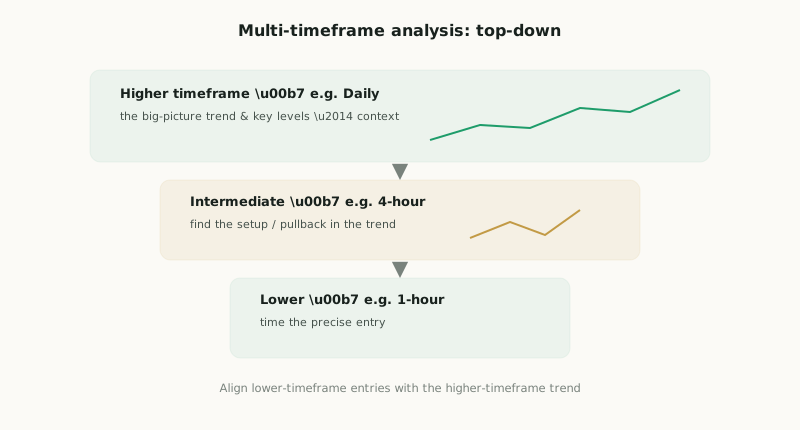
Multi-timeframe analysis is applied through a top-down approach, working from the highest timeframe down to the lowest, with each serving a distinct role. Most traders use about three timeframes, often with a rough 4x to 6x ratio between them (for example daily, 4-hour, 1-hour; or 1-hour, 15-minute, 5-minute), giving meaningfully different perspectives without redundancy. The roles are summarised below.
The role of each timeframe
The higher timeframe (e.g. daily) establishes the dominant trend and context — the big picture you must trade in harmony with, plus the key support/resistance levels that matter most. You read its market structure (HH/HL or LH/LL) to determine the prevailing direction. The intermediate timeframe (e.g. 4-hour) is where you find the setup — locating a trade opportunity in the direction the higher timeframe dictates, such as a pullback to support within the higher-timeframe uptrend. The lower timeframe (e.g. 1-hour) is for timing the precise entry — fine-tuning the entry point, looking for an entry trigger (a reversal candlestick, a small break of structure) once the higher-timeframe trend and intermediate setup are in place. The discipline is to move down through them in order: first the trend (higher), then the setup (intermediate), then the entry (lower), so that the entry on the lower timeframe is always aligned with the trend on the higher. This top-down workflow ensures every trade has the dominant trend behind it (higher timeframe), a sound setup (intermediate), and a precise, well-timed entry (lower) — combining the big-picture probability edge with the better entries and tighter risk that a lower timeframe allows. It is the structured way to get the best of all the timeframes rather than the partial, potentially misleading view of any one.
The benefits, and avoiding overload
The benefits of this approach are substantial. It aligns trades with the dominant trend, raising their probability by ensuring you trade with the larger forces rather than against them. It produces better entries and tighter risk: timing the entry on a lower timeframe lets you enter closer to the ideal point with a tighter, more precise stop, improving the reward-to-risk, while still having the higher-timeframe trend in your favour. It provides confluence across timeframes — when the trend, setup and entry all align across the three timeframes, that agreement is itself a form of confluence (the next concept) that strengthens the trade. And it prevents the costly error of trading small moves against the dominant trend, the single biggest pitfall of single-timeframe trading. For all these reasons, multi-timeframe analysis is one of the most valuable habits a trader can adopt, and it is used (in some form) by most successful discretionary traders.
There is, however, a pitfall to avoid: timeframe overload. Using too many timeframes tends to produce conflicting signals and analysis paralysis rather than clarity — with five or six timeframes, you will almost always find some that disagree, leaving you confused and unable to act, or able to justify any trade you want (a confirmation-bias risk). The discipline is to use a manageable number (around three) with clear roles and meaningful separation between them, and to respect the hierarchy when they conflict: the higher timeframe takes precedence, so if the lower timeframe suggests a trade against the higher-timeframe trend, you defer to the higher timeframe and stand aside rather than fighting the dominant force. Handled this way — three timeframes, clear roles, top-down order, higher timeframe winning conflicts — multi-timeframe analysis brings clarity and a real edge. Handled poorly — too many timeframes, no hierarchy, cherry-picking the ones that suit your bias — it brings confusion and rationalisation. As with every technique on the site, the value lies in disciplined, structured application. Used well, the simple act of checking the higher-timeframe trend before taking a lower-timeframe entry is one of the highest-value habits in technical trading, turning a partial, deceivable single-timeframe view into a complete, aligned, top-down picture.
A worked example, and choosing your timeframes
To see the top-down approach in action, follow a typical multi-timeframe trade. You begin on the higher timeframe — say the daily chart — and read its market structure: a clear series of higher highs and higher lows tells you the dominant trend is up. This sets your bias: you will look only for buying opportunities, trading with the daily uptrend, not against it. You also note the key daily support levels where the uptrend might resume. Next you drop to the intermediate timeframe — the 4-hour — and look for a setup in that bullish direction: you find price pulling back toward one of those daily support zones, a classic "buy the dip in an uptrend" opportunity forming. The intermediate timeframe has shown you where the trade sets up. Finally you drop to the lower timeframe — the 1-hour — to time the entry: you wait at the support zone for an entry trigger, such as a bullish reversal candlestick or a small break of structure to the upside signalling the pullback is ending, and enter there with a tight stop just below the zone.
Notice what this achieves: your entry (lower timeframe) is precisely timed and tightly stopped, your setup (intermediate) is a sound pullback to support, and the whole trade is aligned with the dominant daily uptrend (higher timeframe). The big-picture probability edge, the sound setup, and the precise entry all combine — and the agreement across the three timeframes is itself confluence. Had you looked only at the 1-hour chart, you might have seen the pullback as a "downtrend" and either sold (straight into the daily uptrend) or missed the buying opportunity entirely. The top-down process prevented that error and produced a far better trade.
As for choosing your timeframes, match them to your trading style (from the styles-by-timeframe guide). A swing trader might use weekly/daily/4-hour; a day trader might use daily/1-hour/15-minute; a scalper might use 1-hour/15-minute/5-minute. The principle is consistent regardless of the absolute timeframes: pick three with meaningful separation (a rough 4x to 6x ratio works well), assign them the trend/setup/entry roles, and work top-down. The specific timeframes matter less than the relationship between them and the disciplined top-down process. Whatever your style, the habit of establishing the higher-timeframe trend before timing a lower-timeframe entry is what turns multi-timeframe analysis from a concept into a consistent, edge-producing routine.
Multi-timeframe analysis reads a market top-down across (usually three) timeframes to avoid the deception of any single one — since a lower-timeframe "uptrend" may be a pullback in a higher-timeframe downtrend. Higher timeframes carry more weight. The roles: higher TF = dominant trend & context; intermediate TF = the setup; lower TF = precise entry timing — worked through in that top-down order so entries align with the bigger trend. Choose three timeframes matched to your style with meaningful separation (~4x–6x apart). Benefits: higher-probability trades aligned with the dominant trend, better entries and tighter risk, and cross-timeframe confluence. Avoid timeframe overload (too many = conflicting signals and paralysis), and let the higher timeframe win conflicts. Checking the higher-timeframe trend before a lower-timeframe entry is one of the highest-value habits in trading.