A recurring theme across this entire site is that no single signal is reliable — every indicator, pattern and level is probabilistic and fails regularly on its own. Confluence is the concept that answers this limitation: when several independent factors all point to the same level or the same conclusion — a support zone that is also a Fibonacci retracement that is also near a moving average that is also a round number — the odds shift meaningfully in your favour. Confluence is the art of stacking the odds by combining aligned signals, and it is the concept that ties the whole technical toolkit together. This guide explains what confluence is, why it improves a trade, the main types of confluence factor, and — importantly — how to use it without forcing it or fooling yourself.
It is the synthesis of the whole toolkit: support and resistance, Fibonacci, indicators, structure and multiple timeframes all combined.
Key takeaways
Q: What is confluence in trading?
A: Confluence is when multiple independent factors or signals align at the same price level or point to the same conclusion, increasing the probability of a setup. For example, a level that is simultaneously a prior support, a Fibonacci retracement, a moving average and a round number has strong confluence.
Q: Why does confluence improve a trade?
A: Because no single signal is reliable on its own, but several independent signals agreeing makes a setup more likely to work. Confluence stacks the odds — each aligned factor adds weight — turning individually probabilistic signals into a higher-probability combination, though never a guarantee.
Q: Can you have too much confluence or force it?
A: Yes. Adding many indicators that aren't truly independent gives false confidence, and seeing confluence where it isn't (to justify a trade) is confirmation bias. Genuine confluence comes from independent factors aligning naturally; it should be found, not forced, and quality matters more than quantity.
What confluence is
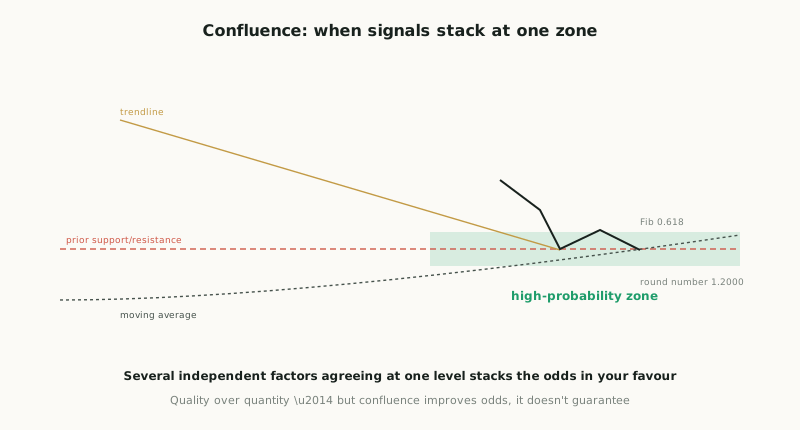
Confluence, in trading, is when multiple independent factors align at the same price level (or point to the same conclusion), increasing the probability of a setup. The word borrows from rivers — the confluence is where streams meet and combine into something stronger — and the trading sense is analogous: where several separate signals meet at one level, they combine into a stronger, higher-probability case than any one alone. A level with strong confluence might be, simultaneously, a prior support/resistance level, a Fibonacci retracement (say the 0.618), near a key moving average, at a psychological round number, and showing a reversal candlestick — five separate factors all pointing to the same zone as significant. That convergence is confluence, and it makes the zone far more compelling than if only one factor were present.
The underlying logic flows directly from the site's honest stance on individual signals. Because no single signal is reliable — a support level alone might hold or break, a Fibonacci level alone is just one of several, a single indicator alone gives many false signals — trading on any one in isolation is a coin-flip-ish proposition. But when several independent signals agree, each adds weight to the others, and the combination is more likely to be meaningful than any one alone. If a level is only a Fibonacci level, that's weak; if it is a Fibonacci level and a prior support and a round number, the agreement of these independent factors makes a reversal there genuinely more probable. Confluence thus turns the weakness of individual signals (unreliable alone) into a strength (powerful in agreement), and it is the practical answer to "if no single tool works reliably, how do I trade?" — you combine them, looking for the levels and moments where many point the same way.
The main types of confluence
Confluence can come from many sources, and recognising the main types helps you spot it. The key categories of confluence factor are summarised below.
Common confluence factors
These draw on the whole toolkit covered across the site. Support and resistance levels are a primary factor (a setup at a strong S/R zone has that confluence). Fibonacci retracement and extension levels add confluence when they coincide with other factors (a 0.618 retracement landing on prior support is classic confluence). Indicators contribute when they agree — an oversold RSI, a moving average providing dynamic support, a MACD signal — especially when they confirm a price-based signal. Market structure adds confluence through swing highs/lows (which are themselves levels) and breaks of structure. Round numbers and other psychological levels add weight. And crucially, multi-timeframe alignment is a powerful form of confluence — when the higher, intermediate and lower timeframes all point the same way (the previous guide's top-down agreement), that cross-timeframe agreement strongly reinforces a setup. Candlestick and chart-pattern signals contribute too (a reversal candlestick at a confluent level confirms it). The key to genuine confluence is that the factors be independent — drawn from different sources of evidence — so that their agreement is meaningful. Five different moving averages all saying "support here" is not strong confluence (they are essentially the same kind of signal, highly correlated); a support level, a Fibonacci ratio, a round number, and a higher-timeframe trend all aligning is strong confluence (they are independent kinds of evidence). Recognising these factor types — and seeking agreement among independent ones — is how you identify high-confluence setups.
Quality over quantity, and not forcing it
Confluence is powerful, but it must be used with discipline, and two cautions are essential. The first is quality over quantity. More confluence factors are better only if they are genuinely independent; piling on many correlated indicators (several oscillators that all measure essentially the same thing, or multiple moving averages) gives the illusion of strong confluence without the substance — they will naturally agree because they are nearly the same signal, adding false confidence rather than genuine independent confirmation. True confluence comes from a few independent factors aligning, not from cluttering the chart with many redundant ones. A clean setup with three genuinely independent factors agreeing (support + Fibonacci + higher-timeframe trend, say) is far stronger than one buried under ten correlated indicators. This also guards against the over-complication and analysis paralysis that too many tools cause.
The second, deeper caution is to find confluence, don't force it. Because confluence is so appealing, there is a powerful temptation to see it where it isn't — to convince yourself that several factors align in order to justify a trade you already want to take. This is confirmation bias (from the cognitive-biases guide) in action: searching for and finding "confluence" to support a predetermined conclusion. Genuine confluence is discovered by objective analysis — you look at a level and find that, independently, several factors happen to converge there — not manufactured by hunting for any factors that fit a desired trade. The disciplined approach is to analyse objectively first and let the confluence reveal itself, being honest about whether the factors genuinely align or whether you are stretching to see agreement. And the final, essential caveat, consistent with the whole site: confluence improves the odds, it does not guarantee. Even a beautifully confluent setup is still probabilistic and can fail — several aligned signals make a reversal or move more likely, not certain, so confluent trades still require stop-losses, proper position sizing and the acceptance that they will sometimes lose. Confluence is the powerful synthesis that makes the individually-unreliable tools genuinely useful in combination — it is, in a real sense, how skilled technical analysis actually works, by stacking independent edges — but it raises probability, not certainty. Used with discipline (independent factors, quality over quantity, found not forced, always with risk management), confluence is perhaps the most important practical concept in technical trading: the principle that ties support/resistance, Fibonacci, indicators, structure and multiple timeframes into coherent, higher-probability decisions. It is the answer to how the whole toolkit comes together.
Confluence in practice
To make confluence concrete, consider how it builds a setup in practice. Suppose you are watching EUR/USD and price is pulling back within a clear uptrend. On its own, "price is pulling back" tells you little. But now examine the level price is approaching, looking for independent factors. You notice the pullback is heading toward a prior support zone (where price reversed up before) — one factor. That zone also coincides with the 0.618 Fibonacci retracement of the prior up-move — a second, independent factor. A rising moving average (say the 50-period) is arriving at roughly the same area, offering dynamic support — a third. The level sits just above a round number (1.0800, perhaps) — a fourth. And on the higher timeframe, the daily trend is clearly up, so a bullish setup here aligns with the dominant trend — a fifth, cross-timeframe factor.
Individually, none of these would justify much. Together, they describe a high-confluence zone: several independent kinds of evidence — a horizontal level, a Fibonacci ratio, a dynamic average, a psychological number, and higher-timeframe trend alignment — all pointing to the same area as a likely place for the uptrend to resume. If, as price reaches this zone, a reversal candlestick forms (a sixth, confirming factor), you have a genuinely compelling, well-stacked setup. This is how skilled discretionary trading actually works: not by acting on any single signal, but by identifying where independent factors converge and waiting for those high-confluence moments.
The practical workflow follows naturally and guards against the pitfalls. Analyse objectively first — mark your levels, trend, Fibonacci and indicators independently — and then notice where they converge, rather than starting with a trade you want and hunting for factors to justify it (the confirmation-bias trap). Demand that the factors be genuinely independent and that the confluence be real, not stretched. Favour the few high-confluence setups over the many marginal ones (quality over quantity, which also means trading less and waiting more — the patience the psychology section prizes). And even on a strongly confluent setup, place a stop and size the position properly, because confluence raises the odds without removing the risk. Trading only when several independent factors align — and passing on everything else — is one of the most reliable ways to improve trade quality, and it is the practical embodiment of using the whole toolkit together rather than relying on any single, unreliable part.
Confluence is when multiple independent factors align at one level, stacking the odds — the answer to "no single signal is reliable." Main factors: support/resistance, Fibonacci, indicators, market structure, round numbers, and multi-timeframe alignment (combining the whole toolkit). The factors must be genuinely independent: many correlated indicators agreeing is false confluence, while a support + Fibonacci + round number + higher-timeframe trend aligning is real. Analyse objectively first and notice where factors converge (don't force it — that's confirmation bias), favour the few high-confluence setups over many marginal ones, and always use stops and sizing since confluence improves odds but doesn't guarantee. It's the synthesis concept: how the individually-unreliable tools combine into higher-probability decisions.