Algorithmic trading hands your strategy to a machine: an automated, rules-based program that executes trades tirelessly, instantly, and — crucially — without emotion. Since emotion and indiscipline are what defeat most traders, automating execution removes the trader's single greatest weakness, which is a genuine and powerful advantage. But algorithmic trading introduces new weaknesses of its own, demands real skill to do well, and is surrounded by a fog of unrealistic promises — the dream of "set-and-forget" passive income from a purchased robot is, for the most part, a myth. This guide explains how algorithmic trading works, its genuine strengths and real pitfalls, and the honest reality of retail algo trading, in the no-hype spirit of the rest of the site.
It pairs closely with backtesting (essential to developing any algo), applies the principles from trading strategies, and intersects with the warnings in common forex scams.
Key takeaways
Q: What is algorithmic trading?
A: Algorithmic trading uses automated, rules-based computer programs to execute trades according to predefined criteria, without manual intervention. In retail forex it is often done through 'expert advisors' (EAs) on trading platforms, which monitor the market and place trades automatically based on the coded strategy.
Q: What are the advantages of algorithmic trading?
A: Its biggest advantage is removing emotion — the algorithm executes the plan mechanically, immune to fear, greed and impulse. It also offers speed, the ability to monitor markets continuously, perfect consistency in following rules, and the capacity to test the strategy on historical data before going live.
Q: Can you make passive income from a trading robot?
A: The dream of set-and-forget profits from a purchased trading robot is mostly a myth, and many EAs sold online are worthless or scams. Building a genuinely profitable algorithm requires real skill in strategy, coding and testing, plus ongoing maintenance, because markets change and edges decay over time.
What algorithmic trading is
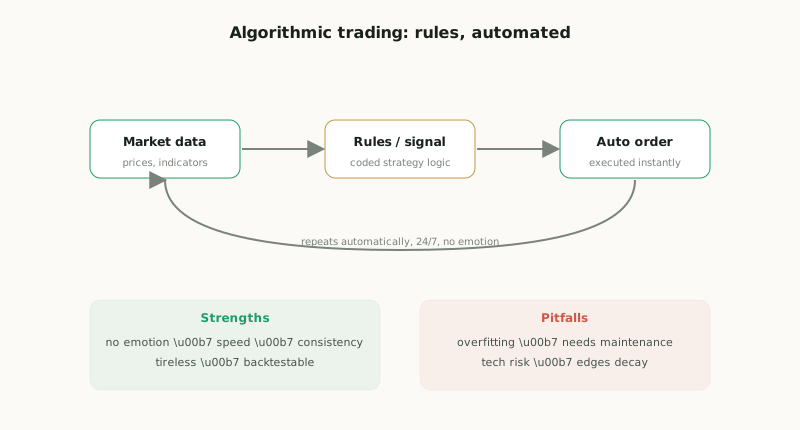
Algorithmic trading means executing trades through automated computer programs that follow predefined rules, without manual intervention. The trader's strategy — its entry criteria, exit rules, and risk management — is codified into precise, unambiguous rules, and a program (the "algorithm") then monitors the market continuously and executes trades automatically whenever the conditions are met. The human defines the strategy and the rules; the machine carries them out. This contrasts with discretionary trading, where a human makes each decision in real time, applying judgement to the current situation.
In retail forex, algorithmic trading is most often done through expert advisors (EAs) — automated programs that run on trading platforms (such as the popular MetaTrader) and trade an account according to their coded logic — or through strategies coded in other languages and connected to a broker. The defining requirement is that the strategy must be reducible to precise, mechanical rules a computer can follow: "buy when these specific conditions are met, exit when these are, risk this much." Strategies that depend on subjective judgement or interpretation that cannot be fully specified are hard to automate. This need for complete, unambiguous specification is both a discipline (it forces total clarity about the strategy) and a constraint (it excludes the discretionary judgement a skilled human can apply). Understanding algorithmic trading as "the strategy, fully codified into rules, executed automatically by a machine" is the foundation — everything about its strengths and weaknesses flows from this mechanical, rules-based nature.
The genuine strengths
Algorithmic trading has real, substantial strengths, the foremost of which addresses trading's central problem. It removes emotion. The algorithm executes the plan mechanically, immune to the fear, greed, impulse, revenge trading, tilt and indiscipline that the psychology section identifies as what defeats most traders. Where a human trader struggles to follow their plan under emotional pressure — hesitating, deviating, moving stops, revenge trading — the algorithm simply does what it is programmed to do, every time, without the emotional interference. This is genuinely powerful: automating execution solves, at a stroke, the discipline problem that is the downfall of so many traders. For a trader who knows their plan is sound but cannot consistently follow it under pressure, automation can be transformative.
The other strengths reinforce this. Speed: algorithms react instantly to conditions and execute without the delay of human decision-making, valuable for time-sensitive strategies. Tireless monitoring: an algorithm can watch the market continuously, around the clock and across many instruments, without fatigue — impossible for a human. Perfect consistency: the algorithm applies the rules identically every time, achieving the consistency that lets an edge play out (the consistency the strategy and expectancy guides stress is essential) without the human tendency to deviate. And backtestability: because the strategy is fully specified in rules, it can be tested on historical data (the subject of the backtesting guide) before risking real money. The table below contrasts the two approaches.
Algorithmic vs discretionary trading
| Aspect | Algorithmic | Discretionary |
|---|---|---|
| Emotion | Removed — mechanical | Ever-present challenge |
| Consistency | Perfect rule-following | Prone to deviation |
| Speed & coverage | Instant, tireless, 24/7 | Limited by human capacity |
| Judgement | None — only coded rules | Adapts to novel situations |
| Requires | Coding & maintenance | Discipline & focus |
The real pitfalls
Against these strengths stand real pitfalls that temper the appeal of automation. First, algorithmic trading requires genuine skill: building a profitable algorithm demands a sound strategy and the ability to code it correctly and rigorous testing — a serious undertaking, not a shortcut. Those who lack these skills often turn to buying EAs, which leads directly to the scams problem (below). Second, algorithms need maintenance and monitoring: markets change, and an edge that worked can decay and stop working (exactly the adaptive-market-hypothesis lesson — edges are real but temporary), so an algorithm cannot simply be left to run forever; it must be monitored and adapted as conditions evolve. The "set and forget" ideal collides with the reality that markets and edges shift.
Third, there is the overfitting danger in development: it is dangerously easy to build an algorithm that performs beautifully on historical data but fails live, because it was curve-fit to the past's noise (the central pitfall of backtesting, covered in that guide). Fourth, algorithms carry technical and tail risks: a bug, a connectivity failure, an unexpected market condition (a flash crash, a gap, conditions the rules never anticipated) can cause an algorithm to behave catastrophically, executing rapidly in the wrong direction with no human to intervene — automation removes the emotional human, but also the judgement that might recognise and halt a disaster. Robust algos need safeguards, reliable infrastructure (such as a server to run continuously), and monitoring. Fifth, the algorithm has no judgement for genuinely novel situations a human might navigate. These pitfalls do not negate algo trading's strengths, but they show that automation is not a magic solution — it trades the human's emotional weakness for a different set of technical and developmental challenges, and demands real skill and ongoing effort to do well.
Automation's great prize is removing emotion — the very thing that defeats most traders. But it doesn't remove the need for a real edge; it just executes whatever edge (or lack of one) you give it, tirelessly. A sound strategy automated is powerful; a flawed or overfit one automated simply loses money faster and more consistently. The machine is only as good as the strategy behind it.
The honest reality of retail algo trading
The honest reality of retail algorithmic trading must be stated plainly, because it is heavily obscured by marketing hype. The dream of set-and-forget passive income from a purchased trading robot is, overwhelmingly, a myth. The internet is awash with EAs and "trading robots" sold with promises of automatic, hands-off profits — and the vast majority of these are worthless, curve-fit to look good in backtests, or outright scams (a major category in the common-forex-scams guide). The logic that exposes them is the same as for all such offers: anyone with a genuinely profitable, automatic money-making robot would run it themselves, not sell it cheaply to strangers. The promise of effortless automated riches is the fantasy that signals a scam, and beginners drawn to algo trading by this promise are prime targets.
The genuine reality is more demanding and less glamorous. Real, profitable algorithmic trading does exist and is practised by skilled individuals and institutions — but it requires the real skill, rigorous testing, and ongoing maintenance described above, not a downloaded robot. Building a profitable algo means developing a genuine edge (hard in itself), coding it correctly, backtesting it rigorously while avoiding overfitting, forward-testing it, deploying it with proper risk controls and infrastructure, and continually monitoring and adapting it as its edge decays. This is a serious, skilled endeavour — essentially combining trading expertise with software development and disciplined testing. For the trader with these skills (or willing to develop them), algorithmic trading offers the powerful benefit of removing emotion and achieving perfect consistency. For the trader hoping to buy a robot and collect passive profits, it offers mostly disappointment and scams. The balanced verdict: algorithmic trading is a legitimate, powerful approach with the genuine and significant advantage of mechanical, emotion-free execution — but it is a skilled discipline requiring strategy, coding, rigorous testing and maintenance, not a shortcut, and the marketing promising easy automated riches should be treated with deep scepticism. Build your own, with real skill and honest testing, or be very wary of anything sold as a money-printing robot.
Where it fits, and how to approach it
So where does algorithmic trading fit, and how should an interested trader approach it? It fits best for those who have, or are willing to build, the combination of skills it demands — a genuine trading strategy and the ability to code and rigorously test it — and who are particularly drawn to its core benefit of removing emotion and enforcing consistency. A trader who has developed a sound, fully-specifiable rules-based edge but struggles to execute it consistently under emotional pressure is an ideal candidate: automation lets a proven strategy run with the mechanical discipline a human cannot match. It also suits those who want to monitor many markets or trade around the clock, which manual trading cannot accommodate.
The sensible path into algorithmic trading mirrors the disciplined process this site advocates throughout. Start with a genuine strategy idea (not a downloaded robot), specify it precisely in rules, and backtest it rigorously while scrupulously avoiding overfitting (the backtesting guide's central warning). If it survives honest backtesting including realistic costs and out-of-sample validation, forward-test it on a demo account (the demo-vs-live step) to see how it performs in live conditions before risking real money. Only then deploy it with real capital, conservatively sized, with proper risk controls and reliable infrastructure, and monitor it continuously — ready to adapt or retire it as its edge decays (the adaptive-markets reality). This is a serious, skilled, ongoing undertaking, essentially uniting trading expertise, software development and disciplined testing. It is well within reach of a committed trader willing to develop these skills, and it offers the real and substantial prize of emotion-free, consistent execution. But it is a discipline to be built, step by careful step — not a shortcut to be bought, and never the effortless robot of the marketing.
Algorithmic trading executes a fully-coded, rules-based strategy automatically, without manual intervention (often via expert advisors/EAs in retail forex). Its great strength is removing emotion — mechanical, consistent, tireless, fast execution — solving the discipline problem that defeats most traders, plus it's backtestable. But it requires real skill (strategy + coding + testing), needs maintenance as edges decay, risks overfitting and technical failures, and lacks human judgement. The honest reality: profitable algo trading is a skilled discipline, not a shortcut — the "set-and-forget robot for passive income" is mostly a myth and a common scam. Build your own through the disciplined path (strategy → rigorous backtest → demo forward-test → careful live deployment → ongoing monitoring), or be deeply sceptical of robots sold to you.