Backtesting lets you see how a trading strategy would have performed on the past, before you risk a penny on the future. It is one of the most valuable tools a systematic trader has — a way to test whether a strategy has a genuine edge using historical data rather than expensive live experimentation. But it is also one of the most misused tools, because a backtest can be made to look brilliant while being worthless: done well, backtesting validates an edge and builds justified confidence; done badly, it manufactures false confidence in a strategy that will fail the moment real money is on the line. This guide explains how backtesting works, what it can and cannot tell you, and the pitfalls — above all overfitting — that separate useful testing from self-deception.
It is essential to algorithmic trading, measures the expectancy of a strategy, and confronts the same data-mining dangers raised in does technical analysis work.
Key takeaways
Q: What is backtesting?
A: Backtesting is the process of testing a trading strategy on historical price data to see how it would have performed in the past, before risking real money. It involves applying the strategy's precise rules to past data and measuring the results — return, win rate, drawdown and expectancy.
Q: What is overfitting in backtesting?
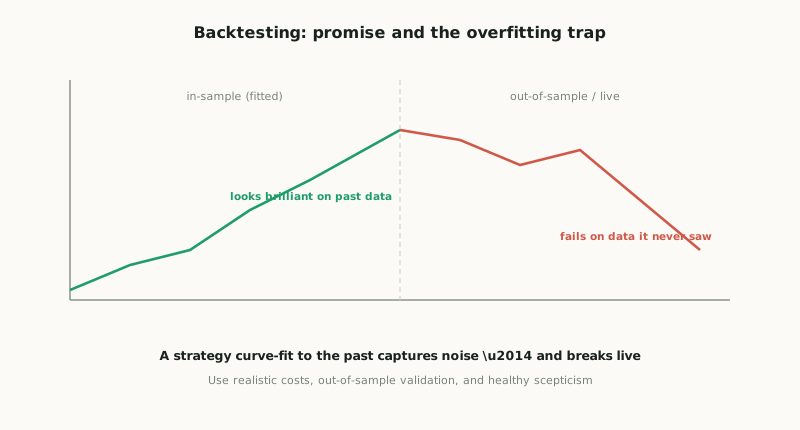
A: Overfitting (or curve-fitting) is when a strategy is optimised so heavily to fit historical data that it captures random noise rather than a genuine edge. It produces a beautiful backtest but fails in live trading, because the patterns it learned were specific to the past data and don't repeat. It's the biggest danger in backtesting.
Q: Does a good backtest guarantee future profits?
A: No. A good backtest is necessary but not sufficient. Past performance doesn't guarantee future results — edges decay, markets change, and backtests can be overfit or flawed. Backtesting validates that a strategy had an edge historically; live and forward testing, realistic costs and out-of-sample validation are needed before trusting it.
What backtesting is
Backtesting is the process of applying a trading strategy's rules to historical price data to see how it would have performed. The trader specifies the strategy precisely — its entry conditions, exit rules and risk management — then runs those rules over a period of past data, simulating the trades the strategy would have taken and measuring the results. The output is a record of how the strategy would have done: its total return, the equity curve, the win rate, the average win and loss, the maximum drawdown, and ultimately its expectancy (the average profit or loss per trade, the key measure of edge from the expectancy guide).
The purpose is to validate a strategy cheaply before risking real money. Rather than testing an idea by trading it live (slow and expensive in losses if it is bad), backtesting lets the trader assess it against years of history in moments, seeing whether it would have been profitable and what its characteristics are. This makes backtesting central to systematic and algorithmic trading, where strategies are precise enough to test mechanically — indeed, the backtestability of a fully-specified rules-based strategy is one of algorithmic trading's advantages. Backtesting also reveals a strategy's character — how large its drawdowns are, how long its losing streaks, what win rate to expect — which prepares the trader psychologically and practically for live trading (knowing in advance that a strategy has, say, occasional 20% drawdowns and long losing streaks helps you withstand them when they come). Used properly, backtesting is how a trader builds justified confidence in a strategy: evidence that it has a real, measurable edge, rather than mere hope.
What it can tell you
A well-conducted backtest can tell you several genuinely valuable things. It can indicate whether a strategy had a positive expectancy historically — whether, over many trades, it made money on average — which is the fundamental question of whether the strategy has an edge. It reveals the strategy's risk characteristics: the maximum drawdown (the worst peak-to-trough loss, crucial for position sizing and for knowing what you must be able to endure), the length and frequency of losing streaks, and the volatility of returns. It shows the win rate and reward-to-risk profile, clarifying whether the strategy is (for example) a high-win-rate small-reward approach or a low-win-rate large-reward one — important for setting expectations and for the psychological demands (a low-win-rate trend strategy will test patience differently than a high-win-rate one).
This information is valuable for three reasons. It helps you decide whether to trade the strategy at all (no historical edge is a strong reason not to). It helps you size and manage the strategy appropriately (knowing the drawdown profile informs position sizing per the risk-management guides). And it prepares you psychologically for what live trading will feel like (knowing the strategy's losing streaks and drawdowns in advance helps you withstand them without abandoning a sound strategy at the worst moment). A backtest, in short, turns a vague trading idea into a characterised, measured strategy with known historical performance and risk — a far stronger basis for trading than untested intuition. But — and this is the heart of the matter — all of this value depends entirely on the backtest being done well. A flawed or overfit backtest tells you nothing reliable, or worse, tells you confident falsehoods. The pitfalls are therefore as important as the process.
The pitfalls that mislead
Backtesting's pitfalls are serious and common, and they share a theme: they make a strategy look better in the backtest than it will be in reality, manufacturing false confidence. The most dangerous by far is overfitting (curve-fitting): optimising a strategy so heavily to fit the historical data — tweaking parameters and adding rules until it performs beautifully on the past — that it ends up fitting the random noise of that specific history rather than any genuine, repeatable edge. An overfit strategy produces a gorgeous backtest and then fails live, because the patterns it "learned" were accidents of the past data that do not recur. This is the same data-mining danger raised in the does-technical-analysis-work discussion: test and tweak enough, and you will find something that fit the past perfectly by chance. Overfitting is insidious because it feels like success — the backtest looks better the more you overfit — right up until live trading reveals the edge was illusory.
The more you tweak a strategy to perfect its backtest, the more likely you are fitting noise, not signal — and the worse it will do live. A backtest that looks too good, festooned with optimised parameters and special-case rules, is a red flag, not a triumph. Curve-fit confidence is worse than no confidence, because it makes you risk real money on an edge that was never there.
The other pitfalls compound the danger. Ignoring costs is a classic error: a backtest that omits spreads, commissions and slippage can show profits that vanish once realistic costs are applied — a strategy profitable on paper may lose money in reality, especially high-frequency ones where costs dominate (the scalping lesson). Look-ahead bias — accidentally letting the strategy use information it could not have known at the time (for example, using a day's closing price to make a decision earlier in that day) — produces impossibly good results that cannot be replicated live. Insufficient or unrepresentative data tests the strategy on too little history, or only on conditions that favour it (a trend strategy backtested only over a trending period will look great and then fail in a range), missing how it performs across different market regimes. The defences against all of these are disciplined practice: include realistic costs; use out-of-sample validation (develop and optimise the strategy on one portion of data, then test it on a separate portion it has never seen — if it holds up out-of-sample, it is far less likely to be overfit); test across sufficient and varied data spanning different conditions; favour simple, robust strategies with few parameters over complex, heavily-optimised ones (simpler strategies overfit less); and forward-test on a demo account after backtesting (the demo-vs-live guide), since live forward performance is a sterner test than any backtest. These practices do not guarantee a strategy will work live, but they dramatically reduce the chance that a good backtest is an illusion.
The fundamental limit
Even a perfectly-conducted backtest has a fundamental limit that no technique can overcome: past performance does not guarantee future results. This is not a mere disclaimer but a deep truth rooted in the market theories. A backtest tells you how a strategy performed in the past; it cannot tell you how it will perform in the future, because markets change and edges decay. The adaptive-market-hypothesis lesson applies directly: an edge that genuinely existed historically (so the backtest was honest and not overfit) can still erode as markets evolve and other participants compete it away. A strategy with a real historical edge may see that edge diminish or vanish going forward, through no fault of the backtest — the world simply moved on.
This means backtesting, however well done, is necessary but not sufficient. A good, honest, non-overfit backtest is strong evidence that a strategy had a real edge, which is a reasonable basis for trading it — far better than untested hope. But it is not proof the edge will persist, and it must be combined with forward-testing, ongoing monitoring of whether the edge is holding in live trading (the trading journal's role), and readiness to adapt or abandon the strategy if its edge decays (the adaptive-markets mindset). The honest framing: backtesting is an essential, powerful tool for validating an edge and characterising a strategy before risking money — indispensable for systematic and algorithmic trading — but it is a tool that is easily misused to manufacture false confidence (through overfitting and the other pitfalls), and that even at its best cannot guarantee the future. Used with rigour and honesty — realistic costs, out-of-sample validation, varied data, simple robust strategies, forward-testing, and humility about the future — backtesting greatly improves a trader's odds and decisions. Used carelessly — overfitting to a beautiful curve and trusting it blindly — it is worse than useless, leading the trader to risk real money on an edge that was never real. As with every tool on this site, the value lies in disciplined, honest use; the danger lies in self-deception.
Backtesting applies a strategy's precise rules to historical data to see how it would have performed — validating an edge, measuring expectancy, and revealing the drawdown/win-rate profile before risking money. It's essential for systematic and algorithmic trading. But its pitfalls manufacture false confidence: overfitting (curve-fitting to past noise — the biggest danger), ignoring costs, look-ahead bias, and insufficient/unrepresentative data. Defend with realistic costs, out-of-sample validation, varied data, simple robust strategies, and forward-testing on demo. And remember the fundamental limit: past performance doesn't guarantee the future — edges decay (the adaptive-markets lesson) — so a good backtest is necessary but not sufficient. Rigour and honesty make it powerful; carelessness makes it worse than useless.