When the price of what a country sells rises against the price of what it buys, the nation grows richer without lifting a finger — each shipment of exports now buys more imports than before — and its currency tends to feel the benefit. That simple ratio, the terms of trade, is a quiet but powerful fundamental force in forex, and it's the key to one of the market's most reliable relationships: why commodity currencies rise and fall with the prices of what their countries dig up and grow. This guide explains the terms of trade and forex: what the ratio is, how it drives income and currencies, and why it matters so much for commodity exporters.
It's closely tied to commodities and currencies, feeds into the current account and the balance of payments, and helps explain pairs like AUD/USD.
Key takeaways
Q: What are the terms of trade?
A: The terms of trade are the ratio of a country's export prices to its import prices — a measure of how much it can import per unit of what it exports, or the 'real' purchasing power of its exports. Improving terms of trade mean export prices are rising relative to import prices; worsening terms mean the reverse.
Q: How do terms of trade affect a currency?
A: Improving terms of trade raise a country's national income (it earns more for its exports relative to what it pays for imports), which tends to strengthen the currency through higher earnings and demand. Worsening terms of trade reduce income and tend to weaken the currency. The effect operates mainly over the medium to long term.
Q: Why do terms of trade matter for commodity currencies?
A: Commodity-exporting countries see their export prices swing with commodity prices, so their terms of trade move sharply with those prices. When commodity prices rise, exporters like Australia, Canada and New Zealand enjoy improving terms of trade and stronger currencies (AUD, CAD, NZD); when commodity prices fall, the reverse. It largely explains why these currencies track their key exports.
What the terms of trade are
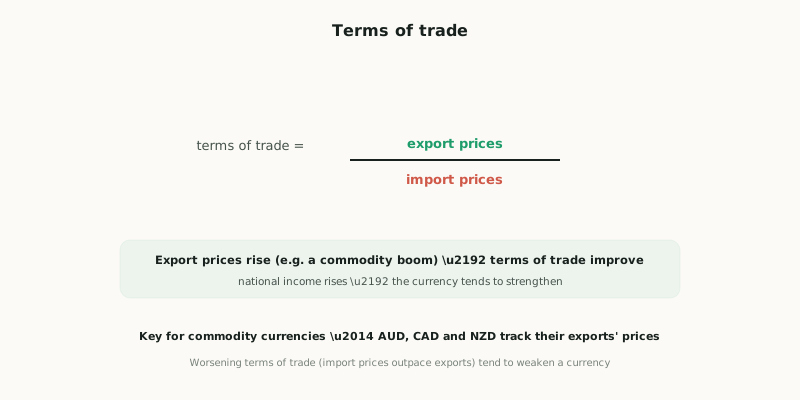
The terms of trade (ToT) are the ratio of a country's export prices to its import prices. Conceptually, they measure how much a country can import per unit of what it exports — the "real" purchasing power of its exports in terms of the imports they can buy. If a country's export prices rise relative to its import prices, its terms of trade improve: each unit of exports now commands more imports, so the country is effectively earning more from its trade. If export prices fall relative to import prices (or import prices outpace export prices), the terms of trade worsen: each unit of exports buys fewer imports, and the country earns less in real terms. The terms of trade thus capture a fundamental aspect of a country's economic fortunes — the relative prices at which it engages with the world — independent of the volume of trade.
Because this directly affects a country's real income from trade, it carries through to its currency. When terms of trade improve, the country enjoys an income gain — more earnings for the same exports — which tends to be currency-supportive (higher national income, stronger trade earnings, and greater demand for the currency to pay for those higher-valued exports). When terms of trade worsen, the income loss tends to be a currency drag. The table summarises the two directions.
Improving vs worsening terms of trade
| Aspect | Improving terms of trade | Worsening terms of trade |
|---|---|---|
| Prices | Export prices rise vs import prices | Import prices rise vs export prices |
| National income | Rises (earns more per export) | Falls (earns less per export) |
| Currency effect | Tends to strengthen | Tends to weaken |
| Commodity example | Exporter in a commodity boom | Exporter in a commodity slump |
Why it's crucial for commodity currencies
The terms of trade matter for every country, but they're especially important — and most visible — for commodity currencies, which is the most practical application of the concept for forex traders. Commodity-exporting nations have their export prices dominated by commodity prices: Australia exports iron ore and coal, Canada exports oil, New Zealand exports dairy, and so on. So when commodity prices rise, these countries' export prices rise, their terms of trade improve, their national income gets a boost, and their currencies tend to strengthen — the Australian dollar, Canadian dollar and New Zealand dollar climbing as their key exports become more valuable. When commodity prices fall, the chain runs in reverse: export prices fall, terms of trade worsen, income drops, and these currencies tend to weaken. This is, in large part, the mechanism behind the well-known relationship in which commodity currencies track their commodities: it isn't a mystical correlation but a real economic linkage running through the terms of trade and national income. Understanding it gives a trader a fundamental lens on why, say, the AUD often moves with iron-ore prices or the CAD with oil — their terms of trade, and thus their economic fortunes, are tied to those commodities.
The terms of trade also connect to the broader external accounts: improving terms of trade tend to strengthen the current account (better trade earnings), reinforcing the currency support, while worsening terms can pressure it. So the ToT is one of the threads linking global prices, a country's trade earnings, its external balance, and its currency.
The honest caveats hold as for all fundamentals. The terms of trade are one of many factors influencing a currency, operating mainly over the medium to longer term, and they interact with interest rates, growth, sentiment and capital flows — a currency can move against its terms of trade if other forces dominate. Moreover, because the market actively watches commodity prices (the main driver of commodity exporters' terms of trade), much of the terms-of-trade effect is already reflected in the commodity moves traders observe in real time — so the ToT is more a framework for understanding the commodity-currency link than a separate predictive signal. It's not a precise short-term timing tool. The honest framing: the terms of trade (export prices ÷ import prices) are a key fundamental driver, especially for commodity currencies — improving terms (e.g. a commodity exporter in a price boom) raise national income and tend to strengthen the currency, while worsening terms weaken it. They largely explain why the AUD, CAD and NZD track their key commodities, via national income and the current account. But they're one factor among many, operate over the medium-to-longer term, and are often already reflected in the commodity prices the market watches. Use the terms of trade as a structural lens — especially for commodity currencies — alongside the bigger fundamental picture and disciplined risk management, not as a standalone short-term signal.
Beyond commodities, and the limits
While commodity currencies are the clearest example, the terms of trade matter for all economies, and it's worth seeing the broader picture. Every country exports some things and imports others, so every country has terms of trade that shift as the relative prices of those goods change. A nation that exports sophisticated manufactured goods and imports raw materials, for instance, sees its terms of trade improve when raw-material (import) prices fall relative to its manufactured exports — the mirror image of the commodity exporter. Energy is a particularly important swing factor: a major energy importer suffers a terms-of-trade shock when oil and gas prices spike (its import bill jumps relative to its exports), tending to weaken its currency and economy, while a major energy exporter benefits from the same spike. The oil-price shocks of history are classic terms-of-trade events, redistributing income from importers to exporters and pressuring the currencies accordingly. So the framework illuminates more than just the obvious commodity currencies — it applies wherever a country's export and import price baskets diverge.
That said, the limits of the concept deserve emphasis alongside its uses. The terms of trade are a medium-to-long-term, structural influence, and in the short run a currency can move sharply against its terms of trade if interest rates, risk sentiment, or capital flows dominate — a commodity exporter's currency can fall in a global risk-off panic even as its commodity prices hold, because fleeing capital outweighs the terms-of-trade support. The effect is also partial: terms of trade are one input into national income and the current account, which are themselves only some of the forces on a currency. And critically, since the market already watches the commodity and energy prices that drive terms of trade, much of the effect is priced in as those prices move — the terms-of-trade lens helps you understand and anticipate the linkage (why a currency should respond to its export prices) more than it gives you fresh, tradeable information the market hasn't already absorbed. The honest practical use is as a structural understanding: knowing a currency's terms-of-trade exposure (which commodities or price relationships it's tied to) tells you what fundamentally drives it and what to watch, helping you interpret its moves and form a longer-term bias — not as a precise timing signal. Combined with the other fundamentals and disciplined risk management, it's a valuable thread in the macro picture, especially for the commodity and energy-sensitive currencies where its grip is strongest.
The terms of trade are the ratio of a country's export prices to import prices — how much it can import per unit of exports (the real purchasing power of its exports). Improving terms (export prices rise vs import prices) raise national income and tend to strengthen the currency; worsening terms weaken it. The effect is biggest for commodity currencies: when commodity prices rise, exporters like Australia (iron ore), Canada (oil) and New Zealand (dairy) see improving terms of trade and stronger currencies (AUD, CAD, NZD); when commodities fall, the reverse — this is largely why commodity currencies track their exports, via income and the current account. But it's one factor among many, works over the medium-to-longer term, and is often already reflected in the commodity prices the market watches. Use it as a structural lens (especially for commodity currencies), not a short-term signal — with the bigger picture and risk management.