
Every time a country trades with the world, currency changes hands. The current account tracks that flow — and whether a nation sells more to the world than it buys, or buys more than it sells, shapes the long-run pressure on its currency. A trade surplus brings demand for a country's money; a deficit leaves it leaning on foreign capital. This is one of the classic fundamental currency drivers, though, as we'll see, a subtler one than it first appears. This guide explains the current account and trade balance: what they are, why a surplus tends to support a currency and a deficit creates dependence on capital flows, and the crucial caveat that capital flows often dominate trade in the short term.
It's a core part of fundamental analysis, interacts closely with interest rates (which drive the capital flows discussed below), and matters especially for the commodity exporters in commodities and currencies.
Key takeaways
Q: What is the current account?
A: The current account is the part of a country's balance of payments that measures its transactions with the rest of the world in goods, services, income and transfers. Its largest component is usually the trade balance — exports minus imports. A surplus means a country sells more to the world than it buys; a deficit means the reverse.
Q: How does the current account affect a currency?
A: A surplus tends to support a currency, because foreign buyers need it to pay for the country's exports, creating demand. A deficit tends to be a vulnerability, since the country must attract foreign capital to finance it — leaving the currency dependent on continued capital inflows. But it's a structural factor, not a mechanical predictor.
Q: Why can a deficit country still have a strong currency?
A: Because capital flows often dominate trade flows in the short term. A country running a current account deficit can still have a strong currency if it attracts large capital inflows — drawn by high interest rates, investment opportunities, or reserve-currency status — as the United States often has with the dollar.
What the current account is
The current account is part of a country's balance of payments (BoP) — the record of all its economic transactions with the rest of the world. The current account specifically measures transactions in goods, services, income and transfers, and its largest and most-watched component is usually the trade balance: exports minus imports of goods and services. (It also includes net income from foreign investments and net transfers, but the trade balance dominates the picture for most countries.) The current account can be in surplus (the country sells more to the world than it buys — exports exceed imports) or deficit (it buys more than it sells — imports exceed exports).
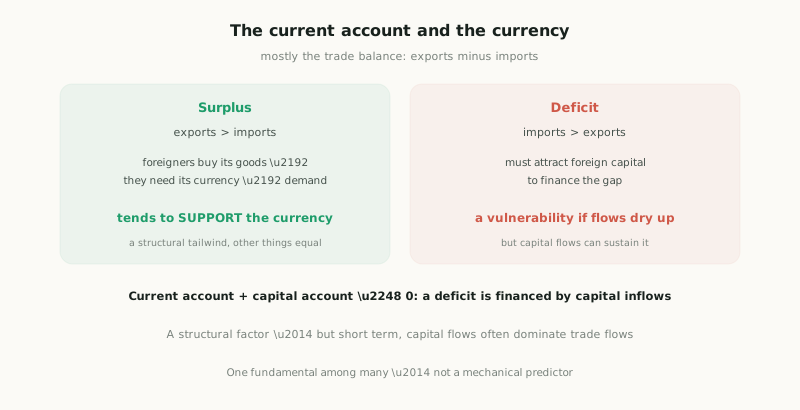
The reason this matters for currencies is the currency flows it implies. When a country exports, foreign buyers must obtain the country's currency to pay for those goods — creating demand for the currency. When a country imports, it must obtain foreign currency to pay overseas sellers — supplying its own currency to the market. So the trade balance reflects a balance of currency demand (from exports) against currency supply (from imports). A surplus means more export-driven demand than import-driven supply (net demand for the currency); a deficit means the reverse (net supply). This is the basic mechanism linking the current account to the currency, and it's why trade-balance figures (released regularly) are watched as a fundamental indicator. The summary below frames the two cases, which the rest of the guide explains.
Surplus vs deficit at a glance
Surplus, deficit and capital flows
A current account surplus tends to support a currency, other things equal. Because the country exports more than it imports, there's net demand for its currency from foreign buyers paying for its goods — a structural tailwind. Persistent-surplus countries (historically the likes of Germany, Japan and China) tend to have this underlying source of currency support. A current account deficit is the more interesting case. Running a deficit — importing more than exporting — means there's net supply of the currency from trade, but, crucially, the deficit must be financed. This brings in the rest of the balance of payments: by accounting identity, the current account and the capital (financial) account roughly sum to zero, which means a current account deficit must be matched by a capital account surplus — that is, by net capital inflows (foreigners investing in or lending to the country). A deficit country, in other words, relies on attracting foreign capital to fund its excess of imports over exports.
This reliance is the heart of why a deficit is often described as a vulnerability. As long as the country attracts sufficient capital inflows (foreign investment in its assets, lending, etc.), the deficit is financed and the currency can be stable — the capital inflows provide the currency demand that trade alone doesn't. But if those capital flows dry up or reverse (foreign investors lose confidence, or are drawn elsewhere), the country struggles to finance its deficit, and the currency can come under pressure or fall — the deficit, previously sustained by capital, becomes a weakness. So a deficit makes a currency dependent on continued capital inflows, and large, persistent deficits are watched as a potential vulnerability, especially if a country's ability to attract capital is in question. Historically, deficit countries (such as the US and UK) have relied on this capital-inflow financing. The key insight is that the current account doesn't act in isolation — it's inseparable from the capital flows that finance it, and a deficit's effect on the currency depends heavily on whether those flows continue.
The crucial caveat: capital flows often dominate
Here is where the simple "surplus good, deficit bad" intuition must be tempered with an honest caveat, central to using this fundamental correctly: capital flows often dominate trade flows in the short term, especially for major currencies. While the trade balance creates underlying currency demand and supply, the capital flows (driven by interest rates, investment opportunities, risk sentiment and the like) are frequently much larger and more volatile than trade flows, and they often overwhelm the trade picture in determining a currency's direction over days, weeks and months. The result is that the current account is more of a longer-term, structural factor and a vulnerability indicator than a reliable short-term predictor of currency moves.
The clearest illustration is that a deficit country can have a strong currency. The United States, for example, has long run substantial current account deficits, yet the dollar is often strong — because the US attracts enormous capital inflows (drawn by its deep markets, investment opportunities, interest rates, and the dollar's reserve-currency status), which more than finance the trade deficit and support the currency. The trade deficit, in isolation, would suggest currency weakness; the capital inflows override it. This is why a trader can't simply short a currency because the country runs a deficit, or buy one because it runs a surplus — the capital-flow side, driven heavily by interest-rate differentials and investor sentiment (the bond-yields and interest-rates material), usually matters more in the short run. The honest, practical framing: the current account and trade balance are genuine fundamental factors — a surplus is a structural support, a deficit a structural vulnerability that depends on capital inflows — but they're one factor among many, more relevant as a longer-term and vulnerability lens than a short-term predictor, and frequently dominated by capital flows. Used that way — as part of the structural picture, alongside interest rates, growth, risk sentiment and the rest, rather than as a mechanical rule — the current account is a valuable piece of fundamental analysis. Treated as a simple "surplus up, deficit down" signal, it will mislead, because the world's capital flows have other ideas.
Reading the trade-balance data
In practice, the current account reaches traders mainly through regularly released trade balance figures (monthly in most countries), reported as a surplus or deficit for the period, with the full current account published less frequently (often quarterly). As with all economic releases, what moves a currency on the day is the figure versus expectations (the surprise, per the economic-indicators material), not the raw level: a trade balance that comes in much better than forecast (a bigger surplus or smaller deficit than expected) can give a currency a modest lift, while a worse-than-expected figure can weigh on it — though, consistent with the caveat above, trade-balance releases typically move major currencies less than interest-rate or inflation news, because capital flows dominate trade flows.
A related concept worth knowing is the terms of trade — the ratio of a country's export prices to its import prices. When the terms of trade improve (export prices rising relative to import prices), a country earns more for what it sells relative to what it buys, which tends to support its currency; when they deteriorate, the reverse. This matters especially for commodity exporters (the commodities-and-currencies link): for a country like Australia or Canada, a rise in the price of its key commodity exports improves its terms of trade and tends to support its currency, while a fall does the opposite. So beyond the headline surplus-or-deficit, the prices behind trade flows matter too. The practical approach is to treat trade-balance and current-account data as part of the structural backdrop — a longer-term read on whether a currency has a trade tailwind (surplus) or a capital-flow dependence (deficit) — rather than as a frequent trading trigger, while watching the terms of trade for commodity currencies. It's a slow-moving fundamental that shapes the bigger picture more than the daily one.
The current account (part of the balance of payments) measures a country's trade in goods, services, income and transfers — dominated by the trade balance (exports minus imports). A surplus (exports > imports) brings net demand for the currency from foreign buyers, tending to support it. A deficit (imports > exports) must be financed by capital inflows (current account + capital account ≈ 0), making the currency dependent on attracting foreign capital — a vulnerability if those flows dry up. But the crucial caveat: capital flows often dominate trade flows short term, so a deficit country (like the US) can have a strong currency if it attracts capital. Treat the current account as a longer-term, structural and vulnerability factor — one fundamental among many, not a mechanical "surplus up, deficit down" predictor.