
Every dollar a country earns from — or sends to — the rest of the world is recorded somewhere in its balance of payments: the complete ledger of its dealings with every other economy. Read correctly, this vast accounting framework reveals the deep, structural forces of supply and demand pressing on a currency over time — whether a nation is a net earner or a net borrower from the world, and how it finances the gap. It's the umbrella framework that ties together the trade balance, the current account, and the investment flows that move modern currencies. This guide explains the balance of payments for forex: its two main accounts, the identity that makes them balance, and how it shapes a currency's structural supply and demand.
It's a core part of fundamental analysis, contains the current account as one half, and connects directly to capital flows as the other.
Key takeaways
Q: What is the balance of payments?
A: The balance of payments is the complete record of all economic transactions between a country and the rest of the world over a period. It's divided into two main parts: the current account (trade in goods and services, plus income and transfers) and the capital and financial account (investment flows in and out, plus reserve assets).
Q: Why must the balance of payments balance?
A: By accounting identity, the two accounts offset each other: a current-account deficit (importing more than you export and earn) must be financed by net capital inflows (a capital/financial-account surplus), and a current-account surplus is matched by net capital outflows. In principle the overall balance of payments sums to zero, aside from reserve changes and statistical discrepancies.
Q: How does the balance of payments affect a currency?
A: It reflects the structural supply and demand for a currency from international transactions — exports and inflows create demand, imports and outflows create supply. A surplus tends to be supportive; a deficit can be a vulnerability, since the country depends on continued capital inflows to fund it, and the currency can weaken sharply if those inflows dry up.
The two accounts
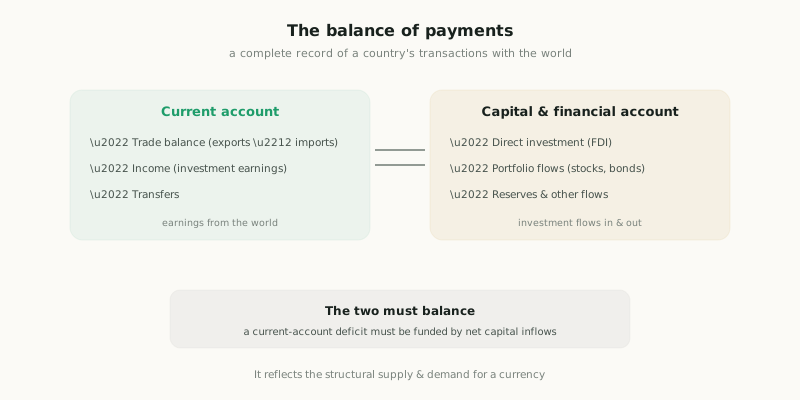
The balance of payments (BoP) is the complete record of all economic transactions between a country and the rest of the world over a period. It's structured into two main accounts, summarised below.
The structure of the balance of payments
The current account records a country's earnings from and spending with the rest of the world through trade and income: the trade balance (exports minus imports of goods and services), plus income (earnings on foreign investments, wages) and transfers (such as remittances and aid). A current-account surplus means the country earns more from the world than it spends (a net earner); a deficit means the opposite (it spends more than it earns abroad). The current account has its own detailed guide; here it's one half of the BoP. The capital and financial account records the investment flows in and out of the country: foreign direct investment (building or buying businesses), portfolio investment (buying stocks and bonds), other investment (loans, deposits), and changes in official reserve assets. Where the current account tracks trade and income, the capital/financial account tracks the movement of capital — the capital flows that fund or follow it.
Why it must balance
The defining feature of the balance of payments is captured in its name: it must balance. This is an accounting identity — the two accounts offset each other so that, in principle, the overall balance of payments sums to zero (aside from changes in official reserves and statistical "errors and omissions"). The intuition is straightforward and important: if a country runs a current-account deficit — importing and spending more abroad than it earns — it must be financing that gap somehow, and it does so by attracting net capital inflows (a capital/financial-account surplus): foreigners lending to it or investing in its assets to fund the shortfall. Conversely, a country running a current-account surplus (a net earner) is effectively lending to or investing in the rest of the world, producing net capital outflows. So the trade picture and the investment picture are two sides of the same coin: a deficit on one side is necessarily matched by a surplus on the other.
This identity carries a profound implication for currencies, because it means a deficit country is structurally dependent on capital inflows. As long as foreigners are willing to fund the current-account deficit by investing in the country's assets (its bonds, equities, businesses), all is well — but that willingness is not guaranteed. If confidence falters and those inflows slow or reverse, the country can no longer easily finance its deficit, and the currency must adjust (typically weaken) to restore balance — sometimes sharply. This dependence is the central vulnerability the balance of payments reveals, and it sits beneath many currency crises.
What it means for the currency
For forex, the balance of payments matters because it reflects the structural supply and demand for a currency arising from a country's international transactions. The logic runs through the currency: a country's exports and capital inflows generate demand for its currency (foreigners must buy it to pay for the goods or to invest), while its imports and capital outflows generate supply (the country's residents sell their currency to buy foreign goods or assets). The net of all this — the overall balance-of-payments position — shapes the deep, longer-term pressure on the exchange rate. Broadly, a current-account surplus tends to be currency-supportive (net demand from being a global earner), while a persistent deficit is a potential drag and vulnerability (net supply, plus reliance on the goodwill of foreign investors to fund it). A country that earns its keep in the world rests on firmer currency foundations than one perpetually dependent on borrowing from it.
The honest caveats are essential, because the BoP is a big-picture, slow-moving structural factor, not a short-term trading signal. In the short run, currencies are driven far more by interest rates, market sentiment, and the capital flows chasing them than by the trade balance directly — indeed, the capital account often dominates day-to-day, which is why a deficit country with attractive interest rates can see its currency strengthen (capital inflows funding the deficit and then some) even as the trade picture looks weak. The BoP's influence is structural and operates over years, it's complex, and much of it is already known and priced in. So it's best used as a framework for understanding a currency's underlying position and vulnerabilities — is this economy a structural earner or a structural borrower, and how exposed is it to a loss of investor confidence? — rather than as a tool for timing trades. The honest framing: the balance of payments is the accounting framework of a country's external transactions — the current account (trade, income, transfers) and the capital/financial account (investment flows, reserves), which must balance, so a current-account deficit is necessarily funded by net capital inflows. It reflects the structural supply and demand for a currency — surpluses generally supportive, deficits a potential vulnerability through dependence on inflows — and underpins many currency crises. But it's a slow-moving structural picture, often overwhelmed in the short run by rates, sentiment and capital flows, and largely priced in. Use it to understand a currency's underlying foundations and risks, alongside the faster-moving drivers and always within disciplined risk management — not as a short-term signal.
Persistent imbalances and their risks
The balance of payments becomes most revealing when an imbalance persists, because chronic positions carry different implications than temporary ones. A country running a persistent current-account deficit year after year is, in effect, steadily borrowing from or selling assets to the rest of the world to fund its excess spending — accumulating external liabilities and a growing dependence on foreign capital. For a while, this can be perfectly sustainable: if the deficit funds productive investment, or if the country is an attractive, trusted destination for capital (deep markets, strong returns, stability), inflows continue happily and the currency holds. But the dependence is the latent risk — the larger and more entrenched the deficit, the more the currency relies on the continued goodwill of foreign investors, and the more exposed it is to a shift in sentiment.
When that shift comes, the adjustment can be abrupt. If investors decide a deficit country's assets are no longer worth funding — because of rising risk, falling returns, political instability, or simply a global flight from risk — the inflows that financed the deficit can slow or reverse, and the currency must weaken to force the external accounts back toward balance (a cheaper currency makes exports more competitive and imports dearer, shrinking the deficit, while also repricing the country's assets to tempt capital back). This adjustment is sometimes orderly and gradual, but it can also be sharp and disorderly — a currency crisis — particularly for emerging markets with large deficits funded by mobile hot money. Persistent surpluses carry their own dynamics: a chronic surplus country (a structural net earner and exporter of capital) tends to face upward pressure on its currency over time, which it may resist (through intervention or reserve accumulation) to protect its exporters — a source of trade and currency tensions between nations. For the trader and analyst, the practical value is in reading these structural positions as a guide to a currency's underlying resilience or fragility: a structural surplus economy rests on firmer foundations, while a large-deficit economy dependent on fickle inflows carries embedded vulnerability that can surface violently when confidence turns. The balance of payments won't time that turn, but it tells you where the fault lines lie.
The balance of payments is the complete record of a country's transactions with the world, in two accounts: the current account (trade balance + income + transfers — earnings from the world) and the capital/financial account (investment flows in/out + reserves). They must balance: a current-account deficit must be funded by net capital inflows, and a surplus produces net outflows — so a deficit country structurally depends on capital inflows (its key vulnerability; if they dry up, the currency can fall sharply). It reflects the structural supply/demand for a currency: surpluses generally supportive, deficits a potential drag. But it's a slow-moving, structural factor — in the short run, rates, sentiment and capital flows dominate (a deficit country with high rates can still see inflows), and much is priced in. Use it to understand a currency's underlying foundations and risks, not as a short-term signal — with risk management.