In today's markets, the trillions of investment dollars sloshing between countries — chasing yield, growth, and safety — move currencies far more than the steady drip of trade ever could. A country can run a yawning trade deficit and still see its currency rise, simply because global investors are pouring capital into its bonds and stocks. To understand modern forex, then, you have to follow the capital: where investment money is flowing, and why. This guide explains capital flows and forex: the types of flows, why they move currencies so powerfully, what drives them, and the danger when they reverse.
Capital flows are the other half of the balance of payments, are driven heavily by interest rates (the basis of the carry trade), and swing with risk sentiment.
Key takeaways
Q: What are capital flows?
A: Capital flows are movements of investment money across borders — into and out of a country's assets such as bonds, stocks, real estate, businesses and bank deposits. They include foreign direct investment (FDI), portfolio investment, and short-term speculative 'hot money', and they are among the most powerful drivers of currencies in the short to medium term.
Q: Why do capital flows move currencies?
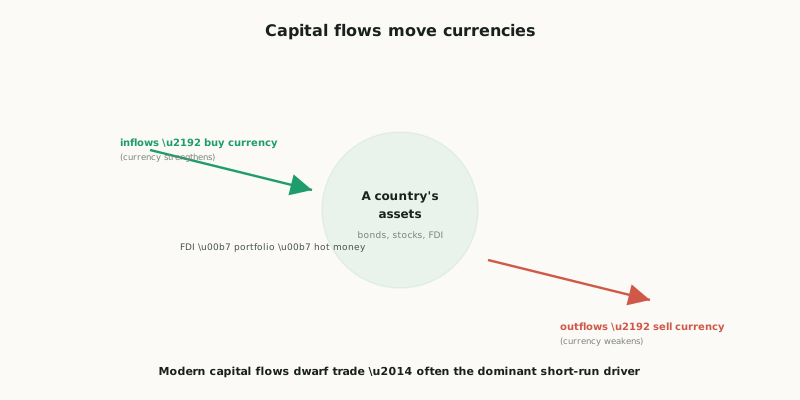
A: To invest in a country's assets, foreigners must first buy its currency — creating demand for it. So capital inflows tend to strengthen a currency and outflows to weaken it. Because modern capital flows are enormous, often dwarfing trade flows, currencies frequently track where investment capital is moving more than the trade balance.
Q: What is capital flight?
A: Capital flight is the rapid exit of investment capital from a country, usually triggered by a collapse in confidence — a crisis, instability or fear of devaluation. A related idea is a 'sudden stop', where inflows abruptly cease. Both can crash a currency, especially for deficit or emerging-market economies that depend on continued capital inflows.
The types of capital flow
Capital flows are the movements of investment money across borders — into and out of a country's assets: bonds, stocks, real estate, businesses, and bank deposits. They come in several forms with very different characters. Foreign direct investment (FDI) is long-term capital — building factories, buying or establishing businesses — and tends to be stable and "sticky," as it's not easily or quickly withdrawn. Portfolio investment is the purchase of financial assets (stocks and bonds) by foreign investors; it's more mobile than FDI, able to move more quickly as investors reallocate. "Hot money" — short-term, speculative, yield- and return-chasing capital — is the most mobile of all, flowing rapidly in search of the best short-term returns and capable of reversing in a flash; it's the most powerful and the most destabilising type. There are also bank flows, loans and deposits. The key distinction is mobility: FDI is slow and stable, portfolio flows are faster, and hot money is fast and fickle — a spectrum that matters greatly when flows reverse.
Why capital flows move currencies
The reason capital flows are such a powerful currency driver is mechanical: to invest in a country's assets, a foreign investor must first buy that country's currency. Buying Japanese bonds means buying yen; buying US stocks means buying dollars. So capital inflows create demand for a currency (pushing it up), and capital outflows create supply (pushing it down) — exactly as trade does, but on a far larger scale. And that scale is the crucial point: in the modern, financially integrated world, capital flows are enormous and routinely dwarf trade flows. The daily volume of cross-border investment and speculation vastly exceeds the value of goods being traded. As a result, in the short-to-medium run, currencies are frequently driven more by where investment capital is flowing — toward yield, growth, or safety — than by the trade balance. This is precisely why interest-rate differentials (which attract yield-seeking capital) and risk sentiment (which drives capital toward or away from risk) move currencies so dramatically: they steer the capital, and the capital steers the currency.
What drives capital flows, then, is what makes a country's assets attractive (or unattractive) to global investors. Interest-rate and yield differentials are central — capital flows toward higher returns (the carry trade is exactly this: borrowing cheap, low-yield currencies to invest in higher-yielding ones), so a country raising rates or offering higher yields tends to attract inflows and a stronger currency. Relative growth and returns matter — capital chases the economies and markets offering the best prospects. Risk sentiment is a huge driver — in "risk-on" moods, capital flows toward higher-yielding, riskier assets and currencies; in "risk-off" moods, it flees to safety (the dollar, yen, Swiss franc, gold). And underpinning all of it is confidence and stability — capital flows toward economies and institutions it trusts, and away from those it fears. Expectations of all these factors drive flows in advance.
The danger: capital flight
The flip side of capital's power is its fickleness, and this is where the real danger lies. Because much capital — especially portfolio flows and hot money — is highly mobile, it can leave as fast as it arrived. When confidence in a country collapses (a crisis, political instability, a fear of devaluation or default), capital can flee rapidly — capital flight — or new inflows can abruptly cease — a "sudden stop." Either can crash a currency: as investors rush to sell the country's assets and convert back out of its currency, the selling pressure overwhelms it. This dynamic is a major source of currency crises, and it's especially dangerous for deficit countries and emerging markets that depend on continued capital inflows to fund their balance of payments (the vulnerability the balance-of-payments framework reveals). A country reliant on the kindness of mobile foreign capital is one shock away from a currency collapse if that capital takes fright. The stickier the capital (more FDI, less hot money), the more resilient the country; the more it relies on hot money, the more fragile.
The honest caveats apply as to all fundamentals. Capital flows are complex, fast-changing, and hard to predict — they respond to a shifting mix of rates, growth, sentiment and confidence, often turning on expectations and surprises, and they interact with everything else. Understanding capital flows explains a great deal of currency movement (arguably more of the short-to-medium-term action than any other single factor), but it does not give a precise predictive signal — you can't simply forecast where capital will flow next with reliability, and the flows can reverse suddenly. The honest framing: capital flows (FDI, portfolio investment, hot money) are a dominant short-to-medium-term currency driver — to buy a country's assets you must buy its currency, so inflows lift it and outflows weaken it, and because modern flows dwarf trade, currencies often track where investment capital is going (chasing yield, growth, safety) more than the trade balance. They're driven by rate differentials, relative growth, risk sentiment and confidence, and their great danger is capital flight/sudden stops, which can crash a currency (especially for inflow-dependent deficit and emerging economies). But they're fickle, complex and hard to predict, and interact with all other factors. Follow the capital to understand currency moves — but treat it as powerful context, not a precise signal, and always trade within disciplined risk management.
Tracking and reading capital flows
Since capital flows are hard to observe directly in real time, traders and analysts read them largely through their drivers and signals — the conditions that attract or repel capital, and the market's response to them. The most-watched signal is relative interest rates and yield differentials: when a central bank raises rates (or is expected to), its assets become more attractive to yield-seeking capital, and the currency often strengthens in anticipation of the inflows. This is why central-bank decisions and the expectations around them move currencies so sharply — the market is, in effect, pricing the capital flows those rate paths will generate. Watching the trajectory of relative rates across countries is therefore one of the best lenses on where capital is likely to flow. Bond yields (the yield link) carry similar information, since they reflect the returns on offer to fixed-income capital.
The second great lens is risk sentiment. Because capital flows toward risk in "risk-on" moods and toward safety in "risk-off" ones, reading the prevailing risk environment tells you much about the direction of flows — and explains the behaviour of the safe-haven currencies (the dollar, yen, Swiss franc), which strengthen as capital flees to them in fearful periods regardless of their own yields. Traders watch equity markets, volatility gauges, and credit conditions as proxies for the risk mood steering capital. Beyond these, relative growth and return prospects (which economies and markets look most attractive), political and institutional stability (capital avoids the untrustworthy), and large one-off events (elections, crises, policy shifts) all signal where capital may move. The practical synthesis: rather than trying to observe capital flows directly, watch the conditions that drive them — relative rates and yields, risk sentiment, growth prospects, and stability — and recognise that much of the currency market's daily movement is the market anticipating and responding to shifts in these drivers. This reframes a lot of forex analysis: when you track interest-rate expectations and risk sentiment, you're really tracking the likely path of capital, and therefore of the currency. It remains, of course, an exercise in reading probabilities and shifting expectations, not certainties — capital can surprise — so it informs your bias and context, applied always with risk management.
Capital flows are cross-border movements of investment money into/out of a country's assets: FDI (long-term, sticky), portfolio flows (stocks/bonds, more mobile), and hot money (short-term speculative, very fast/fickle). They move currencies because to buy a country's assets you must buy its currency — inflows strengthen it, outflows weaken it. Crucially, modern capital flows dwarf trade, so currencies often track where capital is going more than the trade balance — which is why rate differentials (the carry trade), relative growth, and risk sentiment move FX so much. The danger is capital flight / "sudden stops": when confidence collapses, mobile capital flees fast and can crash a currency — especially for inflow-dependent deficit/emerging economies. But flows are fickle, complex and hard to predict. Follow the capital to understand moves, but treat it as context, not a precise signal — with risk management.