
If you watch one thing to understand currency moves, make it bond yields. They sit at the heart of what drives capital across borders — and capital chases yield. A country's bond yields reflect its interest rates, inflation, growth and risk all at once, and the flows they set in motion are among the most powerful forces in the currency market. But there's a crucial twist: why yields are rising matters as much as the fact that they are. This guide explains bond yields and the currency: why higher yields tend to attract capital and support a currency, why yield differentials and real yields matter most, and why the reason behind a yield move can flip the currency reaction.
It's the transmission mechanism behind interest rates and central bank policy, the engine of the carry trade, and the key signal of sovereign-debt stress.
Key takeaways
Q: How do bond yields affect currencies?
A: Higher bond yields tend to attract foreign capital, since investors seek higher returns — and to buy a country's higher-yielding bonds, they need its currency, creating demand that tends to support it. So a currency with rising or relatively high yields tends to strengthen, all else equal. It's the yield differential between countries that matters most.
Q: What is a yield differential?
A: A yield differential is the difference in bond yields between two countries. Because exchange rates are relative, capital flows toward the higher-yielding currency, so it's the gap, not the absolute level, that drives the currency. A widening differential in a currency's favour tends to support it; a narrowing one tends to weigh on it.
Q: Do higher yields always strengthen a currency?
A: No — the reason yields are rising matters. If yields rise because of strong growth or expected rate hikes, that's currency-supportive. But if they rise because of default or inflation fears (a debt crisis), the higher yields reflect risk and capital flight, and can coincide with a weaker currency. Why yields move is as important as the move itself.
The core link: capital chases yield
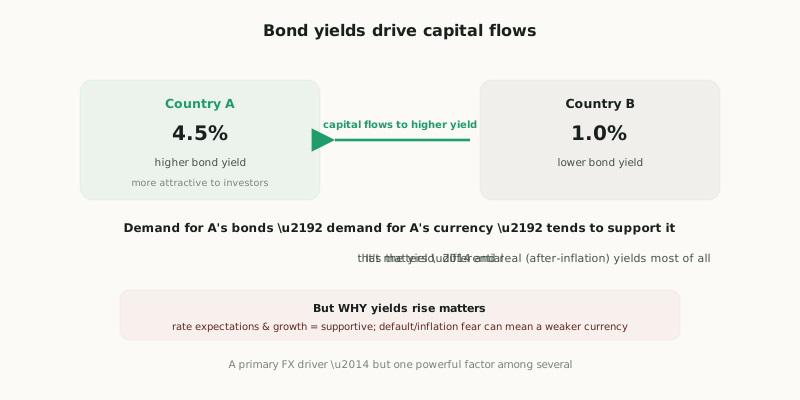
Bond yields are the return on government bonds — the interest rate the market demands to hold a country's debt. They're closely tied to interest rates and, especially, to expectations of future interest rates (yields embody the market's view of where rates are heading). The core link to currencies is simple and powerful: capital chases yield. Higher bond yields tend to attract foreign capital, because investors seek higher returns on their money — and to buy a country's higher-yielding bonds, foreign investors must obtain its currency, creating demand for that currency that tends to support it. Conversely, lower yields make a currency's bonds less attractive, drawing less capital and offering less support. So, broadly, a currency whose yields are rising or relatively high tends to strengthen, all else equal, as capital flows in to capture the yield.
The crucial refinement is that it's yield differentials — not absolute yields — that matter, because exchange rates are inherently relative (a currency's value is always against another currency). What drives capital flows is the difference in yields between two countries: capital flows toward the higher-yielding currency relative to the lower-yielding one (this is precisely the logic of the carry trade). So it's the gap that counts. A widening yield differential in a currency's favour — its yields rising relative to another country's — tends to support it; a narrowing differential (its yield advantage shrinking) tends to weigh on it. A trader therefore watches not just one country's yields but the differential between the two currencies in a pair.
The yield differential and capital flows
| Aspect | Higher-yielding currency | Lower-yielding currency |
|---|---|---|
| Investor appeal | More attractive (higher return) | Less attractive |
| Capital flows | Tend to flow in | Tend to flow out |
| Currency effect | Tends to be supported | Tends to weaken |
| What matters | The differential between them — and real (after-inflation) yields | |
One further refinement: real yields (the yield minus expected inflation) matter most of all, because investors care about returns after inflation. A high nominal yield isn't attractive if inflation is even higher (the real return is negative); a currency offering high real yields is genuinely attractive. So the sharpest version of the rule is that capital is drawn to high real yield differentials, which is what most strongly supports a currency.
What yields reflect, and the twist
To use bond yields well, it helps to know what they reflect — because yields are a composite signal. A bond's yield embeds: central bank policy and rate expectations (the dominant driver — yields move with expected future interest rates, so they're a real-time gauge of where the market thinks the central bank is heading); inflation expectations (higher expected inflation means investors demand higher yields to compensate); growth (stronger growth tends to lift yields, via rate expectations); and a risk/credit premium (riskier sovereigns must pay higher yields to compensate for default risk — the link to sovereign debt). So watching bond yields is, in effect, watching the market's combined read on rates, inflation, growth and risk — which is why they're such a rich, central indicator. Traders often watch the 2-year yield (very sensitive to rate expectations, often closely tied to FX) and the 10-year (a broader benchmark).
And here is the crucial twist that prevents a naive "higher yields = stronger currency" rule from misleading: the reason yields are rising matters. Usually, higher yields support a currency — when they're rising for "good" reasons: expectations of rate hikes, a strong economy, the central bank tightening. In that case, higher yields genuinely reflect a more attractive, higher-return currency, and capital flows in to support it. But yields can also rise for "bad" reasons: default or fiscal/debt fears, or runaway inflation. If a country's yields are spiking because investors fear it might default (a debt crisis — demanding a huge risk premium) or because inflation is spiralling out of control, those higher yields reflect risk and capital flight, not attractiveness — and the currency can weaken (or collapse) despite the rising yields. In a debt crisis, yields and the currency move in opposite directions to the usual rule: yields soar while the currency sinks, because the yield surge is the market pricing danger. So the practical lesson is to ask why yields are moving: rising yields driven by rate expectations and growth are currency-supportive; rising yields driven by default or inflation fear can be currency-negative. The fact of a yield move isn't enough — its cause determines the currency reaction.
The honest, practical framing: bond yields — especially relative yield differentials and real yields — are a primary currency driver, arguably the most important of the rate-related fundamentals, because capital chases yield and the differential drives cross-border flows. Higher relative (real) yields generally attract capital and support a currency. But the reason yields move is essential context (rate-expectation/growth-driven rises support; default/inflation-driven rises can undermine), and bond yields, powerful as they are, remain one factor interacting with risk sentiment, intervention, the current account and the rest. Used with that nuance — watching the differential and the real yield, and asking why yields are moving — bond yields are one of the most illuminating windows a currency trader has onto what's driving the market.
Watching yields in practice
To put bond yields to use, a few practical points help. First, which yields to watch: traders most commonly follow the 2-year and 10-year government yields. The 2-year is especially sensitive to rate expectations (it closely tracks where the market thinks the central bank will set rates over the next couple of years), which makes it particularly relevant to currencies — shifts in 2-year yields often move FX, since they reflect the rate-expectation changes that drive capital flows. The 10-year is a broader benchmark, reflecting longer-term growth, inflation and risk views. Watching how these move — and why — gives a read on the rate-and-risk picture behind a currency.
Second, and most importantly for FX, watch the differential between the two countries in a pair. Because it's relative yields that matter, the key isn't one country's yield in isolation but the gap — for example, the difference between US and German yields for EUR/USD, or US and Japanese yields for USD/JPY. When one side's yields rise relative to the other's (a widening differential in its favour), its currency tends to be supported; when the differential narrows, the support fades. Tracking the spread between a pair's two government yields (often the 2-year spread) is one of the most useful fundamental gauges for that pair, and yield differentials frequently move in step with — or even slightly ahead of — the exchange rate. Third, remember the real-yield refinement (subtract expected inflation) and, above all, the why: a widening differential driven by one country's strong growth and hawkish central bank is genuinely currency-supportive, whereas a yield rise driven by that country's default or inflation fears is not. The practical habit, then, is to watch the relevant yield differential for a pair, note the direction it's moving, and always ask why — because the yield differential is among the clearest windows onto the forces pulling a currency pair, provided its cause is understood. Used this way, bond yields turn the abstract idea of "capital chasing yield" into a concrete, trackable signal.
Bond yields are the return on government bonds, reflecting rate expectations, inflation, growth and risk. The core link: capital chases yield — higher yields attract foreign capital, which must buy the currency, tending to support it. What matters most is the yield differential between two countries (FX is relative, so capital flows to the higher-yielder — the carry logic), and especially real yields (yield minus inflation). A widening differential in a currency's favour supports it; a narrowing one weighs on it. The crucial twist: why yields rise matters — rises driven by rate expectations or strong growth are supportive, but rises driven by default or inflation fears (a debt crisis) reflect risk and can mean a weaker currency (yields soar, currency sinks). A primary FX driver — watch the differential, the real yield, and the reason behind the move.