
A government's debt is usually a slow-burning background factor — until, suddenly, it isn't. For long stretches markets barely notice a country's debt; then confidence cracks, and the currency can be the first casualty. Sovereign debt — a government's borrowing — is mostly a longer-term, structural influence on a currency, but one capable of producing dramatic moves when sustainability comes into question. This guide explains how sovereign debt shapes currencies: debt levels and credit ratings, why moderate debt is benign but unsustainable debt or a crisis can be devastating, and the crucial divide between borrowing in your own currency and borrowing in a foreign one.
It's closely tied to fiscal policy (deficits build debt), signalled by bond yields (rising yields warn of debt stress), and intersects with geopolitics and safe-haven flows in crises.
Key takeaways
Q: How does sovereign debt affect a currency?
A: Moderate, sustainable government debt usually has little currency effect. But high or rapidly rising debt, especially if its sustainability is questioned, can weaken a currency through fears of default, inflation or capital flight. A credit-rating downgrade can pressure a currency, and a full debt crisis can cause it to collapse.
Q: What are sovereign credit ratings?
A: Sovereign credit ratings are assessments by agencies (such as S&P, Moody's and Fitch) of a government's creditworthiness — its ability and willingness to repay debt — ranging from the highest grade (AAA) down to speculative or 'junk' status. A downgrade signals higher perceived default risk and can weigh on a currency.
Q: Why does borrowing in your own currency matter?
A: A country that borrows in its own currency can always create that currency to repay debt, so it can't be forced into outright default the same way — though printing risks inflation and currency debasement. Countries that borrow in a foreign currency face genuine default risk, since they can't print it, making them far more vulnerable to debt and currency crises.
Debt, ratings and the basics
Sovereign debt is a government's outstanding borrowing — the accumulated total it owes, financed by issuing government bonds. It's commonly measured relative to the size of the economy as the debt-to-GDP ratio, which gives a sense of the debt burden's scale (a country with debt equal to 60% of GDP is less burdened than one at 130%, broadly speaking). Debt grows when governments run budget deficits (spending more than they raise — the link to fiscal policy), so persistent deficits steadily build the debt stock.
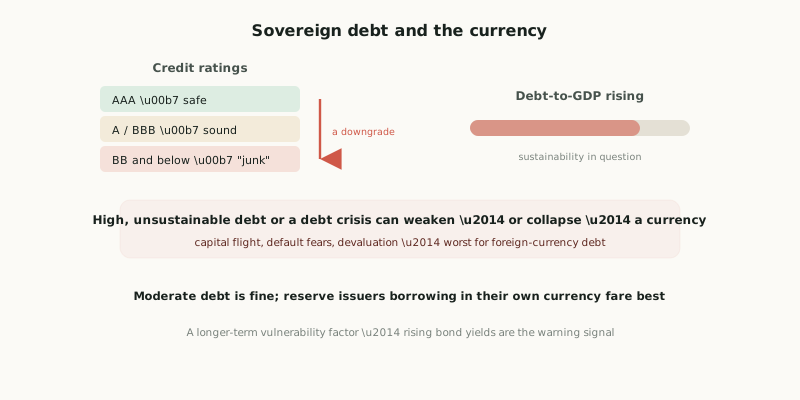
The market's assessment of a government's creditworthiness is captured in credit ratings. Agencies — the major ones being S&P, Moody's and Fitch — rate sovereigns on their ability and willingness to repay, from the top grade (AAA, considered very safe) down through investment grade to speculative or "junk" status (signalling significant default risk). A downgrade (a cut in rating) signals deteriorating creditworthiness and higher perceived default risk. For currencies, the broad picture is: moderate, sustainable debt with a solid rating is generally benign — markets don't worry, and there's little currency effect, as most developed economies carry substantial debt without issue. The concern arises when debt becomes high and rising with sustainability in question: then fears of default, of inflation (if the government resorts to printing money to manage the debt), of capital flight, and a rising risk premium can weigh on the currency. A downgrade can act as a trigger — signalling risk, potentially prompting some investors (who are mandated to hold only higher-rated assets) to sell, which can weaken the currency. So sovereign debt's currency effect scales with concern: negligible when debt is sound, increasingly negative as sustainability is doubted.
When debt becomes a crisis
At the extreme, sovereign debt can produce a debt crisis — and this is where currencies can move most violently.
A sovereign debt crisis occurs when markets lose confidence in a government's ability to service its debt. Bond yields spike (investors demand far higher returns to lend, or refuse to lend at all), the government struggles to borrow or refinance, and a vicious circle can set in. For the currency, the consequences can be severe: capital flight (investors pulling money out), sharp devaluation or collapse, and, in the worst cases, default. Sovereign debt crises are a major source of currency collapses, particularly in emerging markets. When confidence in a government's solvency breaks, its currency is often among the first and hardest hit.
History offers recurrent examples — emerging-market debt crises in which currencies collapsed amid capital flight and default, and episodes of sovereign stress in developed economies (the Eurozone sovereign debt crisis being a prominent case, though complicated by the fact that those countries shared the euro rather than having their own currencies to devalue). The mechanism is confidence: a currency, ultimately, rests on faith in the country's economic and financial stability, and a debt crisis shatters that faith, sending capital fleeing and the currency tumbling. This is why sovereign debt, usually a quiet background factor, becomes a dominant currency driver when a crisis looms — and why traders watch debt sustainability and the signals of stress (especially bond yields and spreads) carefully for vulnerable countries. The danger is real and, when it materialises, fast: currencies can fall a long way, quickly, in a genuine sovereign debt crisis.
Own currency versus foreign currency
A crucial nuance determines how vulnerable a country is: whether it borrows in its own currency or a foreign one. A country that borrows in its own currency (and has its own central bank that can create that currency) cannot be forced into outright default the same way — in the last resort, it can always print its own currency to repay debts denominated in that currency. This greatly reduces the risk of a hard default. However, this is not a free pass: resorting to printing money to service debt risks inflation and currency debasement — so the "escape" from default can itself weaken the currency (through inflation and loss of value) even as it avoids formal default. The risk shifts from default to debasement.
A country that borrows in a foreign currency (common for many emerging markets, which often must borrow in dollars or euros because investors won't lend to them in their own) faces a far harsher situation — sometimes called "original sin." It cannot print the foreign currency it owes, so it faces genuine default risk: if it runs short of the foreign currency to repay, it can be forced to default outright. This makes foreign-currency borrowers much more vulnerable to debt and currency crises — a falling domestic currency makes the foreign-currency debt even harder to repay (in domestic terms), which can feed a doom loop of currency collapse and default risk. This is why emerging-market debt crises, often involving foreign-currency debt, can be so severe for the currency. At the other end, reserve-currency issuers (most notably the US, issuing the world's primary reserve currency) can sustain high debt levels with relatively little penalty, because there's strong, persistent global demand for their debt and currency — a privileged position most countries don't share. The honest, practical framing: sovereign debt is mostly a longer-term, structural and vulnerability factor — moderate debt is benign, but high or unsustainable debt, downgrades, and especially debt crises can weaken or collapse a currency, most severely for emerging markets and foreign-currency borrowers, while own-currency and reserve-currency issuers are more insulated (at the cost of debasement risk for the former). It's one fundamental among many, usually quiet but capable of dominating when sustainability is questioned — and bond yields, covered next, are the key gauge of when that concern is building.
Watching for debt stress
Because sovereign debt is usually quiet but occasionally dominant, the practical skill is recognising when concern is building — and markets give signals well before a crisis erupts. The clearest is rising bond yields and spreads: when investors begin to doubt a government's solvency, they demand higher yields to hold its debt, so a sovereign's bond yields climb — and, tellingly, its spread (the gap between its yields and those of a safe benchmark) widens. A widening spread is a direct market measure of rising perceived default risk, and a key early-warning gauge for vulnerable sovereigns (it's also the link to the bond-yields guide, where rising yields driven by default fear are currency-negative). Related signals include credit-default-swap (CDS) prices (the cost of insuring against default, which rises with perceived risk) and, more bluntly, rating-agency actions — a downgrade, or a shift to a "negative outlook," flags deteriorating creditworthiness.
Beyond market signals, traders watch the fundamentals of the debt itself: the debt-to-GDP trajectory (is debt rising unsustainably, or stable?), the deficit (is the government adding to debt rapidly?), the cost of servicing the debt (rising interest costs can become a vicious circle), and — importantly — who holds the debt and in what currency. As covered above, debt owed in a foreign currency, or heavily reliant on foreign investors who could flee, is far more dangerous than debt owed in the country's own currency to domestic holders. For most major developed economies, these signals stay benign and sovereign debt remains a background factor; for vulnerable countries (particularly emerging markets with foreign-currency debt), the same signals warrant close attention, since a deteriorating trajectory plus rising yields and spreads can be the prelude to a crisis and a sharp currency fall. The practical posture is to keep sovereign debt as a structural watch item — benign most of the time, but with a clear set of warning signs (widening spreads, downgrades, an unsustainable trajectory, foreign-currency vulnerability) that, when they appear, can move a currency from "ignored" to "in crisis" quickly.
Sovereign debt is a government's borrowing (often measured as debt-to-GDP), financed by issuing bonds, and rated by agencies (S&P, Moody's, Fitch) from AAA down to "junk." Moderate, sustainable debt is usually benign for a currency; high or unsustainable debt — with fears of default, inflation or capital flight — can weaken it, and a downgrade can act as a trigger. A full debt crisis (markets losing faith in a government's solvency) can cause a currency to collapse via capital flight and devaluation, especially in emerging markets. Crucial divide: borrowing in your own currency means you can print to avoid default (but risk inflation/debasement); borrowing in a foreign currency means genuine default risk and far greater vulnerability ("original sin"). Reserve issuers (the US) sustain high debt cheaply. A longer-term vulnerability factor — usually quiet, occasionally dominant; watch bond yields as the warning signal.