
Central banks get the attention, but governments move markets too — through fiscal policy, the spending and taxation decisions that make up the government's budget. Yet fiscal policy's effect on a currency is one of the more genuinely ambiguous relationships in fundamental analysis: it pulls in different directions at once, sometimes supporting a currency and sometimes weakening it, depending on context. There's no simple "more spending means a weaker currency" rule. Understanding the channels through which fiscal policy works — and how it combines with monetary policy — is the key. This guide explains fiscal policy and the currency: what it is, the competing channels, why the effect is ambiguous, and why the policy mix matters most.
It's the counterpart to monetary policy, closely linked to sovereign debt (deficits add to debt), and works partly through interest rates.
Key takeaways
Q: What is fiscal policy?
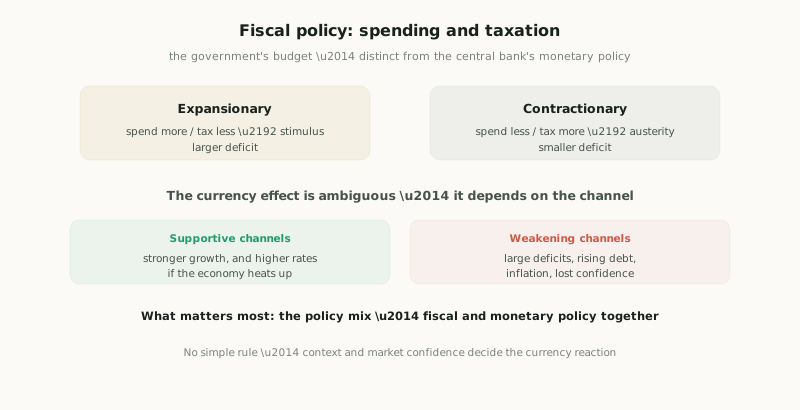
A: Fiscal policy is the government's use of spending and taxation to influence the economy — essentially, the government's budget. It's distinct from monetary policy, which is the central bank's control of interest rates and the money supply. Expansionary fiscal policy means more spending or lower taxes (stimulus); contractionary means less spending or higher taxes (austerity).
Q: How does fiscal policy affect a currency?
A: Ambiguously — it works through several channels that can pull in opposite directions. Expansionary policy can support a currency by boosting growth and pushing interest rates up, but can weaken it through larger deficits, rising debt, inflation, or lost confidence. The net effect depends on context, especially how it combines with monetary policy.
Q: What is the policy mix?
A: The policy mix is the combination of fiscal and monetary policy. It often matters most for a currency: fiscal expansion combined with monetary tightening (higher interest rates) tends to be strongly currency-supportive, while fiscal expansion financed by loose money tends to weaken a currency. The interaction, not fiscal policy alone, drives the outcome.
What fiscal policy is
Fiscal policy is the government's use of spending and taxation to influence the economy — in essence, the government's budget. It's important to distinguish it from monetary policy, the separate domain of the central bank, which controls interest rates and the money supply (covered in its own guide). Fiscal policy is wielded by the government (the treasury/finance ministry and legislature), monetary policy by the (typically independent) central bank — two different levers, two different hands on them.
Fiscal policy comes in two broad stances. Expansionary fiscal policy means increased government spending and/or tax cuts — putting more money into the economy to stimulate demand and growth — which typically widens the budget deficit (spending exceeds revenue, financed by borrowing). Contractionary fiscal policy (often called austerity) means reduced spending and/or higher taxes — restraining the economy — which narrows the deficit or moves toward surplus. The budget balance itself can be a surplus (revenue exceeds spending) or, far more commonly, a deficit (spending exceeds revenue), with deficits financed by government borrowing that adds to the national debt (the direct link to the sovereign-debt guide). So fiscal policy is about how much the government spends, taxes and borrows — and the question for traders is how that translates into currency moves. The answer, unusually, is "it depends" — and understanding why requires looking at the competing channels.
Why the effect is ambiguous
Fiscal policy's currency effect is genuinely ambiguous because it works through several channels that can pull in opposite directions. This is the central, and most important, point of the topic.
Take expansionary fiscal policy. Through the growth channel, it boosts the economy — which can support the currency (a stronger economy attracts investment) and, by stoking activity, may push interest rates up (the central bank tightening to contain inflation), further supporting it. But through the deficit/debt channel, the same policy widens deficits and raises debt — which can weaken the currency (fears over debt sustainability, crowding out, or loss of confidence). And through the inflation channel, fiscal stimulus can stoke inflation — which might weaken the currency (eroding its value) or prompt rate hikes that support it. So the very same expansionary policy has supportive channels (growth, higher rates) and weakening channels (deficits, debt, inflation) operating at once. Which dominates depends on context — hence the ambiguity.
This is why there's no simple rule. Sometimes expansionary fiscal policy supports a currency: if markets focus on the growth and the prospect of higher interest rates (especially when the economy can absorb the stimulus and the central bank responds by tightening), the supportive channels win, and the currency strengthens. Other times the same kind of policy weakens a currency: if markets focus on ballooning deficits, unsustainable debt, or inflation risk — if the stimulus looks reckless or the debt picture alarming — the weakening channels win, and confidence (and the currency) falls. The decisive factors are context: the state of the economy (is there slack to absorb stimulus, or will it just cause inflation and debt?), the level of debt (is there fiscal room, or is debt already worrying?), market confidence (do investors trust the government's finances?), and — above all — how the fiscal stance interacts with monetary policy. The same goes in reverse for austerity, which can strengthen a currency (improving the fiscal picture and confidence) or weaken it (choking growth and prompting rate cuts) depending on context. The honest message is that fiscal policy is a real but context-dependent currency driver with no mechanical direction — a trader must ask which channels the market is focusing on, not apply a fixed rule.
The policy mix matters most
The single most useful framing for fiscal policy's currency effect is the policy mix — the combination of fiscal and monetary policy — because their interaction often matters more than fiscal policy alone. The classic, currency-relevant case is fiscal expansion combined with monetary tightening: when a government runs a large fiscal stimulus while the central bank raises interest rates (to contain the resulting inflation/overheating), the combination tends to be strongly currency-supportive — the economy is boosted by fiscal policy and high interest rates attract capital (the rate differential drawing investment). This "loose fiscal, tight money" mix is a textbook recipe for a strong currency, and history offers notable examples of it driving currencies higher.
The opposite mix points the other way. Fiscal expansion financed by loose money — large deficits accompanied by low rates or, in the extreme, deficits effectively monetised by the central bank (printing money to fund government spending) — tends to weaken a currency, as it combines rising debt with low rates and inflation risk, undermining confidence and the currency's value (a path associated with high inflation and currency debasement in the worst cases). So the same fiscal expansion can support or weaken a currency depending on the monetary policy alongside it. This is why sophisticated currency analysis looks at the policy mix rather than fiscal policy in isolation: it's the interplay of the government's budget and the central bank's rate decisions that shapes the currency outcome. For a trader, the practical takeaway is to consider fiscal and monetary policy together — a fiscal stimulus met by rate hikes is a different (often bullish) currency story than the same stimulus met by money-printing (often bearish). The honest, overarching framing: fiscal policy is a genuine fundamental driver, but its currency effect is ambiguous and context-dependent, working through competing growth, interest-rate, debt and inflation channels — with the policy mix (how it combines with monetary policy) and market confidence usually decisive. There's no simple "spending up, currency down" rule; the skill is reading which channels and which policy mix are in play. Like all fundamentals, it's one important factor among many, to be weighed in context rather than applied mechanically.
Fiscal policy in practice
A few practical illustrations make the ambiguity concrete. The classic currency-supportive case is large fiscal stimulus alongside a tightening central bank: when a government spends heavily while the economy is near capacity, the resulting inflationary pressure pushes the central bank to raise rates, and the combination of strong fiscal-driven growth and high interest rates draws capital in — a powerful tailwind for the currency. History offers notable episodes of exactly this "loose fiscal, tight money" mix coinciding with a sharply stronger currency. The currency-negative case is fiscal expansion that markets read as reckless: a stimulus that balloons the deficit and debt without a credible plan, or that is financed by the central bank printing money, tends to undermine confidence, stoke inflation fears, and weaken the currency — the weakening channels dominating.
Two further practical factors shape the reaction. Timing within the economic cycle matters: fiscal stimulus when there's economic slack (a weak economy with spare capacity) is more likely to boost growth without much inflation — a relatively benign mix — whereas the same stimulus in an overheating economy mainly stokes inflation and debt, a more currency-negative outcome (it forces aggressive tightening and raises debt fears). And market confidence and credibility are decisive: the same deficit can be tolerated comfortably for a country with a strong fiscal reputation and trusted institutions, yet punished severely for one whose finances markets already doubt — confidence is everything, and a loss of it can turn a manageable fiscal position into a currency rout (the link to the sovereign-debt material). So in practice, a trader assessing fiscal policy's currency impact asks: what's the policy mix (is the central bank tightening or accommodating?), where is the economy in its cycle (slack or overheating?), and does the market trust this government's finances? The answers — not the raw size of the deficit — determine whether the fiscal news is bullish or bearish for the currency. This is why fiscal policy resists a simple rule and must be read in context.
Fiscal policy is the government's spending and taxation — its budget — distinct from the central bank's monetary policy. Expansionary (more spending/lower taxes → bigger deficit, stimulus) vs contractionary (austerity). Its currency effect is genuinely ambiguous, working through competing channels: supportive ones (stronger growth, higher interest rates if the economy heats up) and weakening ones (large deficits, rising debt, inflation, lost confidence). Which dominates depends on context — the economy's slack, debt levels, and market confidence. The policy mix matters most: fiscal expansion + monetary tightening (high rates) tends to be strongly currency-supportive; fiscal expansion + loose money (or monetised deficits) tends to weaken a currency. No simple "spending up, currency down" rule — read which channels and policy mix are in play. One important fundamental among many, weighed in context.