The Australian dollar — "the Aussie" — is the market's favourite barometer of commodities, China and global risk appetite. AUD/USD, one of the seven major pairs, isn't just a currency trade; it's a window into the forces that drive all risk-sensitive currencies, which is part of why it's so widely traded and studied. Understanding what moves it — commodity prices, the Chinese economy, global risk sentiment, and the RBA–Fed rate gap — and how it behaves teaches you to read these broader forces. This guide profiles AUD/USD: its drivers, character and correlations, and what beginners should know. (As with all the pair guides, this is educational — a profile of how the pair tends to behave, not a forecast or trading advice.)
It joins the other major-pair guides under the major currency pairs, is the commodity-currency sibling of NZD/USD, and brings together commodities and risk sentiment.
Key takeaways
Q: What drives the AUD/USD exchange rate?
A: AUD/USD is driven mainly by commodity prices (Australia is a major exporter of iron ore, coal and gold), Chinese economic health (China is Australia's biggest trading partner), global risk sentiment (the Aussie is a risk-on currency), and the interest-rate gap between the Reserve Bank of Australia and the US Federal Reserve.
Q: Why is the Australian dollar a commodity currency?
A: Because Australia's economy depends heavily on exporting raw commodities — especially iron ore, coal and gold. When commodity prices and global demand are strong, Australia's export earnings rise and the Australian dollar tends to strengthen, so AUD moves with commodity prices and global growth.
Q: Is AUD/USD a risk-on or risk-off currency?
A: The Australian dollar is a 'risk-on' currency — it tends to strengthen when global risk appetite is high and weaken in risk-off, fearful conditions (the opposite of safe havens like the US dollar, yen and franc). So AUD/USD often tracks global risk sentiment closely.
The pair at a glance
AUD/USD profile
What drives the Aussie
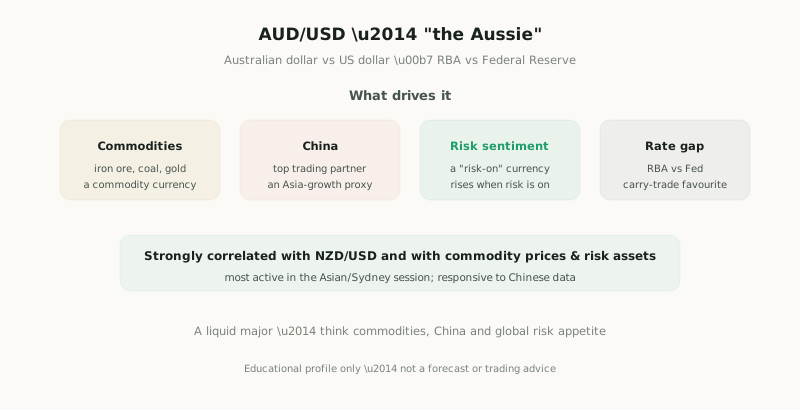
Four interlinked forces drive AUD/USD. First and most defining, commodities: Australia is a major commodity exporter — iron ore above all, plus coal, gold and natural gas — so the Australian dollar is a classic commodity currency (the commodities-and-currencies guide explains the link). When commodity prices and global demand are strong, Australia's export earnings rise and the Aussie tends to strengthen; when they fall, it weakens. Iron ore in particular is so central to Australia's economy that AUD is sensitive to its price. Second, and closely related, China: China is Australia's largest trading partner and the dominant buyer of its commodities, so the Aussie is highly sensitive to Chinese economic health — Chinese growth data, stimulus, and demand all move AUD, to the point that the Australian dollar is often treated as a proxy for Chinese and Asian growth. Strong Chinese data tends to lift the Aussie; weak Chinese data weighs on it.
Third, global risk sentiment: the Australian dollar is a risk-on currency (historically higher-yielding and tied to global growth), so it tends to strengthen when global risk appetite is high ("risk-on") and weaken in fearful, "risk-off" conditions — the opposite of safe havens like the US dollar, yen and franc (the risk-on/risk-off guide covers this dynamic). Because AUD/USD pairs a risk-on currency (AUD) against a safe-haven one (USD), it is an especially clean expression of global risk sentiment, often rising in optimistic markets and falling sharply in panics. Fourth, the interest-rate gap between the Reserve Bank of Australia (RBA) and the US Federal Reserve: as with all pairs, the relative monetary policy and rate differential matters, and the Aussie's historically higher yields have made it a popular carry-trade currency (borrowing low-yield currencies to hold higher-yielding AUD — a strategy that itself depends on risk-on conditions). These four drivers — commodities, China, risk sentiment and the RBA–Fed gap — are deeply interconnected (commodity demand, Chinese growth and risk appetite tend to rise and fall together), which is why the Aussie moves as such a clear barometer of the global growth-and-risk cycle.
Character, correlations and what to know
In character, AUD/USD is a liquid major with moderate volatility, whose moves are dominated by the global risk-and-commodity cycle rather than purely domestic Australian factors. It tends to trend with global risk sentiment and commodity prices, making it responsive to the broad market mood. Its activity is often greatest during the Asian/Sydney session and around Chinese and Australian data releases, given the time zone and China sensitivity (the trading-sessions guide covers session timing) — though as a major it trades actively around the clock.
On correlations (relevant to the correlation-risk guide), the Aussie is strongly positively correlated with NZD/USD — the New Zealand dollar, its Antipodean neighbour and fellow commodity/risk currency — so the two often move together (trading both long is effectively doubling the same bet, a correlation-risk consideration). It's also positively correlated with commodity prices and with global risk assets (equities), and tends to move inversely to safe-haven demand. For a beginner or anyone adding AUD/USD to their trading, the key things to know follow from its profile: watch commodities and China (these are primary drivers, so commodity prices and Chinese data matter more for the Aussie than for most pairs); respect its risk sensitivity (AUD/USD can move sharply with global risk sentiment, rising in calm optimism and falling hard in risk-off panics, so it's exposed to the broad market mood); be aware of the NZD correlation (don't unknowingly double up by trading AUD/USD and NZD/USD in the same direction); and note the carry/rate angle (the RBA–Fed differential and the Aussie's yield status affect its appeal). The honest, educational summary: AUD/USD — the Aussie — is a liquid major and a classic commodity, risk-on currency, driven by commodity prices (especially iron ore), the Chinese economy, global risk sentiment, and the RBA–Fed rate gap, and correlated with NZD/USD, commodities and risk assets. Understanding it means understanding the global growth-and-risk cycle it so clearly reflects — making the Aussie not just a pair to trade but a useful read on the wider market's appetite for risk.
Watching and trading the Aussie
Putting the profile to practical use, a trader following AUD/USD watches a fairly specific set of inputs. On timing, the Aussie is naturally most active during the Asian/Sydney session and around Asian market hours, given Australia's time zone and the pair's China sensitivity — Chinese data and Asian risk sentiment often set the tone for the Aussie's day before European and US traders arrive (the trading-sessions guide covers session timing). That said, as a liquid major it trades actively around the clock, with further moves during the busy London and New York sessions, especially on US data that drives the dollar side.
On what to watch, the Aussie's drivers translate into a clear watchlist: commodity prices (especially iron ore, but also coal and gold) as a barometer of Australia's export fortunes; Chinese economic data and developments (growth figures, stimulus, manufacturing activity), given China's role as the key buyer; global risk sentiment (equity markets, the broad market mood, volatility), since the Aussie rises and falls with risk appetite; and the RBA and Fed (interest-rate decisions, statements and the evolving rate gap), plus key Australian data (employment, inflation) and US data. Because these drivers tend to move together through the global growth-and-risk cycle, the Aussie often gives a fairly coherent signal — strong commodities, healthy China and risk-on markets all tend to support it at once, and the reverse weighs on it together.
A few practical notes for anyone adding the pair, all consistent with the site's risk-first philosophy. The Aussie's pronounced risk sensitivity means it can move sharply when the broad market mood shifts — it tends to fall hard and fast in risk-off panics — so it carries the gap and volatility risk of risk-sensitive assets, to be respected with sound position sizing and stops. Its tight correlation with NZD/USD (and with commodities and equities) means a trader should account for it in their total exposure: holding AUD/USD alongside NZD/USD, or alongside other risk-on positions, concentrates risk in the single theme of global risk appetite (a portfolio-heat and correlation-risk consideration). And the Aussie's value as a macro barometer means that even traders who don't trade it watch it as a read on global risk and Chinese/Asian growth. None of this is a recommendation to trade the pair in any particular way — it's simply how the Aussie's well-understood character informs the watchlist and the risk considerations of those who do follow it.
The carry and yield angle
One nuance worth understanding is the Aussie's role in the carry trade (covered in its own guide). Because Australia has historically offered relatively high interest rates, the Australian dollar has long been a favoured currency to hold in carry trades — borrowing a low-yielding currency to buy and earn the higher Australian yield. This matters for AUD/USD's behaviour in two ways. When carry conditions are favourable (stable or rising risk appetite, an attractive rate gap), carry-trade flows into the Aussie can support it, adding a yield-seeking tailwind on top of its commodity and risk drivers. But carry trades unwind violently in risk-off conditions: when fear spikes, traders rush to exit carry positions (selling the high-yield Aussie to repay the borrowed low-yield currency), which can amplify the Aussie's falls in a panic. This carry dynamic is part of why AUD/USD can drop so sharply in risk-off episodes — it's not just risk sentiment but the unwinding of accumulated carry positions adding fuel. So the Aussie's yield status is a double-edged feature: a support in calm, yield-seeking conditions, and an accelerant of declines when risk-off forces carry unwinds. Watching the RBA–Fed rate gap (which sets the carry's attractiveness) alongside risk sentiment gives a fuller read on this aspect of the pair.
AUD/USD ("the Aussie") is a major and a classic commodity, risk-on currency. Four interlinked drivers: commodities (Australia exports iron ore, coal, gold — a commodity currency), China (its top trading partner and commodity buyer, so AUD is an Asia-growth proxy), global risk sentiment (a risk-on currency — rises when risk is on, falls in risk-off, opposite to safe havens), and the RBA–Fed rate gap (historically higher-yielding, a carry-trade favourite). Character: liquid major, moderate volatility, most active in the Asian session, dominated by the global growth-and-risk cycle. Strongly correlated with NZD/USD (don't unknowingly double up), commodities and risk assets. For beginners: watch commodities and China, respect its risk sensitivity, mind the NZD correlation. Educational profile only — not a forecast or advice.