
The New Zealand dollar — "the Kiwi" — is the Aussie's close cousin: another commodity, risk-on currency, but tied to dairy rather than iron ore, and from a smaller economy. NZD/USD, one of the major pairs, shares much of its character with AUD/USD while having distinctive features of its own, and understanding it means understanding both what it shares with the Aussie and what sets it apart. This guide profiles the Kiwi: its drivers (dairy and commodities, risk sentiment, the RBNZ–Fed gap), its strong correlation with AUD/USD, and what beginners should know. (Educational only — a behavioural profile, not a forecast or advice.)
It's a major-pair guide (see the major currency pairs), the close sibling of AUD/USD, and another example of commodity currencies and risk sentiment.
Key takeaways
Q: What drives the NZD/USD exchange rate?
A: NZD/USD is driven mainly by commodity prices — especially dairy and agricultural exports — global risk sentiment (the Kiwi is a risk-on currency), the interest-rate gap between the Reserve Bank of New Zealand and the US Federal Reserve, and its close link to the Australian dollar.
Q: Why is the New Zealand dollar called the Kiwi?
A: The New Zealand dollar is nicknamed the 'Kiwi' after the kiwi bird depicted on the New Zealand one-dollar coin. It's a commodity, risk-sensitive currency from a relatively small economy, closely linked to the Australian dollar.
Q: How correlated are NZD/USD and AUD/USD?
A: Very highly. New Zealand and Australia are neighbouring economies whose currencies are both commodity-linked, risk-sensitive and similar in their drivers, so NZD/USD and AUD/USD tend to move closely together — something to watch for correlation risk when trading both.
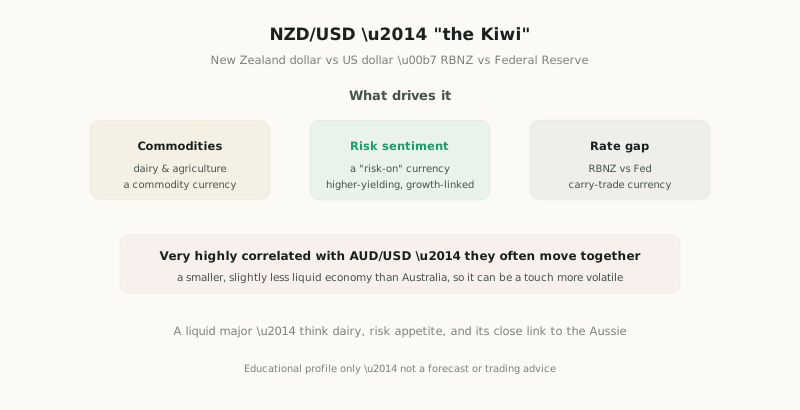
The pair at a glance
NZD/USD profile
What drives the Kiwi
NZD/USD's drivers closely parallel the Aussie's, with a distinctive commodity emphasis. First, commodities — especially dairy: New Zealand's economy depends heavily on agricultural exports, with dairy a particularly major export, so the Kiwi is a commodity currency sensitive to dairy and agricultural commodity prices and to global demand for them (the commodities-and-currencies link). Where the Aussie keys off iron ore, the Kiwi keys off dairy and agriculture — a notable difference in their specific commodity exposure, even as both are commodity currencies. Strong agricultural commodity prices tend to support the Kiwi; weak ones weigh on it. Second, global risk sentiment: like the Australian dollar, the New Zealand dollar is a risk-on currency — historically higher-yielding and tied to global growth — so it tends to strengthen in risk-on conditions and weaken in risk-off, fearful markets (the opposite of safe havens). NZD/USD, pairing a risk-on currency against the safe-haven dollar, thus tracks global risk appetite closely, much as AUD/USD does.
Third, the interest-rate gap between the Reserve Bank of New Zealand (RBNZ) and the US Federal Reserve: relative monetary policy and the rate differential drive the pair, and the Kiwi's historically higher yields have made it, like the Aussie, a carry-trade currency (attractive to hold for its yield in risk-on conditions). Fourth, and distinctively, its close link to the Australian dollar (discussed below) — developments affecting the Aussie typically affect the Kiwi too, given their economic proximity and shared drivers. So the Kiwi is driven by dairy/agricultural commodities, global risk sentiment, the RBNZ–Fed rate gap, and its tight relationship with the Aussie — a profile very similar to AUD/USD's, with dairy in place of iron ore and the added Australian linkage.
The Aussie link, character and what to know
The most important relationship to understand for NZD/USD is its very strong positive correlation with AUD/USD. New Zealand and Australia are neighbouring economies with closely linked trade and similar economic structures, and their currencies are both commodity-linked, risk-sensitive and driven by the same global forces (commodities, risk sentiment, Chinese/Asian demand) — so NZD/USD and AUD/USD tend to move closely together, often almost in lockstep. This tight correlation is the single most notable feature of the Kiwi from a trading perspective, and it carries a clear correlation-risk implication (per the correlation-risk guide): trading NZD/USD and AUD/USD in the same direction is effectively doubling up on the same bet — the same commodity/risk theme — not diversifying, so the two should be treated as closely related, near-duplicate exposures rather than independent positions.
In character, NZD/USD is a liquid major, but New Zealand is a smaller economy than Australia and the Kiwi is somewhat less liquid than the Aussie, which can make NZD/USD a touch more volatile and prone to sharper moves at times — a subtle but real difference from its larger cousin. Its activity, like the Aussie's, is often notable in the Asian session and around relevant data, given the time zone. For a beginner, the key things to know follow from the profile: watch agricultural/dairy commodities and risk sentiment (the primary drivers, as for the Aussie); be very aware of the AUD correlation (this is the big one — don't unknowingly double your exposure by trading NZD/USD and AUD/USD together, and recognise that the two largely move as one); note the slightly higher volatility versus AUD/USD given New Zealand's smaller, less liquid market; and note the carry/rate angle (the RBNZ–Fed differential and the Kiwi's yield status). The honest, educational summary: NZD/USD — the Kiwi — is a liquid major and a commodity, risk-on currency, driven by dairy and agricultural commodities, global risk sentiment, the RBNZ–Fed rate gap, and above all its very tight link to AUD/USD. It's best understood as the Aussie's close cousin — sharing its risk-on, commodity character, with dairy in place of iron ore, from a smaller and slightly more volatile economy — with the AUD correlation the most important practical fact to keep in mind.
Watching and trading the Kiwi
In practice, following NZD/USD looks much like following the Aussie — with the Australian dollar itself added to the watchlist. On timing, the Kiwi is most active during the Asian session and around Asia-Pacific market hours, given New Zealand's time zone (it's among the first markets to open in the trading week), with Australian and Chinese developments and Asian risk sentiment often setting its early tone, and further moves in the London and New York sessions, especially on US data driving the dollar side (per the trading-sessions guide).
On what to watch, the Kiwi's drivers give a clear list: agricultural and dairy commodity prices (New Zealand's key exports — dairy auction results and agricultural demand are watched as a barometer of its export earnings); global risk sentiment (equities, the broad market mood), since the Kiwi rises and falls with risk appetite; the RBNZ and Fed (rate decisions, statements, the rate gap) plus key New Zealand data; and — distinctively — AUD/USD itself, since the Kiwi tracks the Aussie so closely that watching AUD/USD is part of reading NZD/USD. In effect, much of what drives the Aussie (commodities, China, risk) drives the Kiwi too, with dairy in place of iron ore and the Australian dollar as a near-constant companion.
A few practical notes. The dominant practical fact is the AUD correlation: NZD/USD and AUD/USD move so closely together that they should be treated as near-duplicate, not independent, exposures — holding both in the same direction concentrates risk in a single commodity/risk theme (a correlation-risk and portfolio-heat consideration), and the Aussie often acts as a lead the Kiwi follows. The Kiwi's lower liquidity (New Zealand being a smaller economy) can make it a touch more volatile and prone to sharper moves than the Aussie, so its swings — and the gap risk of a risk-sensitive, less-liquid currency — warrant respect with sound position sizing and stops. And like the Aussie, its pronounced risk sensitivity means it can fall hard in risk-off conditions. None of this is advice on trading the pair; it's how the Kiwi's commodity, risk-on, Aussie-linked character shapes what its followers watch and the risks they keep in mind — with the AUD relationship the single most important thing to remember.
The dairy angle and the RBNZ
Two specifics give the Kiwi some character of its own, distinct from the Aussie. First, the dairy angle: dairy is such a significant export for New Zealand that dairy-market developments — including the regular global dairy auctions where prices are set — are watched as a specific barometer of New Zealand's export earnings and, by extension, a potential influence on the Kiwi. Where the Aussie watcher tracks iron ore and Chinese industrial demand, the Kiwi watcher adds dairy and agricultural-commodity prices to the list. This gives NZD/USD a slightly different commodity exposure from AUD/USD even as the two move closely together — occasionally, divergent commodity stories (a dairy move not matched in industrial metals, say) can cause the Kiwi and the Aussie to part company briefly, one of the few things that loosens their tight correlation.
Second, the Reserve Bank of New Zealand: the RBNZ's policy decisions and communications drive the Kiwi's interest-rate side and can move the pair, particularly when the RBNZ's stance diverges from the Fed's or from the RBA's (a relative-rates story between the two Antipodean central banks can shift the AUD/NZD relationship and thus how the Kiwi trades against the dollar). Together, the dairy exposure and the RBNZ give NZD/USD its own identity within its close partnership with the Aussie — a commodity, risk-on currency that mostly tracks AUD/USD, but with dairy in place of iron ore and its own central bank steering the rate side. Keeping both the AUD link and these New-Zealand-specific factors in view is the fuller way to read the Kiwi.
NZD/USD ("the Kiwi") is a major and a commodity, risk-on currency — the Aussie's close cousin. Drivers: commodities (especially dairy and agriculture — where the Aussie keys off iron ore), global risk sentiment (a risk-on currency: rises in risk-on, falls in risk-off), the RBNZ–Fed rate gap (a carry-trade currency), and its tight link to AUD/USD. Its defining feature: a very strong positive correlation with AUD/USD — they move closely together, so trading both in the same direction doubles the same bet, not diversifies it (correlation risk). Character: a liquid major, but from a smaller, less liquid economy than Australia, so a touch more volatile. For beginners: watch dairy/commodities and risk, and above all mind the AUD correlation. Educational profile only — not a forecast or advice.