Most indicators try to tell you which way price will go. The ATR indicator — Average True Range — does something different and quietly invaluable: it tells you how much price is moving. ATR measures volatility, not direction, distilling the size of price movement into a single number. That might sound less exciting than a buy/sell signal, but it is one of the most practically useful indicators a trader can use, because knowing how volatile the market is transforms how you set stop-losses and size positions. Developed by J. Welles Wilder, ATR is a cornerstone of volatility-aware risk management. This guide explains what ATR measures, how it is calculated, and — most importantly — how to use it for stops and sizing.
It is a volatility tool from the toolkit in technical indicators explained, and its real power is in serving stop placement and position sizing.
Key takeaways
Q: What is the ATR indicator?
A: ATR, or Average True Range, is an indicator that measures market volatility — how much price is moving — rather than direction. Developed by J. Welles Wilder, it averages the 'true range' over a period (commonly 14), giving a single value that rises when volatility increases and falls when it decreases.
Q: Does ATR show trend direction?
A: No. ATR measures only volatility, the size of price movement, not its direction. A high ATR means large moves are occurring (in either direction); a low ATR means small moves. ATR does not indicate whether price will rise or fall, so it is not a buy or sell signal.
Q: How do traders use ATR?
A: Traders use ATR mainly to set volatility-adjusted stop-losses (for example, placing a stop a multiple of ATR away from entry, wider in volatile conditions) and to size positions so that risk is normalised across different instruments and market conditions. It is also used for trailing stops and gauging volatility.
What ATR measures
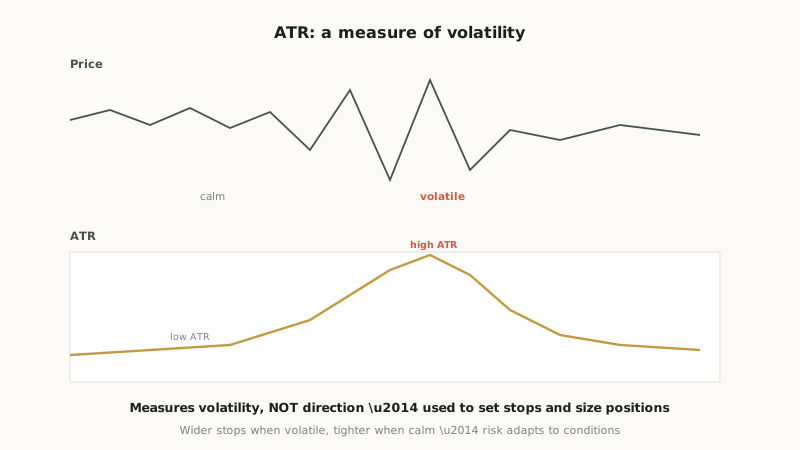
The single most important thing to understand about ATR is that it measures volatility, not direction. A high ATR means price is making large moves (high volatility); a low ATR means it is making small moves (low volatility). ATR says nothing about which way price is moving or will move — a high ATR can occur in a strong uptrend, a strong downtrend, or a wildly choppy market; all that ATR registers is that the moves are large. This makes ATR fundamentally different from directional indicators and from oscillators: it is not a buy or sell signal and should never be read as one. It is purely a gauge of how much the market is moving.
This volatility focus is exactly what makes ATR so useful, because volatility is a crucial input to risk management that most directional indicators ignore. Knowing the current volatility — how much price typically moves in a given period — lets you adapt your trading to current conditions: setting stops that account for the normal range of movement, and sizing positions so that the same dollar risk applies regardless of how volatile the instrument is. ATR provides this volatility reading cleanly and objectively. The conceptual key is to file ATR mentally not with the directional indicators (which try to predict price moves) but with the risk-management tools — it answers "how much is price moving?" so you can manage risk accordingly, rather than "which way will price go?"
How it is calculated
ATR is built on the concept of True Range, which measures the full extent of price movement in a period, including any gaps. For a given period, the True Range is the greatest of three values: the current high minus the current low (the period's own range); the absolute difference between the current high and the previous close; and the absolute difference between the current low and the previous close. The reason for taking the greatest of these three is to capture gaps — if price gapped from the previous close, the simple high-low range would understate the true movement, so True Range incorporates the previous close to capture the full extent of the move including the gap.
ATR is then simply a moving average of the True Range over a chosen period (Wilder used 14 periods, which remains the common default). This averaging smooths the True Range into a steadier reading of typical volatility, filtering out single-period spikes to give a representative measure of how much price has been moving recently. The result is a single value, in the price's own units (pips, for a currency pair), representing the average size of price movement per period. A EUR/USD ATR of, say, 60 pips means the pair has been moving about 60 pips per period on average — a directly interpretable measure of its current volatility. Because ATR is in the instrument's own units, it can be compared across time (is volatility rising or falling?) and, when normalised, across instruments. The calculation need not be done by hand — platforms compute it — but understanding that ATR is the averaged True Range, built to include gaps, clarifies what the number represents.
Using ATR for stops
The first major practical use of ATR is setting volatility-adjusted stop-losses, a powerful application that connects directly to the stop-loss guide's principle of giving stops room based on volatility. The idea is to place your stop a multiple of ATR away from your entry — commonly something like 1.5 to 2 times the ATR — so that the stop distance automatically adapts to current volatility. In a volatile market (high ATR), this places the stop wider, giving the trade enough room to withstand the larger normal swings without being stopped out by noise; in a calm market (low ATR), it places the stop tighter, since smaller moves are normal.
This solves a problem that fixed-distance stops cannot: a stop that is appropriate in calm conditions will be far too tight in volatile conditions (getting hit by routine swings), while a stop wide enough for volatile conditions will be needlessly loose in calm ones. ATR-based stops adapt to the conditions, placing the stop at a distance that reflects the market's current normal range of movement — beyond the noise, but no further than necessary. This is exactly the volatility-aware stop placement the how-to-set-a-stop-loss guide advocates, made systematic via ATR. The same principle extends to trailing stops: ATR-based trailing stops (such as the "chandelier exit") trail the stop a multiple of ATR behind the price, adapting the trailing distance to volatility so the trail is loose enough not to be triggered by normal swings yet tight enough to protect profit — a volatility-aware version of the trailing stops covered in the order-types guide. ATR thus turns the qualitative advice "give your stop room for volatility" into a precise, adaptive method.
ATR answers "how much is price moving?" not "which way?" — which is why it belongs with your risk tools, not your signal tools. Its magic is adaptation: ATR-based stops and sizing automatically widen in volatile markets and tighten in calm ones, so your risk stays constant while the market's behaviour changes around you. A fixed-distance stop can't do that.
Using ATR for position sizing
The second major use of ATR is volatility-based position sizing, which connects to the position-sizing guide's goal of risking a constant amount per trade. When you set your stop a certain ATR-based distance from entry, that stop distance defines your risk per unit traded — and you can then size your position so that, if the stop is hit, you lose only your predetermined risk amount (say 1% of your account). Because the ATR-based stop distance varies with volatility, the resulting position size automatically adjusts: in volatile conditions (wide ATR stop), you take a smaller position; in calm conditions (tight ATR stop), a larger one — so that your dollar risk stays constant regardless of volatility.
This is genuinely valuable because it normalises risk across different instruments and market conditions. Without volatility adjustment, a fixed position size carries very different risk depending on how volatile the market is — the same size is far riskier in a volatile market than a calm one. ATR-based sizing removes this inconsistency: by sizing inversely to volatility (smaller when volatile, larger when calm), it ensures every trade carries the same risk, exactly as the position-sizing discipline requires. It also lets you compare and trade different instruments on an equal-risk footing, since each is sized according to its own volatility. This volatility-normalised sizing is a more sophisticated and robust approach than fixed sizing, and ATR is the tool that makes it possible. Together, the two uses — ATR-based stops and ATR-based sizing — make ATR one of the most practically important indicators for risk management, precisely because it measures the volatility that determines how stops and sizing should adapt. It is the quiet workhorse of volatility-aware trading: not a signal generator, but an indispensable input to managing risk intelligently as market conditions change.
ATR and the volatility regime
Beyond setting individual stops and sizes, ATR is valuable for reading the broader volatility regime — whether the market is in a calm, low-volatility phase or an active, high-volatility one — which has practical trading implications. Volatility tends to move in cycles, alternating between contraction (quiet, narrow ranges) and expansion (active, wide ranges), and ATR makes these phases visible: a low and falling ATR signals a contracting, quiet market, while a high or rising ATR signals an expanding, volatile one. Recognising which regime you are in helps set expectations for how much price is likely to move and how to adapt.
A particularly useful pattern is that periods of very low volatility (low ATR) often precede significant breakouts: markets that have been coiling quietly in a tight range frequently break out into a strong move, with volatility expanding as they do. This is the "volatility contraction precedes expansion" idea that also underlies Bollinger Band squeezes (from that guide) — a low ATR flags a market that may be building toward a breakout, alerting a trader to watch for it. Conversely, an extremely high ATR may signal a climactic, possibly exhausting move. ATR thus provides context for what kind of conditions to expect and which strategies suit them.
ATR's regime read also aids cross-instrument comparison and selection. Because ATR quantifies each instrument's volatility in its own units, you can compare how volatile different pairs are, choose instruments whose volatility suits your strategy, and size each according to its own ATR so that risk is equalised across a diverse set of trades. A volatility-aware trader uses ATR not only to set the stop and size of any single trade but to understand the volatility environment — calm or active, contracting or expanding — and to normalise risk across the different instruments they trade. This makes ATR a genuinely strategic tool for managing risk in changing conditions, not merely a tactical input to one trade's stop.
ATR (Average True Range) measures volatility — how much price is moving — not direction, so it's never a buy/sell signal. It's the averaged "true range" (which includes gaps) over a period, usually 14, in the instrument's own units (pips). Its power is in risk management: set volatility-adjusted stops a multiple of ATR from entry (wider when volatile, tighter when calm), and size positions inversely to volatility so dollar risk stays constant across instruments. It also reads the volatility regime — low ATR (contraction) often precedes breakouts — and normalises risk across pairs. File ATR with your risk tools, not your signal tools.