You've done the analysis. The setup is valid. The plan is clear. Your finger hovers over the button — and you freeze. The trade runs without you, and you're left watching the move you correctly identified play out in someone else's account. The fear of pulling the trigger is one of trading's most frustrating psychological blocks, common among newer and even experienced traders — and, encouragingly, it's very fixable once you understand its causes. This guide explains it: what it is, why it happens, and the practical fixes that get you executing with confidence.
It's a close cousin of — but distinct from — analysis paralysis, and overcoming it is a key part of building trading discipline.
Key takeaways
Q: What is the fear of pulling the trigger?
A: It's the inability to execute a trade you've already decided is valid — you've done the analysis, the setup meets your rules and the plan is clear, but you hesitate and freeze, often watching the move run without you. It's distinct from analysis paralysis (being unable to reach a decision); here the decision is made, but emotion blocks the execution.
Q: What causes hesitation in entering trades?
A: Common causes include fear of taking a loss, position sizes that are too large (so each trade feels frighteningly significant), the lingering emotional impact of recent losses, perfectionism (waiting for an impossibly perfect setup), and lack of confidence in your strategy. The root is usually that the emotional stakes of the trade feel too high relative to your comfort, which freezes execution.
Q: How do you overcome the fear of pulling the trigger?
A: The most powerful fix is to reduce your position size until the risk feels comfortable — if a loss wouldn't really hurt, the trigger gets far easier to pull. Beyond that: trade mechanical, clearly-defined rules that remove in-the-moment judgement; fully accept the risk before entering (you can only lose what you risked); build confidence through testing and small live trades; and accept that losses are a normal, expected part of a winning process.
What it is, and what causes it
The fear of pulling the trigger is the inability to execute a trade you've already decided is valid. This is the crucial distinction from analysis paralysis: analysis paralysis is being unable to reach a decision (drowning in too much information and never concluding), whereas here the decision is made — the setup meets your rules, the plan is clear — but emotion blocks the execution. You know what to do and can't bring yourself to do it. It's a deeply uncomfortable experience precisely because the rational and emotional parts of you are in open conflict.
Common causes — and their fixes
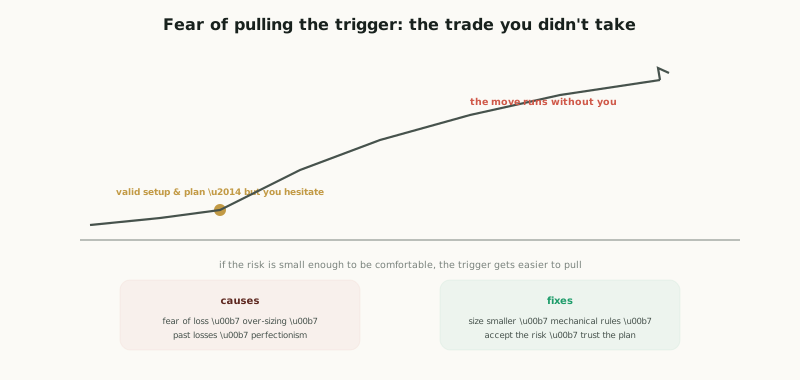
The causes usually trace to the emotional stakes feeling too high. Fear of loss is the most basic — the prospect of being wrong and losing money is simply frightening. Position sizes that are too large dramatically amplify this: if each trade represents a scary chunk of your account, of course you hesitate — the stakes feel enormous. The lingering impact of recent losses can leave you gun-shy, flinching from the next trade after being hurt. Perfectionism makes you wait for an impossibly perfect setup that never quite arrives, so you pass on the good ones. And a genuine lack of confidence in your strategy — not really trusting that it works — makes every entry feel like a leap of faith. Underlying most of these is the same thing: the trade matters too much emotionally, and the mind protects you by freezing.
The fixes
The single most powerful fix follows directly from that root cause: reduce your position size until the risk feels genuinely comfortable. This is the great unlock. If a potential loss is small enough that it wouldn't really hurt — a trivial fraction of your account — then the emotional stakes drop, the fear subsides, and the trigger becomes easy to pull. Many traders paralysed at one size execute effortlessly at a tenth of it. Trading smaller than feels exciting is not a weakness; it's the lever that lets you actually act on your analysis, and it dovetails perfectly with the 1% rule — risk so little per trade that no single one is frightening. Build size back up only gradually, as comfort and confidence grow.
Several other fixes reinforce it. Trade mechanical, clearly-defined rules: when your entry criteria are precise and pre-set ("if X, then enter"), execution becomes a matter of following the rule rather than making a fraught in-the-moment judgement — the decision was made when you wrote the plan, so pulling the trigger is just doing your job. Fully accept the risk before you enter: consciously acknowledge that you can lose only what you've risked (a defined, survivable amount), and that you're willing to lose it on this trade — acceptance defuses the fear far better than hoping to avoid the loss. Build confidence through testing and small live trades: if you've tested your strategy and seen it work over a sample, you'll trust it more, and trading small live positions builds the experience of executing under real (but minor) stakes. And accept that losses are a normal, expected part of a winning process: even a strong strategy loses regularly, so a loss isn't a catastrophe or a verdict on you — it's just one outcome in a long series (the mindset from handling losses). Be kind to yourself through this, too: hesitation is a normal human response to risk, not a character flaw, and it eases with the right sizing and practice rather than self-criticism. Put together — small size, mechanical rules, accepted risk, tested confidence, normalised losses — these turn the agonising freeze into a calm, almost boring execution, which is exactly what good trading should feel like. The honest framing: the fear of pulling the trigger is being unable to execute a trade you've already decided is valid (distinct from analysis paralysis, where you can't decide) — emotion blocks execution. Causes: fear of loss, over-sizing, scarring from past losses, perfectionism, low confidence in the strategy — all amounting to the stakes feeling too high. The most powerful fix is to size down until the risk feels comfortable (a small loss isn't scary); reinforced by mechanical rules (follow the plan, don't judge in the moment), fully accepting the risk before entering, building confidence through testing and small trades, and accepting losses as a normal part of a winning process. Be kind to yourself; it eases with sizing and practice, not self-criticism; manage risk.
Building the execution habit
Beyond the fixes already covered, overcoming trigger fear is partly a matter of building the habit of execution through graded practice — you can't think your way out of it, you have to act your way out, in steps small enough to stay comfortable. A sensible progression: start in a demo or simulator to rehearse pulling the trigger on your setups with zero financial stakes, purely to groove the mechanical act of executing a plan; then move to tiny live positions — deliberately small, even uncomfortably so — where the point is not the profit but the repetition of taking real trades and surviving the outcomes, which steadily desensitises the fear; then scale size up gradually, only as each level becomes genuinely comfortable, never jumping to a size that reawakens the freeze. Each rung builds the evidence your nervous system needs: that taking the trade, win or lose, is survivable and normal. Many traders find the freeze simply dissolves once they've executed enough small trades that the act stops feeling momentous.
A few supporting habits help cement it. Pre-commit: decide your exact entry, stop and size before the moment arrives (ideally with resting orders), so that when the trigger comes you're executing a prior decision rather than making a fraught one in real time — even using limit or stop-entry orders so the platform pulls the trigger for you. Build a consistent pre-trade routine so execution becomes a calm, familiar ritual rather than a fresh ordeal each time. And, importantly, treat yourself with self-compassion through the process: hesitation under risk is a normal, even sensible, human instinct, not a personal failing — berating yourself for freezing only adds anxiety that makes the next trigger harder to pull, whereas patient, kind, graded practice steadily rebuilds confidence. It's also worth distinguishing healthy caution (declining a setup that genuinely doesn't meet your rules — that's good discipline) from the block (freezing on a setup that does meet your rules — that's the fear to work through); the goal isn't to become trigger-happy, but to be able to execute your valid setups without the emotional freeze. Built this way — graded practice, pre-commitment, routine, self-compassion — reliable execution becomes a learned skill rather than a daily battle. The honest reminder: act your way out in steps — demo, then tiny live size, then scale up only as it stays comfortable — pre-commit your orders, build a calm routine, treat yourself kindly (hesitation is human, not a failing), and distinguish healthy caution from the freeze; reliable execution is a learned habit, not a personality trait.
The fear of pulling the trigger is being unable to execute a trade you've already decided is valid — distinct from analysis paralysis (can't decide); here the decision's made but emotion blocks execution. Causes: fear of loss, over-sizing, scarring from past losses, perfectionism, and low confidence in the strategy — all the stakes feeling too high. The most powerful fix: size down until the risk feels genuinely comfortable — if a loss wouldn't really hurt, the trigger gets easy to pull (pairs with the 1% rule). Reinforce it with mechanical rules (follow the plan, don't re-judge in the moment), fully accepting the risk first, building confidence through testing and small trades, and treating losses as normal. Be kind to yourself — hesitation is a human response to risk that eases with sizing and practice, not self-criticism.