
The single most repeated rule in trading is also among the most ignored: never risk more than 1% of your account on a single trade. It sounds almost too modest to matter — a rounding error next to the gains beginners dream of — until you see how it lets you survive the losing streaks that wipe everyone else out. The 1% rule is the cornerstone of staying in the game, and understanding why it works is more important than any entry signal. This guide explains the 1% rule: what it means, how to apply it, and why small, fixed risk is what keeps traders solvent.
It's the practical heart of risk management and position sizing, and the front-line defence against risk of ruin.
Key takeaways
Q: What is the 1% rule in trading?
A: The 1% rule is a risk-management guideline that says you should never risk more than 1% of your trading account on any single trade. 'Risk' means the amount you'd lose if your stop-loss is hit — not the position size itself. On a £10,000 account, the 1% rule caps the loss on any trade at £100, regardless of how large the underlying position is.
Q: How do you apply the 1% rule?
A: First calculate your risk amount: account size × 1%. Then size the position so that the distance from entry to stop-loss equals exactly that amount. Position size = risk amount ÷ (stop distance × value per pip/point). So a wider stop means a smaller position and a tighter stop a larger one, but the money at risk stays fixed at 1% — the stop distance and position size adjust around it.
Q: Is 1% or 2% better?
A: Both are common; 1% is more conservative, 2% more aggressive. The key point is that the difference compounds dramatically over a losing streak: risking 2% loses ground roughly twice as fast as 1%, and larger figures escalate the danger of ruin quickly. Many professionals favour 1% or less precisely because survival through inevitable losing streaks matters more than maximising any single trade. Smaller is generally safer.
What the rule means
The 1% rule states that you should never risk more than 1% of your trading account on any single trade. The crucial word is risk: it refers to the amount you would lose if your stop-loss is hit — not the size of the position itself, and not the margin used. The two are very different. On a £10,000 account, the 1% rule caps the loss on any trade at £100, full stop — whether the underlying position is large or small. You can hold a sizeable position and still only be risking 1%, provided your stop is placed so that being stopped out costs no more than £100. This distinction trips up beginners, who confuse position size (how much currency you control) with risk (how much you lose if wrong) — the 1% rule governs the latter.
The 1% rule in numbers (£10,000 account)
How to apply it, and why it works
Applying the rule is a simple two-step calculation. Step one: work out your risk amount — account size × 1% (£10,000 × 1% = £100). Step two: size the position so the distance from entry to stop-loss equals exactly that amount, using position size = risk amount ÷ (stop distance × value per pip). The elegant consequence is that the stop distance and position size adjust around a fixed risk: a wide stop (say 100 pips) forces a smaller position, while a tight stop (25 pips) allows a larger one — but in both cases the money at risk stays pinned at £100. This is the right way round: you decide where the stop belongs based on the trade (where the idea is proven wrong), then let the position size fall out of the 1% constraint — never the reverse (picking a position size first and cramming the stop to fit is how traders blow up). See position sizing for the full mechanics.
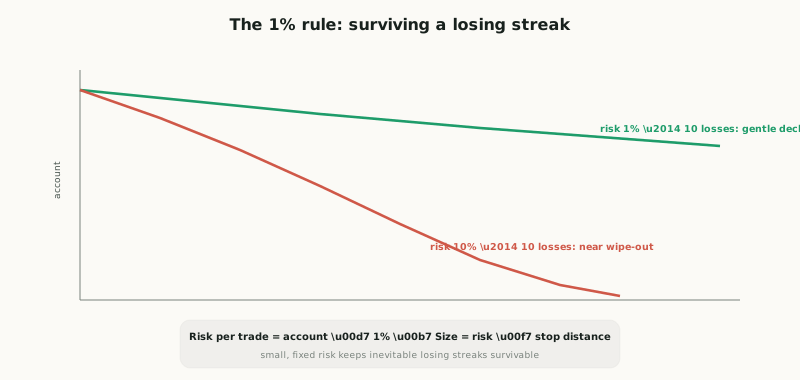
Why does such a modest rule matter so much? Because trading is a game of surviving variance, and losing streaks are inevitable — even a strong strategy with a 55% win rate will, over enough trades, suffer runs of many consecutive losses purely by chance. The 1% rule ensures those streaks are survivable: risking 1%, even ten losses in a row costs only about 10% of the account (slightly less, since each 1% is of a shrinking balance) — a setback, but easily recoverable. Compare that to risking 10% per trade: the same ten-loss streak would obliterate roughly two-thirds of the account, a catastrophe from which recovery is brutal (see the math of drawdowns — a 65% loss needs a ~185% gain to recover). This is the whole point: small, fixed risk keeps you in the game long enough for your edge to play out, whereas large risk hands a normal losing streak the power to end you before any edge can matter. As for 1% versus 2%: both are common (1% conservative, 2% more aggressive), but the danger escalates faster than the reward as you increase the figure, which is why many professionals favour 1% or less — survival first. The honest framing: the 1% rule says never risk more than 1% (the loss if your stop is hit — not the position size) of your account per trade; on £10,000 that caps any loss at £100. Apply it by computing risk = account × 1%, then sizing so the entry-to-stop distance equals that risk (wide stop → smaller position, tight stop → larger, risk fixed). It works because losing streaks are inevitable: risking 1% makes even ten losses survivable (~10%), while risking 10% makes the same streak catastrophic — small fixed risk keeps you alive for your edge to play out. 1% is safer than 2%; smaller is generally better. The cornerstone of survival; manage risk.
Applying it in practice
A fully worked example makes the mechanics concrete. Say you have a £10,000 account and apply the 1% rule, so your maximum risk per trade is £100. You spot a trade on EUR/USD and decide, based on the chart, that your stop belongs 50 pips away (where the idea is invalidated). To find your position size, you need the value per pip: on EUR/USD, one standard lot (100,000 units) is worth about £8 per pip, a mini lot (10,000) about £0.80, a micro lot (1,000) about £0.08 (values vary with the exchange rate). Your risk per pip allowed is £100 ÷ 50 pips = £2 per pip. So you'd trade roughly 2.5 mini lots (£2 ÷ £0.80) — a position sized precisely so that a 50-pip loss costs £100, exactly 1%. Change the stop to a tighter 25 pips and the allowed size doubles (£4 per pip) for the same £100 risk; widen it to 100 pips and the size halves. The risk stays fixed; the size flexes. Most platforms and free position-size calculators do this arithmetic for you — the discipline is simply to do it every time, before entering.
A few refinements are worth knowing. Include costs in the risk picture: the spread and any commission add a little to the real cost of being stopped out, so strictly your stop distance should account for them — a minor point on wide stops, more relevant on tight ones. Percent of current or starting balance? Most traders apply the 1% to the current balance, which naturally reduces position size during a drawdown (you risk less as the account shrinks, a helpful brake) and increases it as the account grows — a gently compounding, self-protecting approach. Don't creep: the rule only works if you actually follow it on every trade, including the "sure thing" you're tempted to size up — the tempting exceptions are exactly where blow-ups happen, since the trade you're most confident about is still subject to variance. And resist revenge-sizing: after a loss, the urge to "win it back" by risking more is the fast route to ruin; the 1% rule's whole value is that it's constant, removing emotion from sizing. Applied consistently, it quietly does its job — keeping any single trade, however confident or however angry you are, incapable of doing serious damage. The honest reminder: compute risk = account × 1%, set the stop from the trade, derive the size from risk ÷ stop distance ÷ pip value, account for costs, apply it to your current balance, and never make exceptions — the rule only protects you if it's followed every single time.
Step back and the rule's deeper purpose is clear: it converts the unpredictable question "how much could this trade hurt me?" into a fixed, known, trivial answer — 1% — on every single trade, no matter how the trade feels. That consistency is what lets a tested edge express itself over a long run of trades without any one outcome mattering, and it's why nearly every durable trader treats small fixed risk as non-negotiable. The flashy gains come from the edge and compounding; the survival that allows them comes from the humble 1%.
The 1% rule: never risk more than 1% of your account per trade — where "risk" is the loss if your stop is hit, not the position size (a big position can still risk only 1% with the right stop). On £10,000, that caps any loss at £100. Apply it in two steps: risk = account × 1%, then size so the entry-to-stop distance equals that risk — a wide stop means a smaller position, a tight stop a larger one, with the money at risk fixed. It works because losing streaks are inevitable: at 1%, ten losses cost ~10% (survivable); at 10%, the same streak is near-fatal. Decide the stop from the trade, let position size follow — never the reverse. 1% beats 2%; smaller is generally safer. Survival first — it's the cornerstone that keeps you in the game for your edge to work.