Every trade starts at a small loss. The moment you enter, you've paid the spread; you may owe a commission; hold overnight and there's a financing charge. These trading costs are small, certain, and relentless — and they sit squarely between your strategy and your profits. Ignore them and even a genuinely winning method can quietly bleed out, which is why costs belong firmly in the risk-management toolkit. This guide explains trading costs: what they are, why they matter so much, and how to control them.
They're the certain drag that every edge must overcome, and they must be modelled honestly in any backtest.
Key takeaways
Q: What are the main trading costs in forex?
A: Four main ones: the spread (the gap between the bid and ask price, paid on entry), commissions (a per-trade fee some brokers charge, often instead of or alongside a wider spread), the overnight swap or rollover (a financing charge or credit for holding a position past the daily cut-off, based on the interest-rate differential), and slippage (the difference between your expected and actual fill price in fast or gapping markets).
Q: Why do trading costs matter so much?
A: Because they're a certain, recurring drag that must be overcome before you make any profit — every trade effectively starts slightly in the red. Over many trades they compound: a strategy with a thin edge can be turned into a loser purely by costs, and frequent trading multiplies the bill. Costs are one of the few things in trading that are guaranteed, so controlling them is a core part of risk and edge management.
Q: How do you reduce trading costs?
A: Trade instruments with tight spreads and use a competitive broker; trade during liquid sessions when spreads are tightest; avoid over-trading, since each trade incurs the full cost stack; be mindful of overnight swap on positions held for days; and factor costs into every strategy's expected value when backtesting, so you only trade methods whose edge genuinely survives realistic costs.
The four main costs
Trading costs come in four main forms, and a trader should know each one.
The cost stack
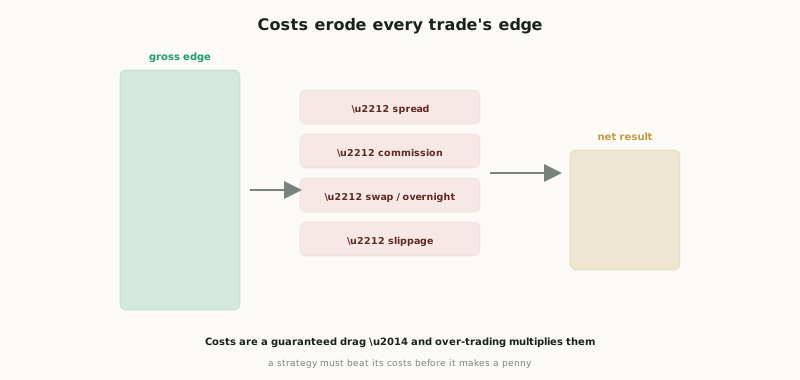
The spread is the gap between the bid (sell) and ask (buy) price, paid effectively the instant you enter — you buy at the higher ask and could only immediately sell at the lower bid, so the spread is an upfront cost on every trade, and usually the main one in forex. Commissions are a per-trade fee some brokers charge (common on "raw spread" or ECN accounts, often instead of a wider spread — so it's the total of spread plus commission that matters, not either alone). The swap (or rollover) is a financing charge or credit for holding a position past the daily cut-off, based on the interest-rate differential between the two currencies — you may pay or receive it depending on direction, and over many nights it adds up (it's the cost side of the carry trade). Slippage is the difference between your expected and actual fill price in fast-moving or gapping markets — a variable cost (see slippage in forex) that's usually small in liquid conditions but can spike when it matters most.
Why they matter, and how to control them
Costs matter because they are a certain, recurring drag that must be overcome before you make a single unit of profit — every trade begins slightly in the red, and your strategy's job is first to climb back to breakeven (covering the costs) and only then to make money. The danger is in the compounding: across hundreds or thousands of trades, costs accumulate into a serious sum, and a strategy with a thin edge can be flipped from a winner into a loser purely by costs — a method that looks profitable on paper (ignoring costs) may lose money in reality once the spread, commission, swap and slippage are deducted from each trade. This is why over-trading is so corrosive: each extra trade incurs the full cost stack, so high-frequency churning multiplies the bill, and a trader paying costs on dozens of marginal trades a day can hand away their edge in fees alone. Costs interact directly with expectancy: your true edge per trade is the gross edge minus the average cost, and if costs exceed the gross edge, expectancy is negative no matter how good the entries look.
Controlling costs is therefore real risk management, and the levers are practical. Use a competitive broker and tight-spread instruments: the majors (like EUR/USD) have far tighter spreads than exotic crosses, and a few tenths of a pip saved on every trade adds up. Trade liquid sessions: spreads are tightest during high-liquidity periods (the major session overlaps) and widen in thin, off-peak hours — so when you trade affects what you pay. Avoid over-trading: take fewer, higher-quality trades rather than many marginal ones, since each trade carries the full cost (this aligns neatly with good process generally). Mind the swap on multi-day holds, especially if you're on the paying side of the rate differential. And, most importantly for a serious trader, model costs honestly in your backtesting — include realistic spread, commission and slippage — so you only ever trade strategies whose edge genuinely survives real-world costs, not just frictionless theory. Costs are one of the few things in trading that are guaranteed; treating them as a controllable, ever-present risk — rather than an afterthought — is what keeps a real edge intact. The honest framing: the main trading costs are the spread (bid-ask gap, paid on entry, usually the biggest), commission (per-trade fee in some broker models — judge spread + commission together), swap/rollover (overnight financing from the rate differential), and slippage (worse-than-expected fills in fast markets). They matter because they're a certain drag every trade must overcome before profiting, they compound over many trades, and they can turn a thin edge into a loss — with over-trading multiplying the bill. Control them by using a competitive broker and tight-spread instruments, trading liquid sessions, avoiding over-trading, minding swap on multi-day holds, and modelling costs honestly in backtests so you only trade edges that survive them. Guaranteed costs deserve guaranteed attention; manage risk.
A worked example: how costs eat an edge
Numbers make the danger vivid. Imagine a strategy with a genuine gross edge — say it wins 55% of the time with equal-sized wins and losses, a respectable system on paper. Now introduce costs. Suppose the all-in cost per round-trip trade (spread plus commission, ignoring swap and slippage for simplicity) is 2 pips, and the strategy's average gross win and loss are each 20 pips. The gross expectancy is positive: (0.55 × 20) − (0.45 × 20) = +2 pips per trade. But subtract the 2-pip cost from every trade and the net expectancy collapses to 0 pips — the entire edge has been consumed by costs, and the strategy merely breaks even before you even account for slippage. Make the cost 3 pips (a wider-spread pair, or a less competitive broker) and the same "winning" system becomes a steady loser, bleeding ~1 pip per trade. The strategy didn't change; the costs decided whether it made or lost money.
Now layer in frequency, which is where it gets brutal. A scalper taking 20 trades a day at 2 pips cost each pays 40 pips a day in costs alone — roughly 10,000 pips a year — an enormous hurdle that the strategy must clear before earning a penny, which is exactly why high-frequency, thin-edge scalping is so punishing and why costs dominate the scalper's results. A swing trader taking a few trades a week at the same per-trade cost pays a tiny fraction of that, so costs barely dent their longer, larger moves. This is the heart of why over-trading is so corrosive and why fewer, higher-quality trades with larger targets are so much more cost-efficient: the cost is roughly fixed per trade, so the more trades you take and the smaller your targets, the larger costs loom relative to your edge. The lesson for a serious trader is to always compute net expectancy — gross edge minus realistic all-in costs — and to favour approaches where the expected move dwarfs the cost, not ones where you're scraping a tiny edge that costs can erase. The honest reminder: model the full cost per trade, multiply by your trade frequency, and only trade strategies whose edge comfortably survives that bill — because a 55% system can break even or lose purely on costs, and over-trading guarantees costs win.
The unifying principle is simple but easy to forget: costs are the one part of trading you can predict with near-certainty, so they deserve deliberate management rather than neglect. Picking a competitive broker, trading liquid instruments and sessions, and — above all — not over-trading are decisions entirely within your control that directly improve your bottom line, independent of how good your strategy is. A trader who respects costs keeps more of their edge; one who ignores them quietly donates it to the spread, the commission and the swap, one small, certain leak at a time.
The main trading costs: the spread (bid–ask gap, paid on entry — usually the biggest), commission (per-trade fee in some broker models — judge spread + commission together), swap/rollover (overnight financing from the rate differential), and slippage (worse-than-expected fills in fast markets). They matter because they're a certain, recurring drag every trade must overcome before profiting, they compound over many trades, and they can flip a thin edge into a loss — with over-trading multiplying the bill. Control them: competitive broker and tight-spread instruments, trade liquid sessions, avoid over-trading, mind swap on multi-day holds, and model costs honestly in backtests so you only trade edges that survive them. Costs are guaranteed — so treat them as a controllable, ever-present risk, not an afterthought.