
You click to sell at one price and get filled at another. That gap — slippage — is an unavoidable fact of execution in a market that never stops moving, and it has an important consequence many traders overlook: your stop-loss is not quite the guaranteed safety net it appears to be. Understanding slippage means setting realistic expectations about fills, and never assuming a stop caps your loss exactly. This guide explains slippage: what it is, what causes it, why stops can slip, and how to manage it.
It's closely related to gap risk, it directly affects how reliable your stop-loss is, and it depends partly on your broker's execution.
Key takeaways
Q: What is slippage in forex?
A: Slippage is the difference between the price you expected to get on a trade and the price you actually got when it executed. It happens because the market can move in the brief moment between placing your order and it being filled. Slippage can be negative (a worse price than expected, the usual concern) or positive (a better price), and it's an unavoidable part of execution in a fast-moving market.
Q: What causes slippage?
A: Price moving between order and execution — driven by high volatility (fast markets), low liquidity (thin markets with wider gaps between prices), news events (prices jump), weekend or session gaps, and large order sizes that consume available liquidity. It's worst around major news releases, market opens and closes, and quiet, illiquid periods like late Friday or holidays.
Q: Can a stop-loss slip?
A: Yes — importantly, it can. A standard stop-loss becomes a market order once its level is touched, so in a fast-moving or gapping market it can be filled at a worse price than the stop level, meaning your actual loss exceeds what you planned. A stop-loss is therefore not a guaranteed maximum loss. Guaranteed stop-loss orders, offered by some brokers for a fee, do fill exactly at the level.
What it is and what causes it
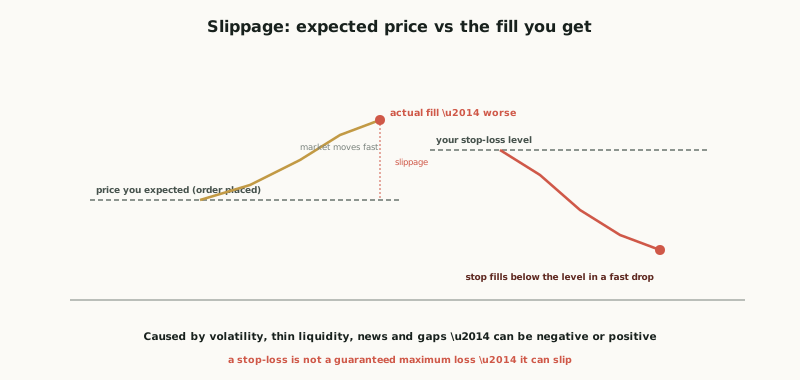
Slippage is the difference between the price you expected to get and the price you actually got when your trade executed. It arises because price can move in the brief interval between you placing an order and the order being filled — in a fast market, that interval is enough for the available price to shift. Slippage can be negative (you're filled at a worse price than expected — the common worry) or positive (filled at a better price, which does happen, especially with positive news or improving liquidity). The causes all come down to price moving or liquidity thinning at the moment of execution: high volatility (fast-moving markets), low liquidity (thin markets, where there are wider gaps between available prices), news events (prices can jump in an instant), session and weekend gaps (price reopening away from where it closed — see gap risk), and large order sizes (a big order can eat through the available liquidity at one price and fill across several). Slippage is therefore worst around major news releases (employment reports, central-bank decisions), market opens and closes, and quiet, illiquid periods such as late Friday, holidays and the daily rollover.
The stop-loss catch, and managing slippage
Here's the crucial, often-misunderstood point: stop-loss orders can slip. A standard stop-loss is not a special protected order — once price touches your stop level, the stop becomes a market order, to be filled at the best available price then. In normal conditions that's at or very near your level. But in a fast-moving or gapping market — a news spike, a weekend gap, a liquidity vacuum — the best available price can be well past your stop level, so you're filled worse than intended and your actual loss exceeds what you planned. This means a stop-loss caps your loss approximately, not exactly: you should never assume "my stop is at 50 pips, so 50 pips is my absolute maximum loss," because in a violent move it could be 60, 80, or in an extreme gap far more. The lesson isn't to abandon stops — they remain essential — but to account for potential slippage in your risk planning, avoid holding through known high-slippage events unless deliberate, and never size as though your stop guarantees an exact loss. Where it matters, some brokers offer guaranteed stop-loss orders (GSLOs) that do fill exactly at the level even in gaps, in exchange for a fee or premium — a way to buy certainty on the trades where you need it.
Beyond the stop-loss issue, slippage is managed (never eliminated) by a few sensible habits. Use limit orders where appropriate: a limit order fills only at your specified price or better, guaranteeing you won't suffer negative slippage — the trade-off being that it may not fill at all if price doesn't reach it (whereas a market order fills but accepts slippage). Avoid trading during the highest-slippage windows if you're slippage-averse — around major scheduled news and in thin-liquidity periods — or at least trade them knowingly. Choose a broker with good execution and trade liquid pairs (major pairs in active sessions slip far less than exotics in quiet hours). And, as above, consider guaranteed stops for event risk. The honest reality is that slippage is an unavoidable feature of execution — you can reduce and plan for it, but you can't make it disappear, and pretending fills are always perfect leads to under-estimating risk. The honest framing: slippage is the difference between your expected and actual execution price, caused by price moving between order and fill (volatility, low liquidity, news, gaps, large size); it can be negative (worse — the usual worry) or positive (better), and is worst around news, opens/closes, thin liquidity and gaps. Crucially, stop-loss orders can slip (filling worse than the level in fast markets), so a stop is not a guaranteed maximum loss. Manage it with limit orders (price-guaranteed but may not fill), avoiding high-impact news and thin liquidity, choosing good execution and liquid pairs, and — where offered — guaranteed stop-loss orders for a fee. Slippage is an unavoidable reality of execution; factor it into expectations, and never assume perfect fills.
The hidden cost that erodes an edge
Beyond the dramatic stop-loss scenario, slippage matters as a quiet, recurring cost that erodes a strategy's edge over time — and it's one many traders fail to account for until their live results disappoint. Every trade that suffers negative slippage is a small subtraction from your profit (or addition to your loss), and across hundreds or thousands of trades those subtractions compound into a meaningful drag. This matters most for high-frequency styles: a scalper aiming for a handful of pips per trade can have their entire edge consumed by slippage and spread, because the costs are large relative to the small target. The same slippage is far less significant to a swing trader aiming for hundreds of pips, where it's a tiny fraction of the move. Slippage also compounds with the spread (the bid-ask cost) and commissions to form your total transaction cost — and it's the total, not any one component, that your edge must overcome.
This is a major reason live trading often underperforms a backtest. Backtests typically assume clean fills at the exact price, ignoring the slippage (and sometimes the spread) that real execution imposes — so a strategy that looks profitable on paper can bleed out in reality once realistic execution costs are applied. A serious approach therefore models slippage in backtesting (adding a realistic cost assumption to every trade) and tracks actual slippage live (comparing intended versus filled prices in your journal) to know the true number for your pairs, sessions and broker. Execution quality also depends on your broker model: the way orders are routed and filled differs between dealing-desk and direct-market-access setups (see how forex brokers work), and a broker with poor execution can impose systematically worse slippage. The practical takeaways: favour liquid pairs in active sessions (where slippage is smallest), match your style to your slippage tolerance (don't scalp through heavy costs), account for slippage in expectations rather than assuming perfect fills, and measure it so it's a known quantity rather than a nasty surprise. Treated this way, slippage moves from an invisible leak to a managed, understood cost — which is exactly what separates realistic trading from the backtest fantasy of frictionless fills.
The other side: positive slippage
It's worth balancing the picture: slippage is not always against you. Positive slippage — being filled at a better price than you requested — genuinely happens, particularly when price is moving in your favour at the moment of execution or liquidity improves, and some quality brokers actively offer price improvement, passing on a better available price rather than pocketing the difference. Over many trades with good execution, positive and negative slippage may partly offset, though most traders should plan conservatively as if the net effect is a small cost. This also offers a practical way to assess a broker: by logging your intended versus filled prices over time, you can see whether slippage is roughly symmetric (a sign of fair, neutral execution) or consistently against you (a warning that execution quality — or the broker's model — may be poor). A broker that only ever slips you negatively, never positively, deserves scrutiny. Finally, keep perspective: not every disappointing fill is the broker's fault — in a genuinely fast market, some slippage is unavoidable physics, not malpractice. The goal isn't a grievance but an informed relationship: know your execution, measure it, and choose a broker whose fills are fair across the board.
Slippage is the gap between your expected and actual fill price, caused by price moving (or liquidity thinning) between order and execution — from volatility, low liquidity, news, gaps and large size. It can be negative (worse — the usual worry) or positive (better), and is worst around news, opens/closes and thin periods. Crucially, a stop-loss can slip — once touched it becomes a market order, so in a fast or gapping market it can fill well past your level: a stop is not a guaranteed maximum loss, so plan for it. Manage slippage with limit orders (price-guaranteed but may not fill), avoiding high-slippage windows, choosing good execution and liquid pairs, and using guaranteed stops (for a fee) where certainty matters. It can't be eliminated — only reduced and accounted for; never assume perfect fills.