Your broker is your gateway to the forex market — as a retail trader, you can't deal directly on the interbank market where the big players trade, so the broker provides your access. But how a broker makes money, and crucially whether it profits when you lose, depends on its business model. Understanding the two main models — and the potential conflict of interest in one of them — helps you choose a broker wisely and trade with your eyes open. This guide explains how forex brokers work: how they make money, the market maker and ECN/STP models, the conflicts involved, and why regulation matters most of all.
It's the model behind the selection checklist in choosing a broker, closely tied to the cost of trading, and important context for avoiding forex scams.
Key takeaways
Q: How do forex brokers make money?
A: Mainly from spreads (the difference between the bid and ask price) and/or commissions on trades, plus sometimes swap/financing on overnight positions. Some brokers (market makers) can also profit when their clients lose, because they take the other side of those clients' trades.
Q: What is the difference between a market maker and an ECN broker?
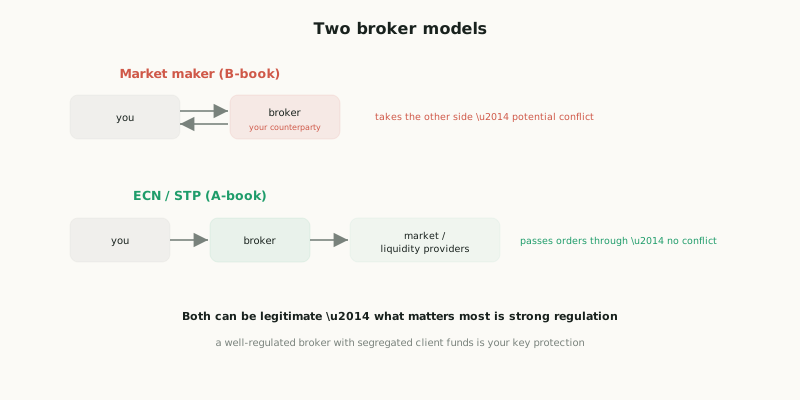
A: A market maker (dealing desk, 'B-book') takes the other side of your trade — it's your counterparty, which creates a potential conflict of interest since your loss can be its gain. An ECN/STP broker ('A-book', no dealing desk) passes your orders through to the real market and liquidity providers, making money from commissions or a markup, with no direct conflict.
Q: Does it matter which broker model I use?
A: It's worth understanding the model and its potential conflict, but what matters most is strong regulation. A well-regulated broker (under a respected authority, with segregated client funds) is constrained from abusive practices, whether it's a market maker or ECN. Unregulated brokers — of any model — are a major risk and a common source of scams.
Your gateway, and how they earn
A forex broker is the company that gives you access to the forex market. The interbank market — where banks and large institutions trade currencies directly — isn't open to retail traders, so the broker acts as your intermediary and gateway, providing the platform, prices, and execution that let you trade. In return, brokers make money in a few ways: primarily from spreads (the difference between the bid and ask price you're quoted) and/or commissions on your trades, plus sometimes swap/financing on positions held overnight (the swap link), and — for some brokers — from clients' losses, which brings us to the crucial question of models. How a broker earns, and whether your losing is good or bad for it, hinges on whether it takes the other side of your trades or passes them through to the market.
The two main models
Brokers broadly operate on one of two models (or a hybrid). The table compares them.
Market maker vs ECN/STP
| Aspect | Market maker (B-book) | ECN / STP (A-book) |
|---|---|---|
| Also called | Dealing desk | No dealing desk |
| Your counterparty | The broker itself | The real market / liquidity providers |
| Earns from | Spread; can profit from your losses | Commission / markup on volume |
| Conflict of interest | Potential — your loss can be its gain | None direct — aligned with your activity |
| Typical pricing | Often fixed spreads | Raw/variable spread + commission |
A market maker (or "dealing desk," often called "B-book") takes the other side of your trade — when you buy, it sells to you; it "makes the market" for you, often internalising the trade rather than passing it to the real market. This creates a potential conflict of interest: because the broker is your counterparty, your loss can be its gain (on that trade). Market makers often offer fixed spreads and no separate commission. It's important to be fair here: a market-maker model is not inherently bad or a scam — regulated market makers are legitimate businesses that provide valuable liquidity and execution for small traders (who couldn't access the interbank market otherwise), and they manage their risk by hedging and netting client positions rather than simply betting against each customer. But the conflict is real, and an unregulated or unscrupulous market maker can abuse it (through practices like requotes, manipulated slippage, or "stop hunting") — which is exactly why regulation matters so much.
An ECN/STP broker ("no dealing desk," often called "A-book") instead passes your orders through to the real market — to liquidity providers (banks, other institutions) — acting as an intermediary rather than your counterparty. It makes its money from commissions and/or a small markup on the raw spread, earning from your trading volume and activity rather than your losses. This means there's no direct conflict of interest: the broker is essentially aligned with you — it wants you to keep trading (ideally successfully, so you continue), since it profits from your activity, not your failure. ECN/STP brokers typically offer raw or variable spreads plus a commission. In practice, many brokers run a hybrid model — routing some clients (often the larger or consistently profitable ones) to the real market (A-book) while internalising others (B-book) — so the line isn't always clean.
What matters most: regulation
For a beginner, two practical takeaways stand out. First, understand the model and its potential conflict: with a market maker, your broker may profit from your losses — not necessarily sinister (regulated market makers are entirely legitimate), but worth knowing, and a reason some traders prefer the conflict-free ECN/STP model. Second, and far more important than the model: choose a well-regulated broker. Strong regulation (under a respected authority such as the FCA, ASIC, or equivalent) is your key protection — regulated brokers are constrained from abusive practices, are subject to oversight and audits, and typically must segregate client funds (keeping your money separate from the company's, protecting it if the broker fails). An unregulated broker — of any model — is a major risk and a common source of scams (the worst being outright fraud where deposits simply vanish). Costs also differ by model (fixed spread versus raw spread plus commission — the cost-of-trading link), which feeds into choosing a broker. The honest framing: a forex broker is your gateway to the market (retail traders can't access the interbank market directly), making money mainly from spreads and/or commissions. There are two main models: market makers (dealing desk / B-book) take the other side of your trade — a potential conflict of interest (your loss can be their gain), though regulated ones are legitimate and provide real execution and liquidity; and ECN/STP (no dealing desk / A-book) brokers pass your orders to the real market, earning from commissions/markup with no direct conflict (aligned with your activity). Many are hybrids. Understand the model and its potential conflict — but above all, choose a well-regulated broker with segregated funds, your key protection against abuse, since unregulated brokers (of any model) are a major scam risk. Understanding how brokers work lets you choose wisely and trade with eyes open.
Red flags and protecting yourself
Since the broker holds your money and stands between you and the market, knowing how to spot a bad or fraudulent one is essential self-protection. The first and most important check is regulation: verify that the broker is authorised by a respected regulator (such as the UK's FCA, Australia's ASIC, or another reputable authority for your region), and — crucially — verify it independently by checking the regulator's own public register, not just trusting a logo on the broker's website (scam brokers routinely display fake or borrowed regulatory claims). A broker that's unregulated, or regulated only in an obscure offshore jurisdiction with weak oversight, is a serious warning sign. Confirm, too, that client funds are held in segregated accounts (kept separate from the firm's own money, so your deposit is protected if the broker fails) — a standard protection that reputable regulation requires.
Several red flags should make you walk away. Withdrawal problems are the classic sign of a scam broker — if a broker makes it easy to deposit but difficult, slow, or "complicated" to withdraw your money (endless verification demands, stalling, or fees that materialise on withdrawal), that is a grave warning, often the first sign of outright fraud. Be wary of unrealistic promises — guaranteed returns, "risk-free" trading, suspiciously generous bonuses with opaque conditions — and of high-pressure sales tactics (aggressive "account managers" pushing you to deposit more or trade more, which is both a scam signal and a conflict of interest). Other warning signs include manipulated pricing or execution (persistent suspicious slippage, frequent requotes, spikes that hit your stop and reverse), a lack of transparency about costs or company details, and poor or evasive customer support. The connection to forex scams is direct: the worst "brokers" are not really brokers at all but fraud operations designed to take your deposit. To protect yourself: stick to well-regulated, established brokers with a solid reputation and verifiable regulation; test withdrawals with a small amount early; start small until you trust the broker; and treat any of the red flags above as a reason to take your money elsewhere. A good broker is a boring, reliable utility that holds your funds safely and executes your trades cleanly — anything that feels pushy, opaque, or too good to be true is telling you something important. The honest summary: understanding broker models matters, but the single best protection is choosing a genuinely well-regulated broker with segregated funds and a clean reputation, verifying its regulation yourself, and walking away at the first sign of withdrawal trouble, unrealistic promises, or pressure.
A forex broker is your gateway to the market (retail traders can't access the interbank market directly), earning mainly from spreads and/or commissions. Two main models: a market maker (dealing desk, "B-book") takes the other side of your trade — a potential conflict of interest (your loss can be its gain), though regulated ones are legitimate and provide liquidity/execution; an ECN/STP broker (no dealing desk, "A-book") passes your orders to the real market, earning from commission/markup with no direct conflict (aligned with your activity). Many run a hybrid. Understand the model and its conflict — but what matters most is choosing a well-regulated broker (respected authority, segregated client funds), your key protection; unregulated brokers of any model are a major scam risk. Knowing how brokers work helps you choose wisely.