Hold a forex trade past the end of the trading day and a small charge — or sometimes a small credit — quietly appears on your account. This is swap (or rollover), the often-overlooked interest you pay or earn for carrying a position overnight. For a day trader who closes out before the day ends, it never appears; but for anyone holding trades for days or weeks, it can quietly add up — a recurring cost (or occasional income) that's easy to forget but real. This guide explains rollover and swap: what it is, why it exists, how it's calculated, the triple-swap quirk, and when it matters.
It's a component of the cost of trading, driven by the interest rates of each currency, and it underlies the carry trade.
Key takeaways
Q: What is rollover or swap in forex?
A: Rollover (or swap) is a small amount of interest you either pay or earn for holding a forex position open overnight, past the daily rollover time. It exists because every forex trade effectively involves borrowing one currency to buy another, and each currency carries its own interest rate — so the swap reflects the difference between those rates.
Q: Why do you pay or earn swap?
A: It depends on the interest-rate differential between the two currencies in your pair. If the currency you're long (bought) has a higher interest rate than the one you're short (sold), you tend to earn swap; if it has a lower rate, you pay swap. Brokers also add a markup, so both sides can be slightly unfavourable in practice.
Q: Does swap matter for short-term traders?
A: Not much for day traders, who close their positions before the daily rollover and so incur no swap at all. It matters for swing and position traders who hold overnight or for longer — negative swap is a recurring cost that can erode profits over weeks, while positive swap can be a small source of income (the basis of the carry trade).
What it is and why it exists
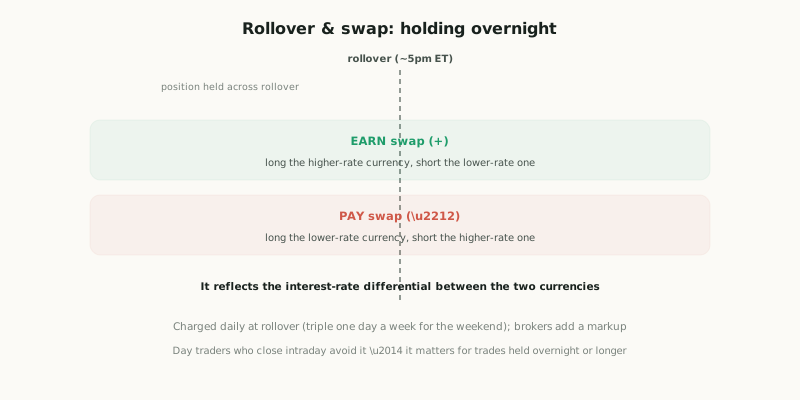
Swap (rollover) is the interest you pay or earn for holding a forex position open overnight — past the daily rollover time (around 5pm New York time). It exists because every forex trade effectively involves borrowing one currency to buy another, and each currency carries its own interest rate (set by its central bank). The swap reflects the interest-rate differential between the two currencies in your pair. The logic: if the currency you're long (bought) has a higher interest rate than the one you're short (sold), you tend to earn swap (you're effectively holding the higher-yielding currency and funding it with the lower-yielding one, pocketing roughly the difference). If the currency you're long has a lower rate than the one you're short, you pay swap. So whether you pay or earn comes down to which side of the rate differential your position sits on. (In practice, brokers add a markup, so it's not exactly the pure differential — both directions can end up slightly unfavourable — and the exact figures vary by broker.)
This is exactly the mechanism behind the carry trade: deliberately holding a higher-yielding currency against a lower-yielding one to earn the positive swap over time. Earning positive swap is the carry — so rollover isn't only a cost to be aware of; on the right pairs it can be a (small) source of income, and on certain strategies it's central. For most beginners, though, the key point is simply to know that holding overnight has an interest consequence, in one direction or the other.
The mechanics and the triple-swap day
A few practical details complete the picture. Swap is charged or credited daily, at the rollover point (around 5pm New York time) — the moment that defines the "end" of the forex trading day. Crucially, a position closed before rollover incurs no swap at all, which is why day traders who close out intraday simply never deal with it. There's one well-known quirk: a "triple swap" day — on one day each week (commonly Wednesday, though it varies), the swap charged or credited is three times the normal amount. This accounts for the weekend: although the market is closed on Saturday and Sunday, interest still accrues over those days, and the convention is to apply that weekend interest via a triple charge on a single weekday (related to the standard two-day settlement, "T+2"). So if you hold across that day, expect roughly triple the usual swap. Finally, some brokers offer swap-free (sometimes called "Islamic") accounts that charge no swap, for traders whose beliefs prohibit paying or earning interest — often with other fees substituted instead.
So when does swap actually matter? For short-term/day traders, hardly at all — closing before rollover sidesteps it entirely. For swing and position traders who hold overnight or for longer, it's a real factor to account for: a negative swap on a position held for many days or weeks is a recurring cost that quietly erodes your profits (and adds to losses), and on a long-held trade it can become significant — so you should know, before holding, whether your trade will pay or earn swap, and factor it into your expectations. Conversely, a positive swap can modestly add to returns over time. It's rarely a make-or-break factor for sensible short-to-medium-term trading, but it's a genuine cost that beginners often overlook entirely. The honest framing: rollover (swap) is the interest paid or earned for holding a forex position overnight, reflecting the interest-rate differential between the two currencies — you tend to earn it if you're long the higher-yielding currency (and short the lower) and pay it if reversed, with brokers adding a markup. It's charged daily at rollover (~5pm New York time), with a triple charge one day a week to cover the weekend, and it underlies the carry trade. For beginners: it's a real, easily-overlooked cost (or occasional income) for positions held overnight or longer — day traders avoid it by closing intraday, while swing and position traders must factor it in, since negative swap erodes longer-held trades. Know whether your trades pay or earn swap, and account for it.
Working out the impact, and managing it
To factor swap into your trading, you first need to know the rates. Brokers publish their swap rates for each pair — usually visible within the trading platform (often in the symbol's specification or properties) and on the broker's website — quoted separately for the long and the short side of each pair, since one direction earns (or pays less) while the other pays (or earns less). Before holding a position overnight, it's worth a quick check: will this trade, in this direction, pay or earn swap, and roughly how much? That single habit saves the common surprise of discovering, weeks into a position, that a steady negative swap has been quietly eating your profit.
Estimating the impact over a holding period is straightforward once you have the daily figure: multiply the daily swap by the number of nights you expect to hold (remembering the triple-swap day adds the equivalent of two extra nights each week). For a trade held a day or two, the swap is usually negligible; for one held many weeks or months, a meaningful negative swap can accumulate into a real drag that your profit target needs to clear — so longer-horizon traders should build the expected swap into their planning, treating persistent negative swap as a cost of the position much like the spread. You can also manage swap to some degree: where two pairs or directions offer similar trade ideas, the one with more favourable swap is marginally preferable for a longer hold; and traders pursuing the carry trade deliberately choose positions that earn positive swap. A word on swap-free ("Islamic") accounts: these remove swap for traders whose beliefs prohibit interest, but they typically substitute other charges (a fixed administration fee, wider spreads, or commissions), so they're not a free way to dodge overnight costs — understand the alternative fee structure before assuming they're cheaper. The practical bottom line: check your broker's swap rates for the pair and direction before holding overnight, estimate the cost (or credit) over your intended holding period, factor it into your plan for anything held more than a day or two, and don't let it surprise you on longer trades. Swap is rarely decisive for sensible short-to-medium-term trading, but it's a genuine, knowable cost that's trivial to account for once you're in the habit — and ignoring it is an avoidable, if minor, leak in your trading.
Keeping it in proportion
It's worth keeping swap in proportion so you neither ignore it nor over-worry about it. For the vast majority of beginners — who should be trading small and learning — swap on a modest position held for a few days is genuinely tiny, often just pennies, and won't be what makes or breaks your results; your spread, your position sizing, and above all your trade decisions matter far more. Where swap moves from trivial to relevant is at the combination of larger size, longer holding periods, and a negative direction — a sizable position carrying negative swap for many weeks can accumulate a cost worth a real chunk of the trade's target. So the sensible attitude is awareness without obsession: know it exists, check it before holding overnight, account for it on anything held more than a few days, and otherwise keep your focus on the things that drive your results. As your size and time horizons grow, simply give swap proportionally more attention. It's one of those small, knowable details that distinguishes a thorough trader from a careless one — not glamorous, but worth getting right.
Rollover (swap) is the interest you pay or earn for holding a forex position overnight (past ~5pm New York time). It reflects the interest-rate differential between the two currencies: you tend to earn swap if you're long the higher-rate currency (and short the lower), and pay swap if reversed — though brokers add a markup. It's charged/credited daily at rollover, with a triple-swap day once a week to account for the weekend's interest; positions closed before rollover incur none. It underlies the carry trade (earning positive swap), and swap-free accounts exist. It barely matters for day traders (who close intraday), but it's a real, easily-overlooked cost (or small income) for swing/position traders holding overnight or longer — negative swap erodes longer-held trades. Know whether your trade pays or earns swap, and factor it in.